
The actual evidence on fall prevention has been well-studied and is surprisingly clear. And it contradicts many intuitive assumptions. The most important message of this article is therefore: Fall prevention is not about being cautious. It’s about exercise, medication review, and structured assessment.
As a geriatrician, I see both of these misguided approaches every day—patients who move less and less out of fear, and patients whose doctors prescribe vitamin D and are satisfied with that alone. Both approaches lead away from what really helps.
Why Fall Prevention Needs to Be Thought of Differently
The traditional approach to prevention—“avoid hazards”—doesn’t work for falls among older adults because it misunderstands the underlying problem. Falls are not caused solely by external hazards, but by an interplay of internal factors (muscle strength, balance, medications, cognition, vision) and external factors (home environment, footwear, lighting conditions).
The result: Those who only adapt the home environment but ignore the internal factors prevent very few falls. Those who merely reduce medication but do not engage in exercise overlook the most powerful single lever. Only the combination of multiple measures—multifactorial intervention—achieves the significant effects documented in the Cochrane reviews.
→ For an overview of the causes of falls and an initial structured assessment: Falls in Older Adults.
What the evidence shows: Effective measures
1. Structured strength and balance training
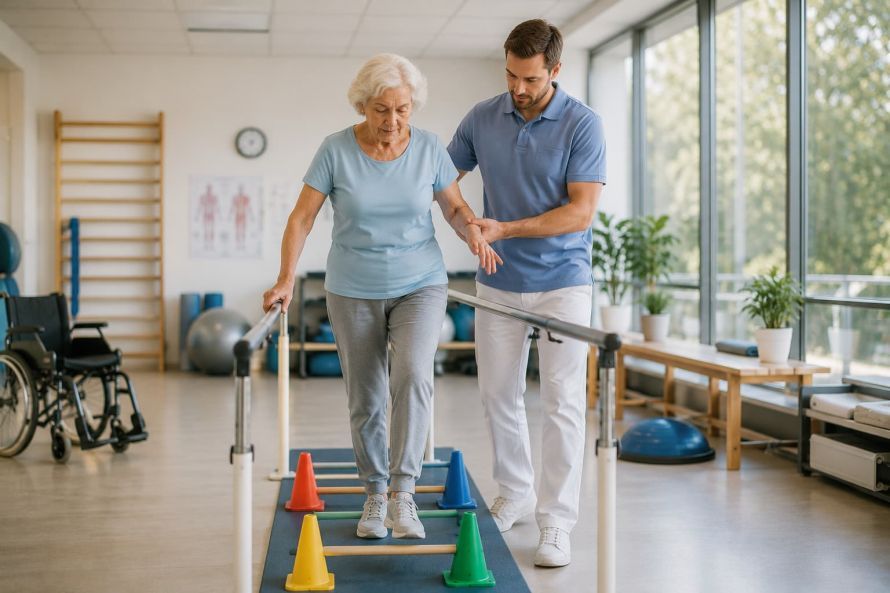
The most powerful single lever. Studies show that progressive training that addresses both muscle strength and balance reduces the fall rate by 30 to 40 percent. Two programs have been particularly well studied:
- Otago Exercise Program: A structured home exercise program with strength and balance exercises, three times a week for 30 minutes, plus daily walking. Developed in New Zealand, extensively validated.
- Tai Chi: Particularly effective for balance and fall prevention. Studies show a reduction in falls of up to 40 percent.
- Group-based strength and balance training: Offered at specialized sports clubs, physical therapy practices, or health insurance-sponsored fall prevention courses.
Important: Walking alone is not enough. Aerobic exercise is important for heart and circulation, but fall prevention requires targeted balance and strength training—ideally under supervision, starting with manageable exercises and then progressively increasing the intensity. A structured approach with physical therapy support is particularly recommended for older adults who are also experiencing immobility.
→ On the role of muscle strength in older adults: Sarcopenia—Recognizing and Stopping Muscle Loss.
2. Systematic Medication Review
The second most important factor—and the one most frequently overlooked. Studies show that discontinuing or switching medications associated with falls significantly reduces the fall rate. The medications with the highest risk profile:
- Benzodiazepines (lorazepam, diazepam, oxazepam)
- Z-drugs as long-term medication (zolpidem, zopiclone)
- Tricyclic antidepressants (amitriptyline, doxepin)
- Strongly anticholinergic substances
- Opioids, especially at the start of treatment and during dose adjustments
- High-dose antihypertensives
- Diuretics when there is a risk of dehydration
- Certain SSRIs
The PRISCUS list and the FORTA classification provide structured assessment frameworks. A medication review is not a one-time event, but a recurring process—especially after every fall, every hospital stay, and every medication change. Older patients taking multiple long-term medications are particularly at risk; in these cases, it is worth taking a closer look at the topic of polypharmacy in older adults.
→ How medication reduction is carried out in a structured manner: Reducing Medications — Deprescribing in Older Adults.
→ For an overview of polypharmacy as a cause of falls: Polypharmacy in older adults.
3. Treatment of Orthostatic Hypotension
A drop in blood pressure upon standing is a common and underdiagnosed cause of falls. Treatment is often simple and highly effective:
- Review and reduction of aggressively dosed blood pressure medications
- Adequate fluid intake, especially in the morning
- Slowly standing up with an intermediate phase of sitting
- Compression stockings
- For severe cases: medication with midodrine or fludrocortisone
4. Optimize vision
Cataract surgery has been shown to reduce the risk of falls in the operated eye by up to 30 percent. Up-to-date eyeglasses and the correction of refractive errors also help. Be cautious with progressive lenses—they can increase the risk of falls in some patients because it becomes harder to judge distances on the ground. In these cases, having a second pair of glasses specifically for walking may be helpful.
5. Home environment modifications (in combination with training)
On its own, home environment modifications have less of an effect than expected—their impact is most pronounced when combined with the other measures. The most important points:
- Grab bars in the bathroom, especially near the shower and toilet
- Non-slip mats, including in the bathtub
- Adequate lighting, especially at night on the way to the toilet
- No loose rugs or cables
- Sturdy, closed-toe, well-fitting shoes—even indoors
- Toilet seat riser for hip or knee problems—especially important after joint replacement surgery in older adults
- Adjust the bed riser and nightstand height
- Handrails on both sides of the stairs
6. Vitamin D for confirmed deficiency
Vitamin D supplementation in cases of deficiency moderately reduces the fall rate. Important: only in cases of confirmed deficiency. High-dose studies in individuals without deficiency have in some cases even shown an increased risk of falls. The recommendation is therefore: Determine blood levels; if deficient, take 800 to 1,000 I.E. daily—not as a blanket recommendation for all seniors. Vitamin D deficiency is also closely linked to osteoporosis in older adults—both issues should be addressed together.
7. Hip Protectors for High-Risk Patients
Padded hip protectors can reduce the rate of hip fractures in seniors requiring care or living in long-term care facilities who are at high risk of falling—an important consideration, as femoral neck fractures are among the most serious fall-related injuries in older adults. Consistent use is crucial—even at night and even when using the restroom.
8. Geriatric Assessment and Multifactorial Intervention
The framework within which the individual measures take effect: a structured assessment of all fall risk factors and the individualized combination of effective interventions. Studies show that multifactorial, individualized programs following a geriatric assessment reduce the fall rate by 20 to 30 percent. A supplementary frailty screening helps identify patients at particularly high risk at an early stage.
→ For a comprehensive geriatric assessment: Geriatric Assessment.
What Is Less Effective or Has No Effect
It is equally important to be aware of the measures that, despite their popularity, have little or no effect:
- Vitamin D without a confirmed deficiency: No benefit without an indication for supplementation; high doses may even be potentially harmful.
- Isolated home environment modifications without exercise: Significantly less effective than when combined.
- Shoe inserts and special shoes alone: Often ineffective without a structured evaluation.
- Magnesium, calcium, and multivitamins with an adequate diet: No proven effect on reducing falls. However, in cases of genuine malnutrition in older adults, the situation must be assessed differently.
- General recommendations for walking aids: Rollators or canes are helpful for certain patients, but for others they increase the risk if they are not properly fitted and the patient has not practiced using them.
- Limiting physical activity out of fear: The most counterproductive approach of all. Those who move less lose strength and balance—and then fall more severely. This also contributes to frailty syndrome.
???? The strongest single recommendation for fall prevention is not greater caution—but more targeted exercise. People who do targeted balance and strength training two to three times a week reduce their risk of falling more significantly than through any home environment modification.
The Role of Fear: Post-Fall Syndrome
After a fall, many older adults develop a fear of further falls, which, paradoxically, increases the risk. They move more cautiously, less frequently, and more hesitantly—and as a result, they lose even more muscle strength and balance. The result is a self-fulfilling cycle. In geriatrics, this syndrome is known as “Fear of Falling” or Post-Fall Syndrome.
Treatment does not involve simply reassuring the patient, but rather structured training in a safe environment—ideally as part of a fall prevention program with psychological support. Gradually regaining confidence in one’s mobility is part of the therapy. If depressive symptoms are present, depression in older adults should also be ruled out as a possible cause.
For various settings: at home, in a nursing home, after a hospital stay
Seniors living at home
Focus: structured home exercise (Otago, Tai Chi), medication review by a primary care physician or geriatrician, targeted home environment modifications, and vision optimization. Fall prevention courses offered by health insurance providers are a good starting point.
In a nursing home
Focus: structured group exercise programs, hip protectors for high-risk patients, medication review, structured mobility exercises following the daily routine. The nursing home administration and the attending primary care physician are key partners in this context. For residents with cognitive impairment, consistent delirium prevention is also essential, as states of confusion significantly increase the risk of falls.
After a hospital stay
Focus: structured early rehabilitation, medication review (new medications prescribed during the hospital stay), secondary prevention following a fall or fracture (osteoporosis treatment, investigation of the cause of the fall), and re-establishing a safe home environment.
→ For geriatric early rehabilitation following a fall or fracture: Geriatric Early Rehabilitation.
→ For secondary prevention following an osteoporotic fracture: Osteoporosis in Older Adults.
What Family Members Can Do Specifically
- Work together to find a fall prevention program: health insurance providers, sports clubs, adult education centers, physical therapy practices. Starting the program together significantly increases the likelihood of sticking with it.
- Have the medication list reviewed annually: by a primary care physician or geriatrician—and specifically advocate for the potential de-prescribing of substances that increase the risk of falls.
- Walk through the living environment together: Through the eyes of a stranger. Tripping hazards are often invisible to residents.
- Keep vision aids and hearing aids up to date: And actually wear them.
- After a fall, don’t just reassure the person—investigate the cause: The first fall is the most critical window of opportunity—and may indicate underlying osteoarthritis in older adults or other treatable causes.
- Take fear of movement seriously, but take steps to counteract it: Take walks together, engage in small, safe activities, and gradually increase the level of challenge.
When should you see a doctor or geriatrician?
Clear indications for a structured fall assessment:
- After the first fall, even without visible consequences
- If there have been more than one fall in twelve months
- If you experience new-onset unsteadiness or dizziness
- In cases of polypharmacy involving five or more long-term medications
- Before planned surgeries involving limited mobility—in such cases, an assessment of surgical risk in older adults is also recommended
- If fear of falling limits daily life
- After a hospital stay involving new medication or loss of function
The first point of contact is the primary care physician. In complex situations—such as multiple risk factors, polypharmacy, or cognitive impairment—the geriatric perspective is particularly valuable. It provides the holistic view that individual medical specialties often cannot offer. The field of geriatrics and geriatric medicine offers the necessary interdisciplinary expertise for this.
→ For a detailed fall assessment by a geriatrician: Falls in Older Adults.

About the medical author
Naumche Matoski
Medical writer
Sources
- Gillespie LD, Robertson MC, Gillespie WJ et al. (2019): Interventions for preventing falls in older people living in the community. Cochrane Database of Systematic Reviews. DOI: 10.1002/14651858.CD007146
- Sherrington C, Fairhall NJ, Wallbank GK et al. (2019): Exercise for preventing falls in older people living in the community. Cochrane Database of Systematic Reviews. DOI: 10.1002/14651858.CD012424.pub2
- German Society for Geriatrics (DGG): S3 Guideline on Fall Prevention in Older People. AWMF Register 084-002, current version.
- Mann NK, Mathes T, Sönnichsen A, et al. (2023): Potentially Inadequate Medications in the Elderly: PRISCUS 2.0. Deutsches Ärzteblatt International.
