Permanent damage to the knee or the knee joint often makes surgery necessary. The severity of the procedure usually requires orthopedic knee rehabilitation afterward.
Below you will find information on the benefits and options associated with such knee rehabilitation, as well as a selection of specialists and knee rehabilitation clinics.
Definition: Knee Rehabilitation
Knee rehabilitation is a follow-up treatment (AHB) that takes place in a rehabilitation clinic after knee surgery.
You will typically begin light physical therapy exercises while still in the hospital, just a few days after the procedure. Rehabilitation usually begins a few days after you are discharged from the hospital.
Only after the implantation of a knee prosthesis (such as a total knee replacement, or TKR) is follow-up rehabilitation mandatory. The prosthesis’s functionality depends on appropriate mobilization exercises.
For other surgeries, rehabilitation is only recommended—for example, following
- meniscus surgery,
- axial correction (realignment osteotomy), or
- cartilage cell transplantation.
Reasons for Knee Rehabilitation
The primary goal of knee rehabilitation is to actively support the restoration of mobility. Rehabilitation should begin a few days to no later than two weeks after the end of the hospital stay.
In addition to improving mobility, the focus is also on learning how to properly use the knee—for example, with a new knee joint.
Rehabilitation is essential for long-term, smooth functioning of the knee after surgery. It helps stabilize the knee and ensure proper function of the muscles and ligaments.
If you have been prescribed orthopedic aids, you will learn how to use them properly during knee rehabilitation.
These therapeutic measures prepare you as best as possible for your normal professional and social daily life.
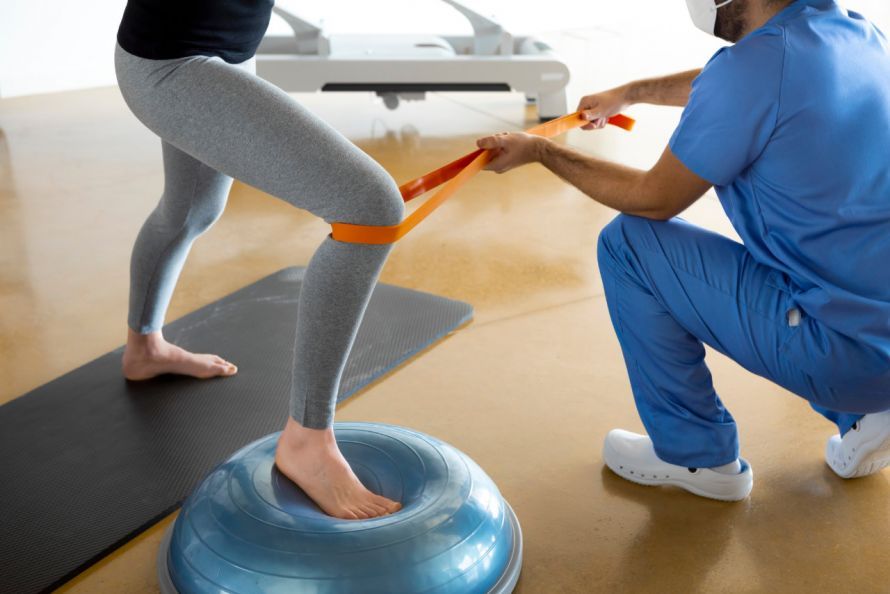
The Process of Knee Rehabilitation
Follow-up treatment for the knee is orthopedic rehabilitation. Accordingly, the treating therapists are primarily specialists in the fields of orthopedics and physical therapy.
For knee rehabilitation, you’ll receive a personalized therapy and treatment plan tailored specifically to your knee surgery. Your doctor will adapt the treatment based on your starting point for rehabilitation, such as the implantation of a prosthesis.
Your personalized treatment plan consists of various components that are coordinated with one another.
The following measures, among others, may be included in your rehabilitation:
- Physical therapy (individual or group sessions),
- walking and running training,
- Training to build muscle and stabilize joints,
- Manual lymphatic drainage,
- Electrostimulation therapy,
- Exercise baths,
- Movement training,
- Counseling on issues related to returning to work.
Orthopedic rehabilitation can be
- be provided on an inpatient basis at a rehabilitation clinic,
- on a partial inpatient basis (e.g., on a daily basis), or
- on an outpatient basis (by the hour)
.
The hospital where you’re having your knee surgery will usually advise you on this.
Knee rehab usually lasts three to four weeks. Depending on the medical indication, an extension to six weeks is possible in individual cases. This requires prior approval from the insurance provider, and your doctor will assist you with this.
Follow-up Care After Knee Rehabilitation
Rehabilitation also takes into account the period following knee rehab. In many cases, weekly physical therapy sessions are recommended. This helps maintain your current condition or specifically train the knee for a period of time.
The treatment plan often includes exercises that you can do on your own at home after knee rehab. Incorporate these exercises into your daily routine—this is the best way to make the training a habit. This helps stabilize the joint long-term and ensures that muscle building is not neglected.
Performing the exercises regularly is important for maintaining the success of your knee rehab.
Depending on your initial condition, your doctor may recommend strength training. In general, the longevity of an artificial knee joint depends largely on the type of stress placed on it. Sports involving jerky or jumping movements may cause the joint to become loose.
In addition, follow-up examinations are conducted to monitor your condition after surgery and rehabilitation. Follow-up care includes X-rays of the knee, which your doctor will perform initially after a period of three months. After that, the examinations take place at longer intervals: after another year and later, usually every three to five years.
Risks and Prognosis for Knee Rehabilitation
The outlook after knee rehabilitation depends largely on how
- fit you were as a patient before the surgery and
- how carefully you exercise your knee as you continue your recovery.
Strong muscles are essential for a stable knee. In addition, movements that place an even load on your knee are important. If you’d like to engage in regular physical activity, it’s advisable to consult your orthopedic surgeon. If necessary, a sports medicine evaluation can help you choose the right type of exercise.
Being significantly overweight is considered a major risk factor for a positive outcome following knee surgery and subsequent rehabilitation. In this case, a lifestyle change that includes weight loss is recommended.
Conclusion
In most cases, orthopedic knee rehabilitation is essential for maintaining your knee’s long-term function and mobility after surgery.
This includes
- the therapeutic measures prescribed by your treating orthopedic specialist during follow-up care, as well as
- your own efforts afterward.