Laparoscopic prostatectomy is usually performed under general anesthesia and offers advantages such as less blood loss, shorter recovery times, and good functional outcomes. It is now considered the standard procedure in urology, particularly for patients who want or need a radical prostatectomy.
What is a laparoscopic radical prostatectomy?
Laparoscopic prostatectomy is a minimally invasive surgical procedure to remove the prostate, which is used primarily for locally confined prostate cancer. Unlike open radical prostatectomy, the procedure is performed through several small incisions in the lower abdomen, through which a laparoscope and fine surgical instruments are inserted.
During the surgery, the entire prostate—including its capsule, the seminal vesicles, and the vas deferens—is precisely separated from the surrounding tissue. The surgeon works with optical magnification provided by the laparoscope, which allows for the preservation of sensitive nerves and blood vessels. The urethra is transected directly below the prostate and, after removal of the organ, reconnected to the bladder via a fine anastomosis (suture connection).
The goal of laparoscopic prostatectomy is the complete removal of the prostate, including all tumor-bearing portions, in order to achieve a cure for prostate cancer while preserving continence and—in cases of nerve-sparing surgery—erectile function as much as possible.
Since laparoscopic surgery does not require a large abdominal incision, it is considered a less invasive alternative to open procedures. Blood loss is minimal, postoperative pain is usually reduced, and recovery is faster. Thanks to modern laparoscopic techniques, the procedure can be performed either extraperitoneally (outside the abdominal cavity) or transperitoneally, depending on the surgical team’s experience and the patient’s anatomical condition.
Laparoscopic surgical techniques have become the standard in urology and form the basis for modern variations such as robot-assisted laparoscopic prostatectomy, which allows for even greater precision.
When is laparoscopic prostatectomy a suitable surgical option for prostate cancer?
Laparoscopic prostatectomy is primarily used to treat prostate cancer when the tumor is locally confined and has not metastasized. It is one of the most common procedures in urological surgery and offers a less invasive alternative to open surgery.
Indications for laparoscopic prostatectomy
Surgery is generally considered for:
- Locally confined prostate cancer that has not yet spread beyond the prostate capsule
- Patients in good general health who prefer surgical treatment
- A desire for radical tumor removal while preserving continence and sexual function
- After failure or refusal of other treatments such as radiation therapy or active surveillance
The goal is to completely remove the entire prostate, including its capsule and seminal vesicles, thereby maximizing the chances of a cure. The laparoscopic technique allows for the preservation of even delicate structures such as nerves and blood vessels under optical magnification.
Alternatives to Laparoscopic Prostatectomy
In certain cases, surgery may be avoided or another treatment method chosen, for example:
- Active surveillance for slow-growing, low-risk tumors
- Radiation therapy (e.g., brachytherapy or external beam radiation)
- Hormone therapy for advanced stages
- Robot-assisted laparoscopic prostatectomy as a technically advanced alternative
When is surgery not recommended?
Laparoscopic prostatectomy is generally not recommended if:
- the prostate cancer has metastasized,
- the patient has severe heart or lung disease, or
- the patient cannot tolerate general anesthesia due to other medical conditions.
Procedure for Laparoscopic Radical Prostatectomy
Laparoscopic prostatectomy is performed under general anesthesia. The patient lies on his or her back with the pelvis slightly elevated to allow the surgeon optimal access to the prostate. Special trocars are inserted through several small incisions in the lower abdomen, through which the surgical instruments and the laparoscope are introduced. The laparoscope provides a highly magnified view of the surgical site, allowing the procedure to be performed with extreme precision and minimal nerve damage.
Once access to the abdominal cavity has been established, the bladder is carefully detached from the prostate. The surgeon then cuts the urethra below the prostate to remove the entire prostate, including its capsule, the seminal vesicles, and the vas deferens. Depending on the oncological situation, lymph nodes in the pelvic area are also removed to rule out possible tumor metastases.
The urinary tract is then reconstructed: the urethra is connected to the bladder via a fine anastomosis (suture connection). To allow urine to drain after the operation, a urinary catheter is inserted, which is usually removed after one to two weeks.
Laparoscopic prostatectomy is primarily performed either extraperitoneally (outside the abdominal cavity) or transperitoneally (inside the abdominal cavity). The surgical technique used depends on the surgeon’s experience and the patient’s individual anatomy.
During the procedure, the surgical team takes special care to preserve the nerves and blood vessels responsible for continence and erectile function. This so-called nerve-sparing surgical technique is used primarily in patients with locally confined prostate cancer.
Because of the minimally invasive approach, blood loss is minimal, and the postoperative recovery time is usually significantly shorter than with open procedures. After the surgery, the patient typically stays in the hospital for a few days and can then gradually resume physical activity.
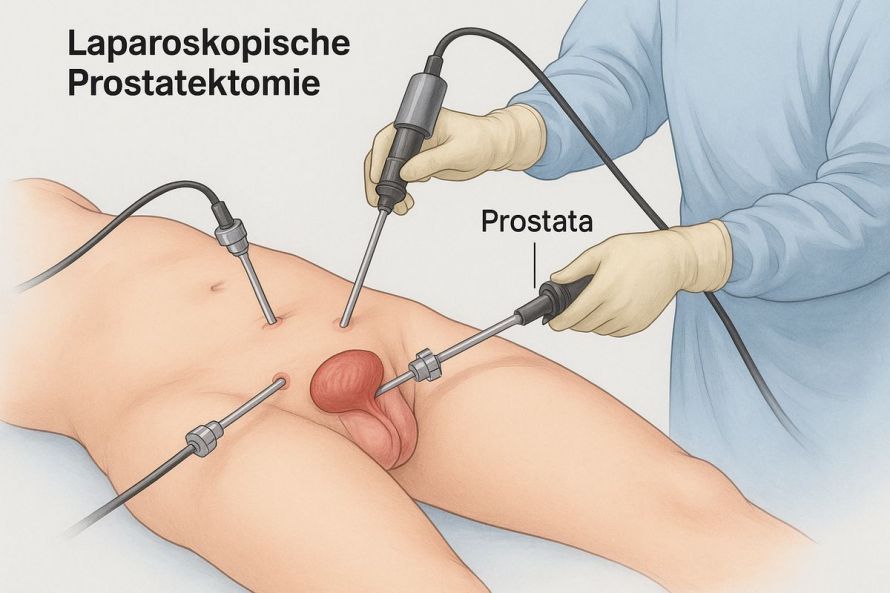 Schematic illustration of laparoscopic prostatectomy: A camera and instruments are guided to the prostate through small skin incisions
Surgical Techniques and Variations of Laparoscopic Prostatectomy
Laparoscopic prostatectomy is one of the modern, minimally invasive procedures for radical prostatectomy. During the procedure, the entire prostate—including the capsule, seminal vesicles, and lymph nodes—is removed. The goal is complete tumor resection while preserving continence and—if oncologically feasible—erectile function.
In clinical practice, various surgical techniques have become established, differing primarily in their approach and technical complexity.
Laparoscopic Radical Prostatectomy (LRP)
The classic form of laparoscopic prostatectomy is performed through five small skin incisions in the lower abdomen. Trocars are inserted through these incisions to guide the laparoscope and surgical instruments.
The procedure can be performed extraperitoneally—that is, outside the abdominal cavity—or transperitoneally. The advantages include minimal tissue trauma, minimal blood loss, and a rapid recovery. This method is particularly suitable for locally confined prostate cancer without metastases.
Robot-Assisted Laparoscopic Prostatectomy
Robot-assisted laparoscopic prostatectomy represents a further development of traditional laparoscopy. With the aid of a surgical robot system—often the da Vinci system—the surgeon controls the instruments with millimeter-level precision.
The technique offers excellent visibility, finer movements, and improved preservation of nerves and blood vessels. It is therefore particularly commonly used in nerve-sparing laparoscopic radical prostatectomy. Studies show that patients often regain their continence and sexual function more quickly after robot-assisted procedures.
Retropubic Radical Prostatectomy
Retropubic radical prostatectomy is an open procedure in which the prostate is removed through an abdominal incision above the pubic bone. Despite the larger incision, it is still considered oncologically reliable; however, it is increasingly being replaced today by laparoscopic and robot-assisted methods.
Perineal prostatectomy
In perineal prostatectomy, access is gained through the perineum between the anus and the scrotum. This method is technically challenging and is rarely used, for example, in cases of anatomical variations or prior abdominal surgery.
Endoscopic extraperitoneal radical prostatectomy (EERPE)
Endoscopic extraperitoneal radical prostatectomy is a technique in which the prostate is completely removed without opening the abdominal cavity. It combines the advantages of minimally invasive laparoscopy with a rapid recovery and a lower risk of complications.
All procedures share the same goal: to remove the prostate completely and with oncological safety. The technique used depends on the extent of the tumor, the surgeons’ experience, and the patient’s individual anatomical conditions.
Risks and Complications of Laparoscopic Prostate Surgery
Laparoscopic prostatectomy is considered a modern, minimally invasive form of radical prostatectomy and has significantly transformed the surgical treatment of prostate cancer.
Compared to open surgery, it offers a better view of the surgical field, less blood loss, and a faster recovery. Nevertheless, it remains a complex procedure that requires experience and precision.
Advantages of Laparoscopic Prostatectomy
- Minimally invasive approach: The procedure is performed through several small incisions in the skin, thereby sparing the surrounding tissue and blood vessels.
- Less blood loss: By magnifying the structures in the surgical field, the surgeon can precisely control bleeding.
- Faster recovery: Patients are usually mobile after just a few days and can leave the hospital sooner.
- Less postoperative pain: Smaller incisions result in less pain and a shorter duration of catheter use.
- More precise tumor removal: The magnification (up to ten times) allows for the precise removal of the prostate, including its capsule and the adjacent seminal vesicles.
- Preservation of continence and sexual function: The nerve-sparing surgical technique can facilitate a faster recovery of continence and reduce the risk of erectile dysfunction in cases of locally confined prostate cancer.
Risks and Possible Complications
Despite all its advantages, this is a major surgery that—like any surgical procedure—carries risks.
Possible complications include:
- Bleeding and postoperative hemorrhage during or after surgery
- Infections in the wound area or urinary tract
- Urinary incontinence, especially in the first few weeks after the procedure
- Erectile dysfunction, depending on the location of the tumor and the possibility of using a nerve-sparing technique
- Urethral stricture or anastomotic problems between the bladder and the urethra
- Thrombosis or embolism as general surgical risks associated with general anesthesia
In rare cases, an acute complication may require a second surgery, such as a leak at the anastomosis or postoperative bleeding.
However, with experienced surgeons, the complication rate is significantly lower than with open procedures.
Recovery and Follow-Up Care After Laparoscopic Prostatectomy
Immediately after surgery, the urinary catheter is usually left in place for about 5 to 7 days, until the connection between the urethra and the bladder has fully healed.
A mild burning or pulling sensation when urinating is normal during this time.
Many patients are able to return to work and resume physical activities after just two to three weeks—depending on their individual healing process.
In the long term, most patients benefit from:
- stable continence within a few weeks to months,
- improved oncological control of the tumor,
- and an overall higher quality of life.
Regular follow-up visits with a urologist are important to monitor the healing process, detect potential complications early, and confirm that the tumor is gone.
Additional Information on Laparoscopic Prostatectomy
Laparoscopic radical prostatectomy is one of the proven minimally invasive surgical techniques in urological surgery. During the procedure, the prostate is completely removed, including the entire prostate along with its capsule and adjacent seminal vesicles. Trocars are inserted through several small skin incisions in the lower abdomen to provide access to the prostate. The laparoscope provides high magnification, allowing nerves and blood vessels to be spared with precision.
The anastomosis between the urethra and the bladder is meticulously sutured to ensure good continence and a low rate of urinary incontinence. The sphincter muscle between the bladder and the urethra is also carefully preserved. In many cases, lymph nodes are also removed to improve the oncological outcome.
Experienced surgeons typically perform the procedure extraperitoneally for locally confined prostate cancer. With the robot-assisted laparoscopic approach, such as using the da Vinci system, patients benefit from a more precise surgical technique. Studies on the technical aspects and experience with endoscopic extraperitoneal radical prostatectomy show very good functional and oncological outcomes.
Overall, laparoscopic prostatectomy is considered the standard of care in modern prostate surgery. Patients benefit from a faster recovery, less pain, and a more nerve-sparing procedure that preserves continence and sexual function in the long term.
FAQ – Frequently Asked Questions About Laparoscopic Prostatectomy
How exactly is laparoscopic prostatectomy performed?
In laparoscopic prostatectomy, the entire prostate—including its capsule and the seminal vesicles—is removed through several small incisions in the lower abdomen.
A laparoscope and fine instruments are inserted through trocars, allowing the surgeon to cut the urethra below the prostate and reconnect it to the bladder (anastomosis) after the organ has been removed.
The procedure is performed under general anesthesia and takes an average of two to three hours.
What is the difference between laparoscopic and robot-assisted prostatectomy?
Both procedures are minimally invasive surgical techniques for removing the prostate in cases of locally confined prostate cancer.
However, robot-assisted laparoscopic prostatectomy uses a computer-assisted system (e.g., da Vinci) that transmits the surgeon’s movements and provides highly magnified 3D images.
This allows the surgeon to preserve nerves and blood vessels with even greater precision. Patients often benefit from a faster recovery of continence and sexual function.
When is a laparoscopic prostatectomy appropriate?
A laparoscopic prostatectomy is particularly suitable when the tumor is locally confined and surgical removal of the prostate offers a chance of a cure.
It is primarily used for patients who do not have metastases and for whom active surveillance or radiation therapy does not appear to be sufficient.
In advanced stages or in cases of severe comorbidities, hormone therapy or radiation therapy may be considered instead.
What are the risks after surgery?
As with any major surgery, complications can occur.
These include bleeding, urinary incontinence, infections, or temporary erectile dysfunction.
A narrowing of the urethra or dysfunction of the sphincter muscle between the bladder and the urethra is also possible. However,
in experienced urology centers, these risks are low, and many patients regain their continence within a few weeks.
How long does recovery take after a laparoscopic prostatectomy?
Patients can leave the hospital just a few days after the procedure.
The urinary catheter is typically left in place for 5–7 days until the connection between the urethra and the bladder has healed securely.
Mild discomfort when urinating is normal.
Full recovery and restoration of continence can take several weeks.
Consistent follow-up care and pelvic floor exercises help speed up healing.
Are there different types of radical prostatectomy?
Yes. In addition to laparoscopic radical prostatectomy, there are:
- retropubic radical prostatectomy (open surgery via an abdominal incision),
- perineal prostatectomy (access via the perineum), and
- endoscopic extraperitoneal radical prostatectomy (EERPE),
in which the abdominal cavity remains closed.
All procedures have the same goal: to remove the prostate cancer in a way that ensures oncological safety.
The surgeon decides which technique to use based on the extent of the tumor and anatomical conditions.
How does the surgery affect continence and sexual function?
Urinary incontinence may occur temporarily after surgery because the sphincter muscle and surrounding structures are irritated.
Through a nerve-sparing surgical technique and targeted training of the pelvic floor muscles, continence can usually be restored within a few weeks.
Erectile function can also recover over time, particularly with nerve-sparing procedures and in younger patients.
In which cases is laparoscopic prostatectomy not recommended?
It is not suitable for patients with metastatic prostate cancer, severe heart or lung disease, or when general anesthesia would be too risky.
In these cases, urologists usually recommend alternative therapies such as radiation therapy or hormone therapy.
Is laparoscopic prostatectomy covered by health insurance?
In Germany, both public and private health insurance plans generally cover the costs provided there is a medical indication—that is, a confirmed diagnosis of prostate cancer and a justified recommendation for surgery to treat prostate cancer.
The exact billing may vary depending on the hospital, surgical technique, and insurance status.