The liver is an organ that performs a number of important functions in the body. Among other things,
- it is involved in various metabolic processes,
- can store important nutrients,
- detoxifies the body, and supports the immune system.
In cases of severe liver disease, a transplant may be the last resort for those affected. Here you will find further information as well as a selection of liver transplant specialists and centers.
A liver transplant is the process of transplanting a healthy liver into another person’s body. The liver can be obtained either from a deceased donor or through a living donor.
Unlike in the case of a damaged kidney (dialysis), there is currently no artificial method to replicate the liver’s basic functions. A transplant is therefore often the patient’s last chance at survival.
A transplant is a very expensive procedure. It can cost nearly 200,000 euros, which is covered by public health insurance.
When does a patient need a liver transplant?
When a patient’s own liver can no longer perform important tasks such as detoxification, the patient needs a new organ.
A patient’s own liver can be impaired for various reasons. These include both congenital defects and diseases such as
- liver cancer,
- chronic aggressive hepatitis,
- cirrhosis caused by excessive alcohol abuse,
- as well as poisoning (for example, from mushroom toxins and certain chemicals)
can result in irreparable damage and thus necessitate a transplant.
In addition, there are other conditions that can render the liver nonfunctional, including
- Caroli syndrome (a disease of the bile ducts)
- Budd-Chiari syndrome (occlusion of the hepatic veins)
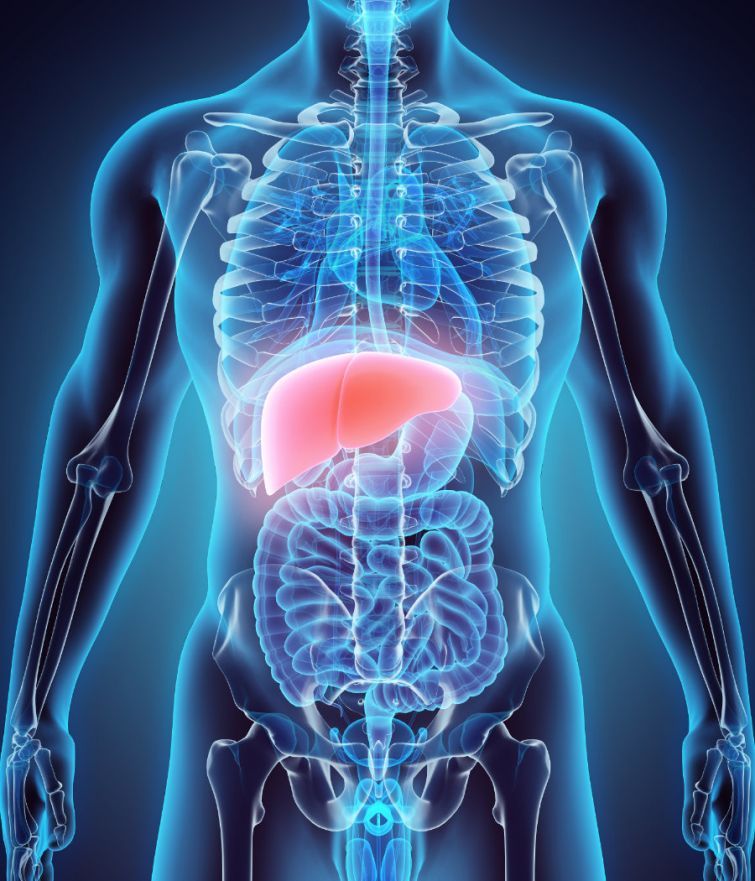
The location of the liver in the human body © yodiyim | AdobeStock
How does a liver transplant work?
Just like with other organ transplants, a liver transplant involves several stages along the long journey:
- Waiting period
- Examinations and surgery
- Postoperative care, possibly including mental health support
Waiting period
Patients—even those with acute conditions—must accept the waiting period. Unfortunately, the demand for organs far exceeds the supply. Therefore, there is a waiting list that patients must join.
These waiting lists are also common for other organs such as the heart, kidneys, or lungs. The waiting period can last several months or even years. This is dangerous for people with severe liver damage, as liver function can only be partially compensated for using certain techniques.
Examinations and Surgery
Once a donor liver has been found, time is of the essence. Basic examinations are conducted to check for
- pre-existing conditions,
- general health status, and
- compatibility between the donor organ and the patient
. The surgical team must also carefully prepare for the surgery.
After removal, the organ must be transplanted within a 16- to 24-hour window. The longer the liver transplant is delayed, the more difficult it becomes to restore liver function.
The actual surgery takes about eight hours. In some cases, parts of a healthy liver can also be transplanted. The organ’s unique regenerative capacity makes it possible, in suitable cases, to divide parts of a donor liver among several patients.
This method is particularly useful when transplanting a liver from an adult patient to a child. This may allow parents to donate part of their liver to their children.
Follow-up Care and Support
After the procedure, the donor remains in the hospital for a few days. The recipient, on the other hand, will need to stay in the hospital a little longer.
This time is used not only for recovery but also to optimize medication dosages. Specifically, this refers to immunosuppressants. These are used because the body will “fight off” a foreign organ. Administering these medications reduces the risk of rejection.
Important: Psychological care should also not be neglected after such a serious procedure.
Are there complications? What is the life expectancy after a liver transplant?
There is no clear-cut answer to either of these questions. In general, complications can arise during and after any surgical procedure. Infections, bleeding, or wound healing problems may occur.
Other complications include rejection of the transplanted organ.
Life expectancy after surgery depends on several factors:
- How long had the liver been damaged?
- What pre-existing conditions led to the damage?
- How old is the patient?
- How does the patient adjust their lifestyle after the transplant?
Generally, one-year survival rates are over 90 percent. After ten years, more than 70 percent of patients are still alive.
As medical science continues to advance, these figures could rise even further in the future.
Which doctor performs a liver transplant?
Liver transplants are regulated by law and are only permitted at certain university hospitals.
If the patient has cancer, an oncologist is also consulted. The attending physician will refer the patient to the appropriate specialist.