Manual lymphatic drainage (MLD) is a gentle massage technique which, by its very nature, helps to drain accumulated tissue fluid via the lymphatic vessels. It is primarily used to treat lymphoedema.
The treatment can alleviate swelling and associated symptoms. The extent of its additional benefits depends on the condition and any accompanying measures. It is carried out by physiotherapists or massage therapists who have received specialised training in this technique.
Who is manual lymphatic drainage suitable for?
Manual lymphatic drainage is designed to support the transport of accumulated fluid within the lymphatic system. Gentle massage techniques specifically stimulate lymph flow. Certain techniques are also intended to loosen hardened tissue.
Lymph nodes act as filter stations along the lymphatic vessels. Many are located on the trunk and in the armpits, with others in the groin. These areas of the body can therefore be included in the treatment.
One important area of application is chronic lymphoedema of the arms or legs. In this condition, lymph accumulates in the tissue. In the case of arm lymphoedema following breast cancer, a combination of manual lymphatic drainage, compression, exercise and skin care can alleviate the swelling and associated symptoms.
- Following breast cancer treatment: The potential additional benefit in cases of arm lymphoedema has not been conclusively established.
- In cases of lipoedema: This additional therapy may be considered if compression does not provide sufficient relief from pain.
- Following knee replacement surgery: The studies do not support routine, priority use to aid recovery.
- In cases of chronic oedema: It remains unclear whether the treatment improves well-being and quality of life.
In cases of lipoedema, additional manual lymphatic drainage is thought to influence pain. It is not intended to reduce the volume of adipose tissue and has not been sufficiently studied as a stand-alone treatment.
What is the effect of lymphatic drainage?
The additional benefit of manual lymphatic drainage is not established for all applications. In a Cochrane review, swelling decreased by a further 7 per cent under intensive compression combined with additional manual lymphatic drainage. Whether this benefit is generally confirmed remains unclear.
Another review of randomised trials found no proven benefit in the prevention or treatment of upper limb lymphoedema following breast cancer. However, the studies examined differed considerably.
Even in cases of chronic lymphoedema of the arms and legs, it is difficult to distinguish the effect of the treatment from that of accompanying measures. In one study, the reduction in volume did not differ significantly between groups with and without lymphatic drainage. Promoting lymph flow therefore does not guarantee a measurably greater reduction in oedema.
How do you prepare for the treatment?
Before decongestion, the specialist checks the skin for any injuries. Intact skin is a prerequisite for the treatment of lymphoedema. Inform your therapist of any acutely inflamed areas of skin or infections.
In the event of skin inflammation or infection, the combination of lymphatic drainage and compression is not an option, or only after careful consideration. This also applies in the case of venous thrombosis or an inflamed vein. These conditions must be disclosed before the first appointment.
How is MLD carried out in physiotherapy?
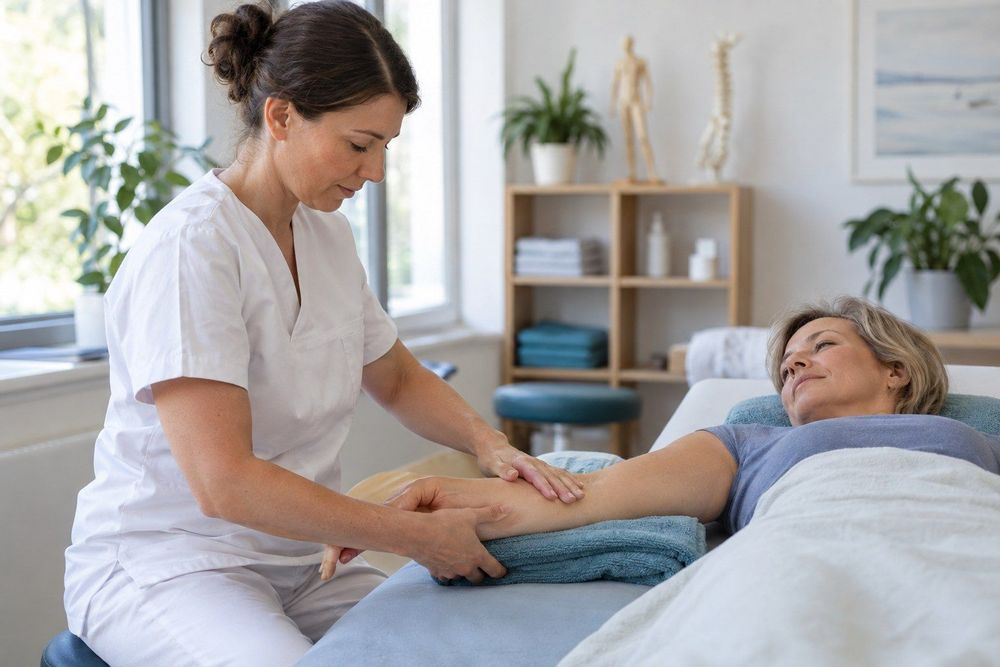
Manual lymphatic drainage is performed using gentle, rhythmic strokes. In the case of arm lymphoedema following breast cancer, this involves circular movements using the palms of the hands. Unlike some forms of massage, the therapist does not apply firm pressure.
As a physical treatment method, lymphatic drainage differs from manual therapy in terms of its objective. Manual therapy primarily mobilises muscles and joints, whilst manual lymphatic drainage is designed to drain accumulated fluid.
- The therapist checks the condition of the skin before treatment.
- They apply specific techniques to the area being treated.
- Gentle, circular movements are designed to support lymphatic drainage.
- Combined therapy also includes compression, exercise and skin care.
For those eligible for federal financial assistance, treatment sessions of 30, 45 or 60 minutes are listed. Decongestion of cancer-related lymphoedema can be carried out on an outpatient basis for most patients.
What risks and side effects are possible?
Manual lymphatic drainage was described as well tolerated in a Cochrane review on cancer-related arm lymphoedema. However, no reliable general incidence figures for side effects of the treatment alone can be derived from this.
In the combined treatment of arm lymphoedema following breast cancer, skin irritation, arm pain or headaches occurred in fewer than 1 in 100 women. This figure applies to the entire treatment programme and not to lymphatic drainage alone.
In a study comparing different decongestive therapies, discomfort and inflammation of the lymphatic vessels were the most common adverse events. There was no difference between the groups with and without manual lymphatic drainage. The symptoms cannot therefore be attributed solely to the procedure.
In studies on the use of the treatment following knee replacement surgery, no treatment-related adverse events were reported. This does not, however, provide a reliable overall incidence of possible side effects.
What happens after decongestive therapy?
In the case of upper-limb lymphoedema following breast cancer, the evidence suggests that custom-made compression stockings should continue to be worn after successful decongestion.
Manual therapy stimulates fluid transport during the session itself. Complementary compression therapy, on the other hand, exerts sustained pressure on the tissue.
| Procedure | For whom | Duration or application | Advantages and disadvantages |
|---|---|---|---|
| Manual lymphatic drainage | Primarily for lymphoedema; used as a complementary treatment for pain in cases of lipoedema | Sessions can last 30, 45 or 60 minutes | Gentle treatment; the additional benefit is unclear depending on the condition |
| Compression combined with exercise | Part of the treatment for lymphoedema and lipoedema-related pain | Part of the treatment plan | In the case of arm lymphoedema, the evidence suggests that a custom-made compression stocking is recommended following successful reduction of swelling |
| Intermittent pneumatic compression with bandages | A method investigated for arm or leg lymphoedema | Investigated in combination with bandages | Does not require massage techniques; in one study, the reduction in volume did not differ significantly |
What does the health insurance cover?
Statutory health insurance covers manual lymphatic drainage for lymphoedema if a doctor’s prescription has been issued for it as a therapeutic treatment. Those with statutory insurance may be required to pay a co-payment. For those with private insurance, reimbursement depends on the specific insurance policy.
A standard out-of-pocket price cannot be derived from the subsidy amounts. For those eligible for federal subsidies, the maximum amounts are €35.10 for 30 minutes, €52.70 for 45 minutes and €70.20 for 60 minutes. These are not generally standard out-of-pocket prices.
Which doctors perform manual lymphatic drainage?
A doctor may prescribe manual lymphatic drainage as a treatment. The practical treatment is usually carried out by specially trained physiotherapists or massage therapists with the relevant additional qualifications. The professional title alone does not indicate that a person has these qualifications.
The following questions are useful for the initial consultation:
- Qualifications: What training have you undertaken in oedema and decongestive therapy?
- Treatment plan: How are manual lymphatic drainage, exercise and compression combined?
- Safety: What is the procedure in the event of skin infections, venous thrombosis or inflamed veins?
- Aftercare: What type of compression is recommended once the swelling has subsided?
You can find specialists in manual lymphatic drainage at the end of this text.
Frequently asked questions about manual lymphatic drainage
Is manual lymphatic drainage a normal massage?
No. It is a therapeutic massage technique involving gentle, rhythmic strokes designed to aid the drainage of accumulated tissue fluid. Firm pressure is not a characteristic of this form of therapy.
Does manual lymphatic drainage help with lipoedema?
Manual lymphatic drainage has not been sufficiently studied as a stand-alone treatment for lipoedema. It may be considered as a complementary treatment if compression does not provide sufficient pain relief. It is not intended to reduce the volume of fatty tissue.
Is the treatment beneficial following knee replacement surgery?
The studies do not support its routine use as a primary treatment following this orthopaedic procedure. Individual studies have reported only minor, short-term benefits in the first few days after surgery.
When should lymphatic drainage not be carried out?
In cases of skin inflammation, skin infection, venous thrombosis or an inflamed vein, careful consideration must be given as to whether decongestive therapy is appropriate. Before treatment, the skin is checked for any injuries.
Do I need to go to hospital for treatment?
This is not usually necessary. For most patients, the treatment of cancer-related lymphoedema can be carried out on an outpatient basis.
Is lymphatic drainage covered by health insurance?
The statutory health insurance scheme covers medically prescribed manual lymphatic drainage for lymphoedema; a co-payment may apply. For privately insured patients, reimbursement depends on the specific policy.