A penile prosthesis (cavernous body implant) is a treatment option for erectile dysfunction when conservative therapies fail to produce improvement.
Doctors insert the implant into the penis, where it takes over the function of the non-functioning erectile tissues.
Background on Erectile Dysfunction
Erectile dysfunction is the inability to achieve and maintain an erection sufficient for a satisfying sex life for at least six months.
Prevalence of Erectile Dysfunction
Studies have shown that 18 to 48% of all men between the ages of 40 and 79 have erectile dysfunction. Of course, there is a clear correlation with age:
2% among men aged 30–39
10% among men aged 40–49
16% among men aged 50–59
34% among men aged 60–69
53% among those aged 70–79
Although it is not a malignant condition, it has a significant impact on the quality of life of those affected. This is also because erectile dysfunction can be an early warning sign of a previously undiagnosed condition. Therefore, those affected should seek medical evaluation.
Causes of Erectile Dysfunction
The causes of erectile dysfunction can be psychological or physical. Often, a combination of both is present.
It is therefore understandable that physically caused erectile dysfunction (due to poor blood flow in people with diabetes) often leads to psychological problems. These, in turn, exacerbate the erectile dysfunction.
The most common physical causes are those that lead to changes (“calcifications”) in the arteries and veins.
Risk factors include:
- High blood pressure
- Elevated blood lipids
- Smoking
- Diabetes
- Overweight
Impaired nerve supply to the pelvic region and the penis is often responsible for erectile dysfunction.
Possible causes include:
- A previous surgery (e.g., removal of the prostate due to prostate cancer)
- Radiation therapy
- A pelvic fracture
- A spinal cord injury
- Parkinson’s disease
- Congenital malformations of the blood vessels in the pelvis and penis (cavernosal disorders)
In cases of cavernous body disorders, venous outflow of blood is insufficient due to reduced elasticity of the cavernous bodies. As a result, the penis cannot become sufficiently rigid. Experts also refer to this as cavernous insufficiency.
Severe induratio penis plastica (penile curvature) can also lead to erectile dysfunction.
Flexible or Hydraulic?
There are two types of penile prostheses. Experts distinguish between flexible (semi-rigid) and hydraulic penile implants.
Since the advantages of the hydraulic system outweigh those of the flexible system, doctors rarely use semi-rigid penile prostheses anymore.
- Flexible Penile Prostheses
Semi-rigid penile implants consist of a pair of silicone rods with a flexible metal core, which doctors insert into the corpus cavernosum.
For sexual intercourse, the patient can bend the penis into the correct position. After intercourse, he bends the penis back into its original position.
The disadvantage of a flexible penile implant is the permanent semi-rigid erection. The size of the penis or the expansion of the implants does not change.
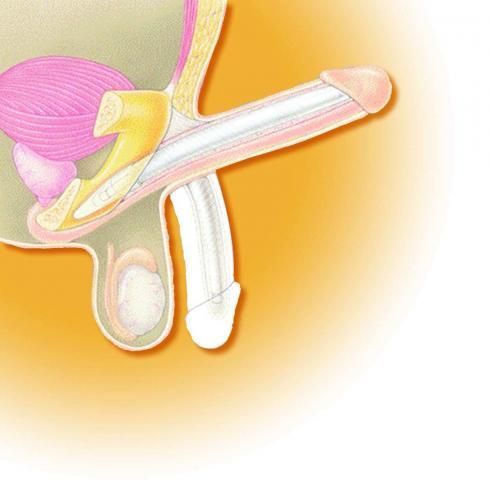
Flexible penile implant. Source: AMS Germany
- Hydraulic penile prostheses
Today, hydraulic penile implants are predominantly used. These essentially consist of three interconnected components.
Inside the corpus cavernosum are two silicone cylinders. Small tubes connect the hydraulic pump, located in the scrotum, to a fluid reservoir. Doctors place the fluid reservoir, which contains saline solution, in the abdominal cavity.
The small pump in the scrotum ensures that the saline solution fills both cylinders. This causes the penis to become erect and rigid.
After sexual intercourse, the patient can drain the cylinders again using a small valve. The saline solution flows back into the reservoir in the abdominal cavity. The penis returns to a flaccid state.
Hydraulic penile prostheses are very easy for the patient to use and mimic the natural mechanism of erection.
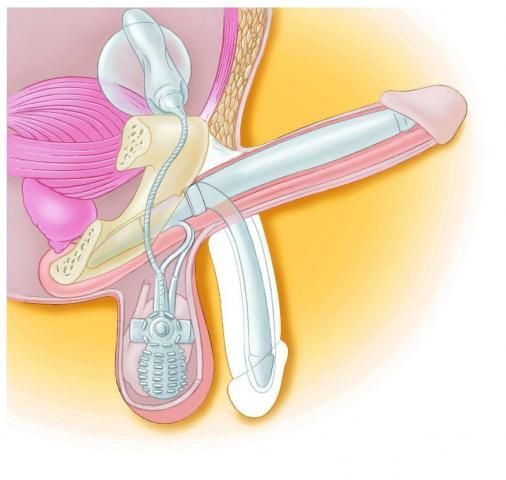
Hydraulic penile implant. Source: AMS Germany
Penile Prosthesis as a Treatment Option
In general, penile prostheses are among the treatment options with the highest satisfaction rates. Individual studies show satisfaction rates of up to 98%—among both patients and their partners.
Since the entire implant is concealed within the body, a penile implant is neither visible nor detectable to outsiders. Even the sexual partner usually notices no difference from a “normally” erect penis.
Sensitivity, the ability to achieve orgasm, and fertility are not impaired by the implantation of a penile prosthesis. However, it is clear that the procedure irreversibly destroys both corpora cavernosa.
The Surgery: Implantation
The most important step is for a detailed consultation to take place between the doctor and the patient beforehand. During this consultation, the advantages and disadvantages of various penile implants are discussed.
The surgery itself is relatively complex, so it should only be performed by experienced surgeons. It lasts one to two hours. The procedure is performed under general anesthesia but can also be done on an outpatient basis.
As with any surgery, there are potential side effects and risks.
Due to the complex technology involved, mechanical complications occur more frequently with hydraulic penile prostheses than with semi-rigid penile implants.
Nevertheless, from the patients’ perspective, the advantages of hydraulic penile implants clearly outweigh the disadvantages. As a result, doctors today virtually never use semi-rigid penile prostheses anymore.
The implants used today consist of medical-grade plastic and silicone components, manufactured with an antibiotic microcoating. This significantly reduces the risk of infection.
Four to six weeks after surgery, the patient can begin using the implant. Provided there are no infections or technical defects, the implant remains in the patient’s body for life.
Alternatives to a penile prosthesis
- Drug Therapy
The market launch of sildenafil (Viagra®) in 1998, followed shortly thereafter by Cialis® and Levitra®, revolutionized the treatment of erectile dysfunction.
These medications do not cause an erection; they merely influence the duration and strength of the erection. This effect occurs only with sexual stimulation.
Tablets are convenient because patients take them shortly before sexual intercourse, and their effects last up to 36 hours.
Due to potential side effects, these tablets should only be taken by patients without cardiovascular disease.
Other drug therapies include intracavernosal and intraurethral treatments:
In intracavernosal injection therapy (SKAT), the patient injects the active ingredient directly into the corpus cavernosum immediately before sexual intercourse.
In intraurethral therapy, doctors use an applicator to insert a gel into the urethra. In both cases, the active ingredient prostaglandin E1 is typically used.
A prerequisite for drug therapy is always intact anatomy and nerve supply.
- Vacuum Therapy
A penis pump and other devices can help achieve an erection. The patient places the cylinder of the penis pump over the flaccid penis and then creates a vacuum by pumping. The negative pressure causes blood to flow into the erectile tissues, resulting in an erection. A constricting penis ring then maintains the erection.
However, the cumbersome procedure results in low patient acceptance. Nevertheless, it has few side effects and can be used for any form of erectile dysfunction.
- Shockwave Therapy
Extracorporeal shock wave therapy (ESWT) is one of the newer conservative treatment methods for erectile dysfunction. The shock waves stimulate the formation of new blood vessels in the penis, which in turn improves blood flow and thus erectile function. Shockwave therapy involves several outpatient sessions and lasts several weeks.
- Surgery
If there are abnormalities in the blood vessels, vascular surgery can alter blood flow and thereby restore the ability to achieve an erection. However, the long-term results of these surgical methods have generally been disappointing. Therefore, vascular surgery is currently recommended only in individual cases.

About the medical author
Sabine Schneider
Editor-in-Chief
Sabine Schneider – medical author: Explore expert articles and medical expertise in the Leading Medicine Guide.
More about the medical author →