PresbyLASIK is a modern method of laser eye surgery used to correct presbyopia. In this procedure, a laser is used to make precise changes to the cornea in order to improve both near and distance vision. This specialized form of LASIK is based on the principles of multifocal vision correction and is frequently used to treat presbyopia. The goal is to enable clear vision at both near and far distances simultaneously.
People aged 40 and older benefit particularly from this technique. Presby-LASIK can serve as an alternative to reading glasses or contact lenses. Thanks to modern procedures such as Femto-LASIK or excimer laser, the treatment is performed with exceptional precision.
Nevertheless, suitability should be assessed on an individual basis, as not every type of vision impairment responds equally well to treatment.
PresbyLASIK and LASIK: Basics of Vision Correction
PresbyLASIK is a specialized advancement of traditional LASIK and is used to correct presbyopia. With this method, the cornea is precisely reshaped using a laser to enable multifocal vision. While traditional LASIK usually corrects only one type of vision problem, Presby-LASIK enables simultaneous near and distance vision. The treatment addresses presbyopia, which typically begins around age 40.
This laser eye surgery can reduce dependence on reading glasses. The cornea is reshaped to create different visual zones. Distance plays an important role in this process, as both near and far vision are taken into account. The method is particularly suitable for people with a combination of nearsightedness and farsightedness.
Other forms of refractive surgery also follow similar approaches. The goal is always long-term correction of vision problems. Modern laser technology enables a high degree of precision. However, the results depend heavily on individual suitability. That is why a thorough preliminary examination is crucial. Overall, PresbyLASIK represents an innovative solution for age-related vision problems.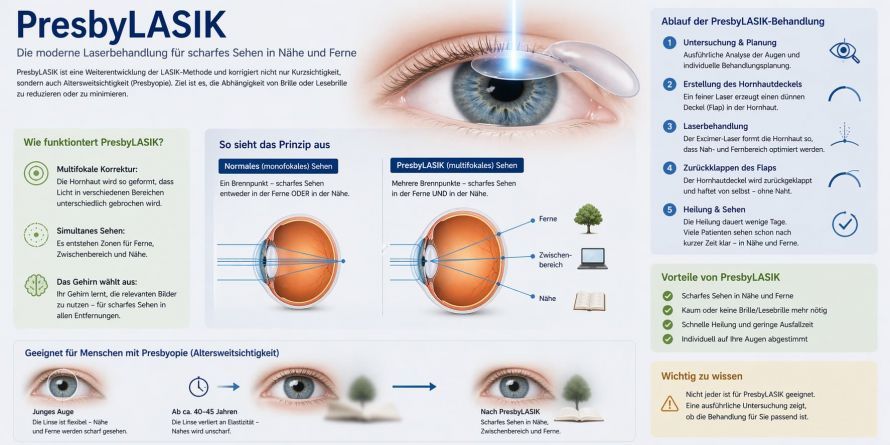
Monovision and Multifocal Techniques in PresbyLASIK
An important approach in PresbyLASIK is monovision, in which one eye is adjusted for distance vision and the other for near vision. This technique is frequently used in PresbyLASIK to correct presbyopia. Alternatively, multifocal procedures are used, in which the cornea is reshaped to create multiple focal points. This allows the eye to perceive different distances simultaneously. This multifocal structure significantly improves vision in everyday life.
The benefits are particularly evident when reading or working at a computer screen. Distance vision is also optimized, resulting in balanced visual quality. Modern procedures such as Presbyond combine various technologies to achieve better results. The eye’s natural lens continues to be used. The laser ensures that the cornea is optimally adjusted. The choice between monovision and multifocal techniques depends on the individual’s refractive error. Factors such as depth perception also play a role.
Many patients report a significant improvement in their visual quality. However, the brain often needs some time to adjust.
Procedure and Technique for Laser Eye Surgery
PresbyLASIK is performed as part of a modern laser eye surgery procedure and typically takes only a few minutes. First, a thin flap is created in the cornea, often using a femtosecond laser.
The cornea is then reshaped using an excimer laser. This alters the shape of the cornea to achieve a multifocal effect. The procedure is performed with precision and under strict control. The treatment is performed on an outpatient basis and is generally painless. After the procedure, the flap is repositioned.
Vision may improve shortly after the surgery. Healing is usually rapid, allowing many patients to resume their daily activities quickly. Nevertheless, regular follow-up visits are important. Eye drops are also used to support the healing process. The technique is based on the proven laser in situ keratomileusis (LASIK) method. The goal is to achieve a permanent correction of refractive errors. Modern equipment ensures a high level of safety and precision.
Advantages, Risks, and Suitability of PresbyLASIK
PresbyLASIK offers many advantages, particularly the ability to do without reading glasses. The correction of presbyopia is performed directly on the cornea and is permanent. Patients benefit from improved near and distance vision. However, there are also risks that must be taken into account. These include dry eyes or a temporary reduction in visual quality.
In rare cases, depth perception may be impaired. Suitability for Presbylasik depends on various factors, including age, refractive error, and the condition of the cornea. Existing eye conditions must also be taken into account. Not every patient is a suitable candidate for this type of laser treatment. Alternatives such as contact lenses or other refractive surgery procedures may be appropriate. It is important to have a detailed consultation with experienced eye surgeons. Overall, PresbyLASIK is considered a safe and effective method. When patients are selected appropriately, the results are very satisfactory.
Conclusion
The conclusion regarding PresbyLASIK shows that modern surgical procedures offer an effective solution for correcting presbyopia. Through laser eye surgery and precise techniques such as laser in situ keratomileusis (LASIK), dependence on reading glasses can be significantly reduced.
The combination of femto-LASIK and an excimer laser enables safe laser eye surgery, in which a thin flap is created and the curvature of the cornea is precisely adjusted. Procedures such as Presbyond or Central Multifocal LASIK rely on a multifocal cornea to optimize visual acuity. This refractive surgery can provide lasting vision correction, particularly for refractive errors such as myopia or hyperopia. Modern intraocular lenses or, in certain cases, lens implants can also be used as complementary treatments.
However, suitability depends heavily on the individual eye and the natural lens, as well as on factors such as astigmatism or an existing refractive error. It is important to have a detailed consultation with experienced eye surgeons who also consider alternatives such as contact lenses. Although near vision and overall visual acuity are improved, depth perception may be slightly altered at first. Many patients, especially those aged 40 and older, benefit from this multifocal laser surgery.
Overall, a review of current data shows that refractive surgery is a safe and effective method, even though, in rare cases, distant objects may appear blurry. The key is proper patient selection and precise execution using femtosecond technology. This ensures long-term improvement in visual acuity and vision correction.
FAQ
What is PresbyLASIK?
PresbyLASIK is a laser eye treatment for correcting presbyopia, in which the cornea is reshaped to a multifocal profile to improve both near and distance vision.
Who is Presbylasik suitable for?
The procedure is primarily suitable for people aged 40 and older who have presbyopia or a combination of refractive errors, such as nearsightedness or farsightedness.
What is the difference between LASIK and Presby-LASIK?
While traditional LASIK corrects only one distance of vision, Presby-LASIK enables multifocal vision for both near and far distances.
Can PresbyLASIK replace reading glasses?
In many cases, PresbyLASIK can significantly reduce the need for reading glasses or even eliminate it altogether.
What are the risks associated with the procedure?
Possible risks include dry eyes, sensitivity to glare, or reduced depth perception, though these are usually temporary.

About the medical author
Sabine Schneider
Editor-in-Chief
Sabine Schneider – medical author: Explore expert articles and medical expertise in the Leading Medicine Guide.
More about the medical author →