
The term “refraction” describes the eye’s refractive power. It refers to a person’s ability to see clearly. A refractive error occurs when the geometry or refractive properties of the eye are altered. The eye is then unable to focus an image sharply on the retina.
Refractive surgery, a subspecialty of ophthalmology, deals with the surgical correction of refractive or imaging errors. It employs methods of refractive corneal surgery and lens surgery, which alter the optical properties of the cornea or the lens. Sharp vision without glasses or contact lenses is then possible again. Refractive surgery includes laser eye surgery.
What conditions do specialists in refractive surgery treat?
If the eye cannot focus an object sharply on the retina under standard conditions, a refractive error is present. An ophthalmologist refers to this as ametropia.
If the cause is an eyeball that is too short or too long, it is called axial ametropia.
In myopia (nearsightedness), the eyeball is too long relative to its refractive power. In hyperopia (farsightedness), it is too short.
If light is refracted too strongly or too weakly by the lens or the cornea, doctors call this refractive ametropia.
If the cornea is not curved in a spherical shape as it normally is, this is known as astigmatism.
A cataract is a clouding of the lens.
Experts in refractive surgery treat the following vision problems and eye conditions, among others:
- Nearsightedness (myopia)
- Farsightedness (hyperopia, hypermetropia)
- Presbyopia (age-related farsightedness)
- Astigmatism
- Cataracts
- Keratoconus (abnormality of the cornea)
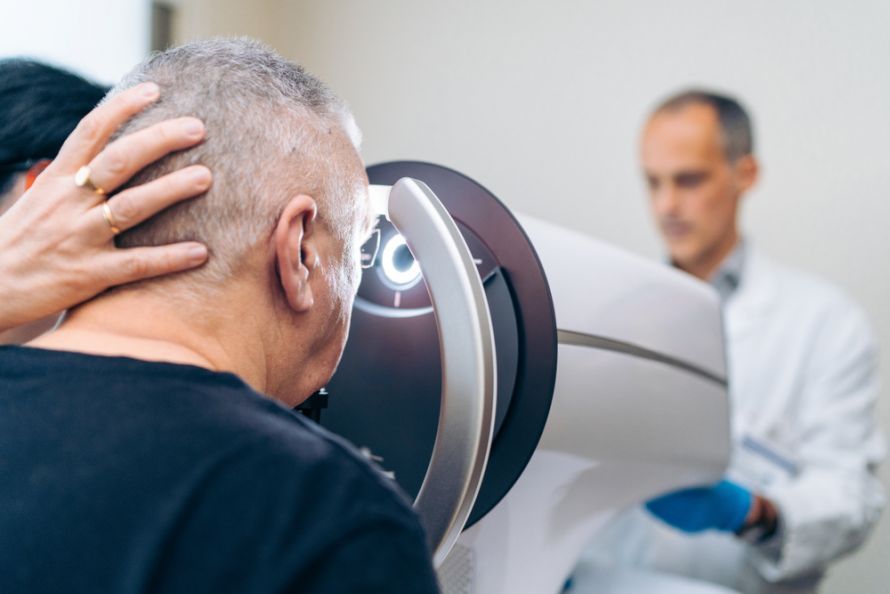 surgery includes procedures on the eye that alter the eye’s overall refractive power @ Koldo_Studio /AdobeStock
What diagnostic procedures do specialists in refractive surgery use?
Every eye exam includes asking the patient about symptoms or eye conditions that run in the family. Doctors test visual acuity using eye charts.
For objective refraction measurement, doctors can use refractometry and skiascopy.
The principle of refractometry is based on observing an image projected onto the retina. Doctors use this method to determine the additional refractive power needed to produce a sharp image on the retina.
With skiascopy, doctors can identify the type of refractive error by observing light reflexes on the retina.
In subjective refraction testing, the doctor asks the patient which lens provides better visual acuity.
What treatment methods are included in the range of services offered by a specialist in refractive surgery?
Surgical correction procedures fall into one of the following categories:
- Refractive corneal surgery or
- Refractive lens surgery
In the first case, surgical changes are made to the cornea; in the second, to the lens.
Procedures in refractive corneal surgery:
In photorefractive keratectomy (PRK), doctors ablate the cornea with an excimer laser as follows:
- layer-by-layer ablation
- ablation only at the edge, or
- oval ablation
Layer-by-layer ablation and peripheral ablation are used to correct nearsightedness.
Oval ablation is suitable for correcting astigmatism.
The LASEK (laser subepithelial keratomileusis) and Epi-LASEK procedures also treat the surface of the cornea with an excimer laser. This also corrects refractive errors.
In LASIK (laser in situ keratomileusis), doctors first separate a portion of the cornea and fold it back. They then use a laser to reshape the inner layer of the cornea. Afterward, they fold the cornea back into place.
Modern forms of LASIK include:
- Femto-LASIK and
- Laser LASIK
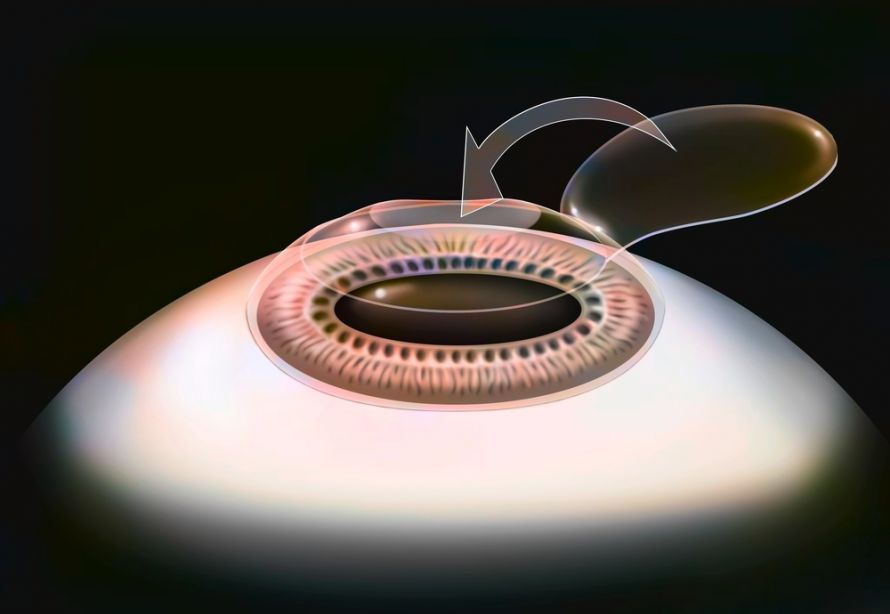 Before the laser removes tissue from the cornea, the doctor makes an incision to create a thin flap in the cornea, the flap @ RFBSIP /AdobeStock
Refractive Lenticule Extraction (RELEX) treats the cornea using only a femtosecond laser (hence also known as FLEX or femtosecond laser lenticule extraction).
SMILE is a specialized method.
Other procedures include:
- Astigmatic keratotomy and
- limbal relaxing incisions (LRI)
The implantation of ring segments into the outer cornea (intracorneal ring segments) and corneal cross-linking.
Refractive lens surgery procedures:
In the implantation of phakic (additional) intraocular lenses (phakic IOLs, PIOLs), doctors supplement the natural lens with an artificial lens.
In refractive lens exchange (RLE), doctors replace the natural lens with an artificial lens.
What sets specialists in refractive surgery apart?
Experts in refractive surgery are ophthalmologists who have specialized experience in the field of eye surgery.
Through their specialty training and professional practice, they can identify refractive errors and treat them using both established and new procedures.
In addition, these eye surgeons possess specialized surgical skills in refractive surgical procedures.

About the medical author
Dr. Claus Puhlmann
Medical Author · Medical journalist
Dr. Claus Puhlmann – medical author: expert articles, professional insights and medical knowledge in the Leading Medicine Guide.
More about the medical author →Sources
- Grehn F (2012) Refraktionsfehler: Brillen, Kontaktlinsen und refraktive Chirurgie. In: Augenheilkunde. Springer-Lehrbuch. Springer, Heidelberg
- Kohlhaas M et al. (2017) Refraktive Chirurgie mit dem Excimerlaser – Bewährt und sicher. Ophthalmologische Nachrichten 10.2017
- Kohnen T, Strenger A, Klaproth OK (2008) Basiswissen refraktive Chirurgie. Korrektur von Refraktionsfehlern mit modernen chirurgischen Verfahren. Dtsch Arztebl 2008; 105(9): 163-72. doi: 10.3238/arztebl.2008.0163
- Kommission Refraktive Chirurgie der DOG und des BVA (2016) Bewertung und Qualitätssicherung refraktiv-chirurgischer Eingriffe durch die DOG und den BVA – KRC-Empfehlungen. Berufsverband der Augenärzte Deutschlands (BVA), Düsseldorf