
What is proton therapy?
Tumors that are difficult to access are hard for doctors to remove surgically. These patients therefore often receive radiation therapy. Proton therapy is a form of radiation therapy. Protons are high-energy particles that penetrate tissue and organs and release energy at the tumor site. This energy damages the tumor tissue, causing it to die.
Specialized centers for proton therapy have been in operation in Germany for several years.
The Advantages of Proton Therapy
Protons have a unique property: they slow down as they pass through tissue and can therefore penetrate to a specific depth. There, the particles release their energy and damage the cancer cells without destroying too much healthy tissue.
How does proton therapy work?
In a synchrotron or cyclotron, protons are accelerated to slightly more than half the speed of light. Magnets focus the protons into a beam that penetrates the tissue and is directed at the tumor.
Depending on the intensity of the proton beam, two irradiation options are available:
- Highly focused (“Pencil Beam Scanning”)
- Scattered (“Scattering”)
In pencil beam scanning, the proton beam strikes the tumor tissue in a focused manner (like the tip of a pencil). In scattering, the proton beam is diffuse and relatively broad.
The precise planning of proton therapy is carried out using CT scans, which determine the required penetration depth and extent. This approach ensures that doctors treat diseased (rather than healthy) tissue.
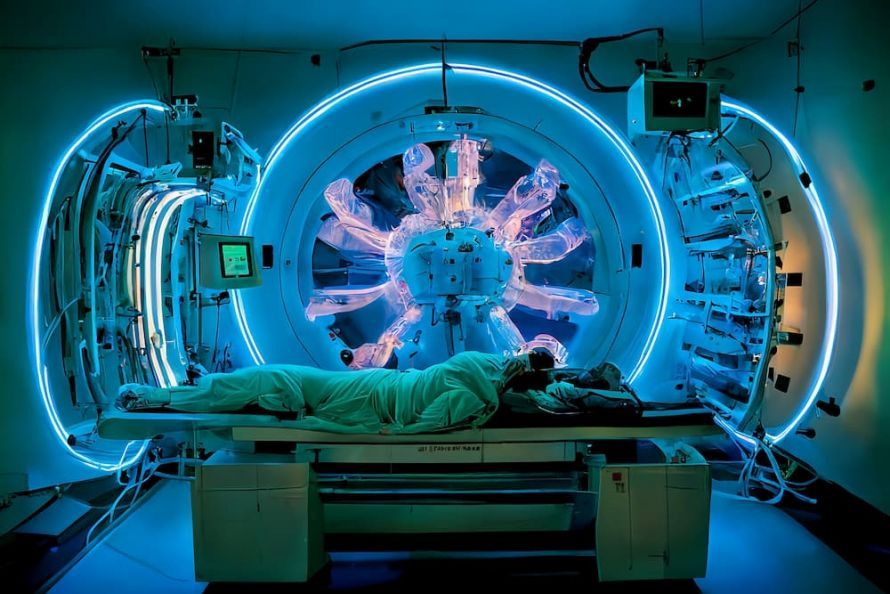 Proton therapy is a modern form of radiation therapy that can be precisely targeted at the tumor @ Thomas /AdobeStock
For which tumors is proton therapy used?
Proton therapy is used when a tumor is located in a radiation-sensitive organ or in a sensitive area of the body.
These include:
- Non-small cell lung cancer
- Brain tumors
- Head and neck tumors
- Inoperable liver and pancreatic cancers
- Prostate cancer
- Metastases,
- Sarcomas
- Eye tumors (retinoblastoma)
Worldwide, approximately 200,000 cancer patients had received proton therapy by 2019. The trend continues to rise.
Proton therapy centers in Germany
There are currently 5 major proton therapy centers in Germany. Thanks to these 5 active centers and their proton therapy specialists, care tailored to patient needs is largely ensured in the north, south, east, and west.
Proton therapy centers in Germany:
- West German Proton Therapy Center, Essen
- Heidelberg Ion Beam Therapy Center
- Marburg Ion Beam Therapy Center (MIT)
- University Proton Therapy Center Dresden
- For eye tumors: Berlin Proton Center at Charité

Sources
der-niedergelassene-arzt.de/medizin/kategorie/urologie-1/neues-verfahren-erhoeht-praezision-der-protonentherapie
flexikon.doccheck.com/de/Protonentherapie