Strabismus surgery is a common procedure in ophthalmology used to correct misalignment of the eyes. In strabismus, also known as a squint, the two eyes are not aligned, which can lead to double vision and vision problems. Strabismus surgery aims to adjust the eye muscles so that both eyes work together properly again.
The procedure may be necessary in both childhood and adulthood. In many cases, the surgery is performed on an outpatient basis at a specialized eye clinic. Depending on the severity of the strabismus, surgical correction can improve both visual function and cosmetic appearance. Early diagnosis by an ophthalmologist is important to prevent long-term visual impairment.
Background Information on Strabismus Surgery
Strabismus can cause emotional distress in those affected. For this reason, doctors often recommend strabismus surgery for such patients.
Surgery is an option when the angle of the squint is so large that comfortable vision with both eyes is not possible, or when prescription glasses and occlusion therapy are insufficient.
Latent strabismus, which involves a slight misalignment of the eyes, can be compensated for by the brain. However, many children require strabismus surgery. Doctors typically wait until the child consistently wears glasses and can see equally well with both eyes. If children develop strabismus later in life, doctors will quickly proceed with strabismus surgery.
Strabismus that has existed since childhood but is not noticed until adulthood is almost impossible to correct.
In such cases, strabismus surgery serves only cosmetic purposes. Paralytic strabismus is relatively rare in childhood. Here, too, doctors often recommend strabismus surgery after determining the causes.
Pre-operative Examinations and Preparation for Strabismus Surgery
Before strabismus surgery, the doctor measures the degree of the squint angle in various directions. The doctor also analyzes the mobility of the eyes and the ability to see with both eyes.
The prism test determines which eye requires surgery and how the eye muscles need to be strengthened or weakened.
If the patient is receiving general anesthesia, they should not eat any meals or consume cloudy liquids for six hours beforehand. They should also avoid drinking clear liquids for two hours before the anesthesia.
Furthermore, the patient should not smoke on the day of the strabismus surgery and, if possible, should avoid taking any medications. In any case, the patient should discuss medication use on the day of the strabismus surgery with the anesthesiologist.
Goals and Procedure of the Surgery
The goal of any strabismus surgery is to adjust the position of the eyeball so that double vision no longer occurs. The cosmetic issue of the eyes appearing misaligned should also be resolved afterward.
Doctors achieve this through surgical corrections to the external eye muscles. Each eye has six muscles on the sides of the eyeball that control its movement in different directions. During strabismus surgery, the surgeon attempts to align the eyes parallel to each other by repositioning or shortening certain muscles.
However, it is not possible to reposition the muscles indefinitely, so it is sometimes necessary to perform multiple procedures. Strabismus surgery may also be necessary on the healthy eye to ensure that both eyes are properly aligned.
 The outer muscles of the left eye
During the operation, the surgeon opens the conjunctiva to gain access to the outer surface of the eyeball, where the eye muscles are located. The surgeon then shortens or reposition the muscles, depending on the type of strabismus, to restore balance.
Strabismus surgery corrects only the misalignment of the eyes, not the visual impairment. Furthermore, strabismus surgery does not always improve depth perception. Some patients may need to undergo strabismus surgery again if the results are unsatisfactory.
In children, strabismus surgery is usually performed under general anesthesia. In adults, local anesthesia is sufficient. The procedure is performed on the outer surface of the eye; therefore, it is not necessary to remove or open the eye.
After Strabismus Surgery
After strabismus surgery, the patient remains under medical observation for some time, even in the case of outpatient strabismus surgery. As soon as the doctor gives the go-ahead and the patient feels well enough, they may go home.
Driving on the day of strabismus surgery is generally not recommended. The patient should arrange to be picked up by friends or acquaintances. If this is not possible, they can also take a taxi home. For the recovery period, the ophthalmologist will prescribe eye drops and ointments, which the patient should use exactly as directed.
After strabismus surgery, the eye is usually slightly red and may feel a little scratchy. The scratchy sensation may be caused by the conjunctival sutures. In some cases, double vision may occur after strabismus surgery, but this usually lasts only a few days.
The patient remains on sick leave for at least two weeks following strabismus surgery. He should avoid strenuous physical activity or sports during the initial recovery period. The patient should refrain from visiting swimming pools or saunas for at least one week.
Prospects for Success and Risks of Strabismus Surgery
Strabismus surgery can correct misalignment of the eye muscles and improve the cosmetic issue. In certain cases, binocular depth perception may even be restored.
Strabismus surgery generally poses a low risk to vision. Complications such as postoperative bleeding and inflammation are rare. The doctor should explain these risks to the patient prior to the surgery.
However, strabismus surgery is not entirely risk-free. A combination of unfortunate circumstances can result in serious health complications:
- In the worst-case scenario, this can lead to loss of vision or blindness in the affected eye.
- Furthermore, bruising may occur
- and injuries to the eyeball or surrounding eye structures are possible.
- In very rare cases, strabismus surgery can result in permanent vision loss.
- The surgery may overcorrect or undercorrect the strabismus, meaning the patient may continue to experience double vision. Fortunately, such complications are extremely rare.
- For up to two days after strabismus surgery, pain may occur when moving the eyes; this can be treated with pain medication.
Further medical treatment is necessary after strabismus surgery. The patient will still need to wear glasses. Although strabismus surgery usually proceeds without problems, the treating physician should first determine whether the surgery is necessary.
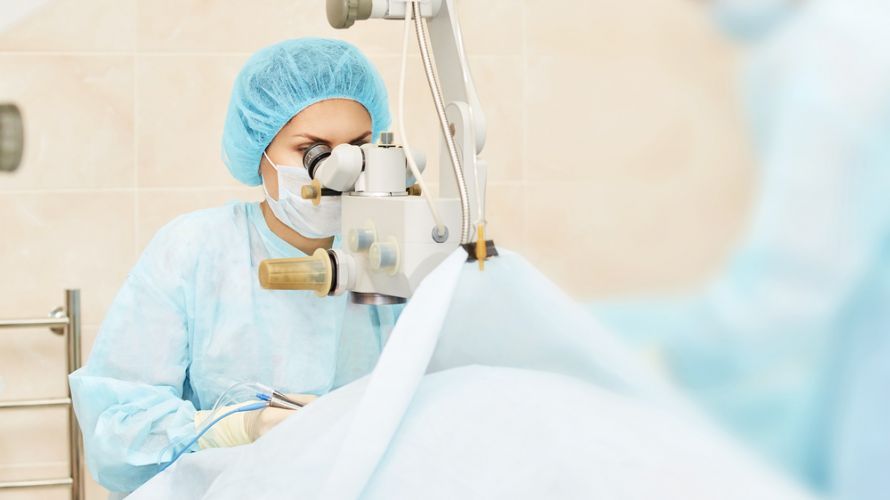 During strabismus surgery, the eye does not need to be removed or cut open @ elenavolf /AdobeStock
Alternative Treatments to Strabismus Surgery for Adults
The appropriate treatment for strabismus depends on the specific form of the condition. Strabismus surgery is never entirely without risk.
One treatment option—though its effects are not long-lasting—is therapy with the neurotoxin botulinum toxin. Medications containing botulinum toxin are suitable for paralytic strabismus. However, the patient must repeat the treatment at regular intervals.
Botulinum toxin can cause facial muscle weakness, but these symptoms are temporary and disappear after a few months. Botulinum toxin should not be used in children, as doctors inject it directly into the eye muscles.
FAQ
What happens during strabismus surgery?
During strabismus surgery, the eye muscles are surgically adjusted. A muscle may be repositioned or shortened to correct the misalignment of the eyes and improve binocular vision.
Is strabismus surgery performed under general anesthesia?
Strabismus surgery is often performed under general anesthesia in children. In adults, the procedure may also be performed under local anesthesia, depending on the situation.
Is strabismus surgery painful?
During the surgery itself, the patient feels no pain due to the anesthesia. After the procedure, the eye may be red, and there may be a slight sensation of a foreign body in the eye, but this usually subsides quickly.
When is strabismus surgery recommended?
Strabismus surgery is recommended when double vision occurs, vision is impaired, or there is a significant misalignment of the eyes. Cosmetic reasons may also play a role.
How long does recovery take after strabismus surgery?
Recovery is usually quick. The alignment of the eyes begins to improve just a few days after the surgery. The final result is visible after a few weeks.