The medical term “strabismus” is commonly understood to mean “crossed eyes.” It refers to an imbalance in the eye muscles. A characteristic feature is a misalignment of the eyes, in which the visual axes no longer point in the same direction. One eye may deviate inward, outward, or upward, causing a visible squint. Depending on its severity, strabismus affects not only a person’s appearance but also their vision and the coordination between both eyes.
What is strabismus?
Normally, both eyes are aligned so that they focus on the same point. When looking at distant objects, the visual axes run parallel; when looking at nearby objects, both eyes converge evenly inward.
In strabismus, this coordination is disrupted. One eye deviates while the other maintains a more precise focus on the target. This deviation can be minimal or clearly visible.
The spectrum ranges from barely noticeable microstrabismus to a pronounced squint. In some cases, only one eye is affected; in others, the condition alternates between both eyes. Unilateral strabismus is particularly significant because, over time, the brain may suppress the image from the affected eye. If the deviating eye is not used sufficiently over the long term, there is a risk of amblyopia and reduced visual acuity.
For those affected, it is not only the position of the eyes that matters, but also their function. Stable depth perception is only possible when both eyes work together. If the eyes are misaligned for an extended period, this coordination is disrupted.
What types of strabismus are there?
Medical professionals classify the various forms of strabismus according to different criteria:
Types of Strabismus
When it comes to strabismus, doctors first distinguish between two types:
- Primary strabismus: occurs without any other eye condition.
- Secondary strabismus: the strabismus is caused by another condition.
The clinical presentation serves as an additional criterion for distinguishing between the two types.
- In manifest strabismus (overt strabismus), the lines of sight of both eyes constantly diverge from one another.
- In latent strabismus (heterophoria), the condition is often merely a symptom of eye strain.
Latent strabismus (heterophoria) is the most common form. This misalignment usually goes untreated, as it often occurs only when the eye is under strain. In most cases, however, the brain is still able to compensate for the slight misalignment. Only ten percent of those affected by latent strabismus experience impairments.
Concomitant strabismus and paralytic strabismus, on the other hand, require medical treatment. Concomitant strabismus often appears as early as infancy or childhood.
In so-called paralytic strabismus, there is paralysis of the eye muscles, usually caused by a previous inflammation or injury.
Direction of the Strabismus
Doctors distinguish between:
- Inward-turning strabismus (convergent strabismus or esotropia), in which one eye turns toward the nose
- Outward-turning strabismus (strabismus divergens or exotropia)
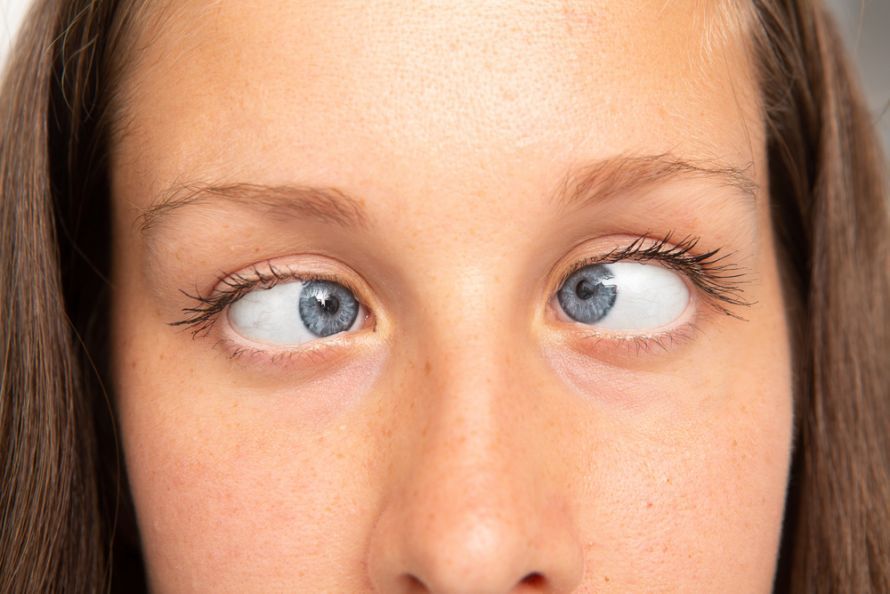 Inward-turning strabismus @ Alessandro Grandini /AdobeStock
In addition to the common horizontal deviations of the visual axes, there are also vertical deviations. The umbrella term for this form is vertical strabismus. If the right eye is higher than the left, doctors refer to it as hypertropia. If the left eye is higher than the right, it is called hypotropia.
With the help of strabismus therapy, patients can often regain normal eye alignment. This is necessary to merge the visual input from both eyes into a single image (fusion). Fusion is what makes stereoscopic vision possible. Affected individuals, however, often see double images.
Toddlers with strabismus often suppress stereoscopic vision by using only one eye. In these cases, strabismus can lead to the development of additional visual impairments.
That is why it is important to check for strabismus in infants and toddlers so that treatment can be initiated as early as possible.
Prevalence of Strabismus
Causes of Strabismus
The cause of strabismus is not always clear. Overall, there are many causes. Often, there is an imbalance in the eye muscles; as a result, both eyes can no longer be steadily focused on the same target, and one eye begins to deviate. In cases of concomitant strabismus, there is often a genetic predisposition. Additionally, refractive errors are frequently present, particularly nearsightedness or farsightedness.
This condition can cause one eye to turn inward, making it appear to squint permanently. This combination is medically significant, particularly in cases of strabismus in early childhood.
In latent strabismus, the balance of the eye muscles is disrupted, but the imbalance is initially compensated for. Under stress, this compensation is no longer sufficient, and the strabismus becomes temporarily apparent.
Paralytic strabismus usually has other underlying causes. These include inflammation, vascular diseases, injuries, neurological conditions, and, in rare cases, a tumor. The affected eye may suddenly appear to be significantly crossed. In such cases, it is often a serious condition that requires prompt evaluation.
Symptoms of Strabismus
A characteristic feature of strabismus is the misalignment of the eyes. As a result, the eyes look in different directions, leading to the typical squint.
The cause is usually that one of the two eye axes deviates from the normal position (parallel alignment). Most commonly, the eyes turn inward or outward.
Strabismus is often accompanied by other symptoms:
- Burning or trembling eyes
- Difficulty concentrating
- Increased sensitivity to light
- Headaches
- Tilting the head
- Blinking or squinting
- Difficulty reading
- Clumsiness when reaching for objects
If these signs appear unexpectedly, they may also indicate the development of strabismus.
The various symptoms of strabismus also depend on the specific type of strabismus:
Heterophoria (latent strabismus)
Heterophoria, or latent strabismus, occurs when the eye muscles are not in balance with one another. However, the brain can compensate for this and ensures that the two visual impressions merge.
As a result, the squint is often not noticeable. The squint only becomes apparent when triggered by unfavorable factors such as fatigue, stress, alcohol, psychological strain, or a general illness.
About ten percent of those affected experience accompanying symptoms:
- Headaches
- Rapid fatigue
- Blurred vision
- Double vision
Concomitant strabismus
In concomitant strabismus, the affected person is unable to compensate for the imbalance in the eye muscles on their own.
The visual axes of both eyes do not automatically align with the same object. The difference in viewing angle persists even when the eyes move.
However, the deviation may be so slight that no visible symptoms appear at first and the typical squint is absent. As a result, doctors sometimes recognize concomitant strabismus only late or not at all.
Concomitant strabismus is often accompanied by mild farsightedness. If the squint occurs in only one eye, that eye may also suffer from reduced visual acuity (medically known as amblyopia).
In this form, the affected person may also tilt their head to one side or experience eye tremors.
Paralytic strabismus
In this form of strabismus, one or more of the outer eye muscles of one eye fail to function properly. The angle of the squint changes depending on the direction of gaze. Because the squint develops suddenly, the affected person usually notices the symptoms immediately.
A typical symptom of this form of strabismus is the perception of double vision. Most often, this occurs in the direction toward which the eye would normally look if the muscle were intact. The strabismus is often accompanied by symptoms ranging from dizziness to nausea. To compensate for the double vision, many people tilt their head to one side (compensatory head tilt).
Progression of Strabismus
Diagnosis of Strabismus
Treatment of Strabismus
In cases of strabismus in children or infants that doctors detect early, conservative treatment is usually sufficient. Children are often spared the need for surgery.
Conservative Treatment for Children
Typically, the treating physician prescribes glasses and eye exercises.
As part of fusion training, children learn to merge double images.
Doctors use occlusion therapy to treat early-stage visual impairment. In occlusion therapy, both eyes are alternately covered with a patch. The patch remains on the eye for a certain period of time. This approach forces the weaker eye to work harder.
With this form of therapy, children are able to learn to see clearly and outgrow their strabismus. Children with strabismus-related visual impairment typically remain in treatment until around the age of twelve.
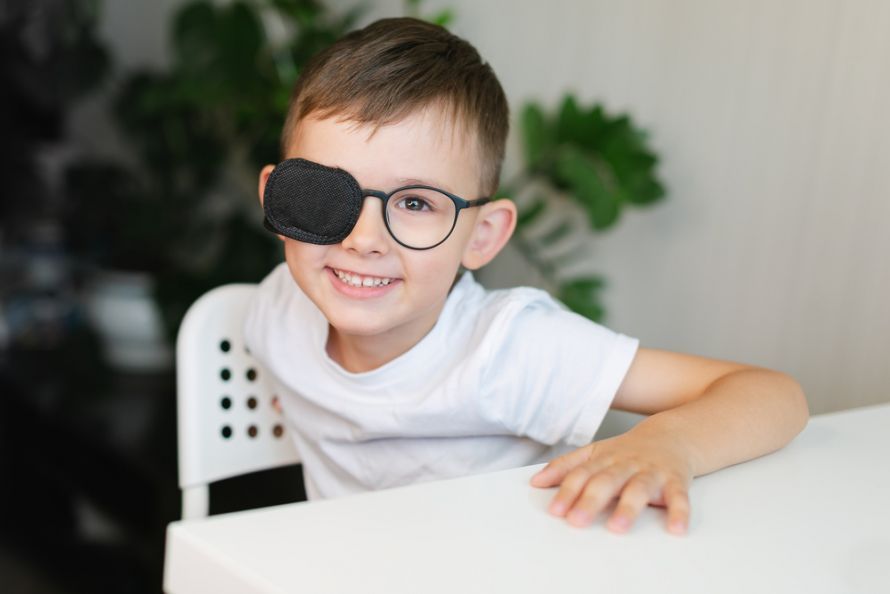 Occlusion therapy for strabismus @ kucheruk /AdobeStock
Conservative Treatment for Adults
Adults who suffer from concomitant strabismus also receive therapy that prevents stereoscopic vision and restores full visual acuity.
If the patient sees double, they are often prescribed prism glasses. These have a matte film on one lens. This helps alter the angle at which light rays enter the eye and prevents stereoscopic vision.
Adults are also frequently given fusion training. This form of therapy can help normalize eye alignment so that the strabismus is no longer noticeable.
In the case of paralytic strabismus, however, doctors must treat the underlying cause of the eye paralysis.
In rare cases, the paralysis of the eye muscles may resolve on its own without treatment. The problem with this form is that the actual trigger often cannot be diagnosed.
This complicates treatment, which is usually based on the underlying cause. Sometimes the squint persists despite treatment. In such cases, the patient is prescribed prism lenses to correct the double vision.
If the strabismus persists for more than six months despite treatment, doctors recommend surgery.
Eye Surgery: Treating Strabismus in Children
If conservative treatment is insufficient, surgery is necessary to realign the eyes. Surgery may also be performed for cosmetic reasons or to alleviate psychological distress. The procedure is usually performed under general anesthesia in children; in adults, local anesthesia is often sufficient.
During strabismus surgery, the surgeon adjusts the mechanics, mobility, and position of the eyes. While this can correct the squint, a relapse is still possible.
Prevention
There is no direct way to prevent strabismus. However, it is important to take early signs seriously right away. Parents should watch for signs such as one eye repeatedly turning in, the child tilting their head, or having difficulty focusing on objects. It is also crucial to identify and treat these conditions early. Regular checkups and thorough evaluation by an ophthalmologist help prevent long-term complications. This reduces the risk of amblyopia, visual impairment, reduced visual acuity, and permanent strabismus.
Frequently Asked Questions
What is strabismus?
Strabismus is the medical term for a squint. It refers to a misalignment of the eyes such that both eyes are not precisely focused on the same point.
Is strabismus dangerous in children?
Strabismus in children should always be taken seriously. If one eye remains turned for an extended period, amblyopia with reduced visual acuity may develop.
Can latent strabismus cause symptoms?
Yes, latent strabismus can cause headaches, fatigue, blurred vision, and occasional double vision, especially during periods of strain.
When should you see an ophthalmologist?
It’s a good idea to make an appointment with an ophthalmologist as soon as one eye appears to be visibly turning in, the child is holding their head in an unusual way, or double vision suddenly occurs.
How is strabismus treated?
Treatment for strabismus may include glasses, occlusion, vision therapy, and, if necessary, surgery. The appropriate treatment depends on the cause and the child’s age.
Can untreated strabismus lead to complications?
Untreated strabismus can lead to reduced visual acuity and impaired binocular vision, especially in childhood.
Share this article