A wisdom tooth operation involves the surgical removal of a back tooth that is causing discomfort or, according to a dental assessment, requires treatment. The procedure is usually carried out on an outpatient basis under local anaesthetic.
If the tooth is still in the jaw, the gum is incised and the tooth exposed. Pain and swelling may occur after the operation. The ability to open the mouth may also be temporarily restricted.
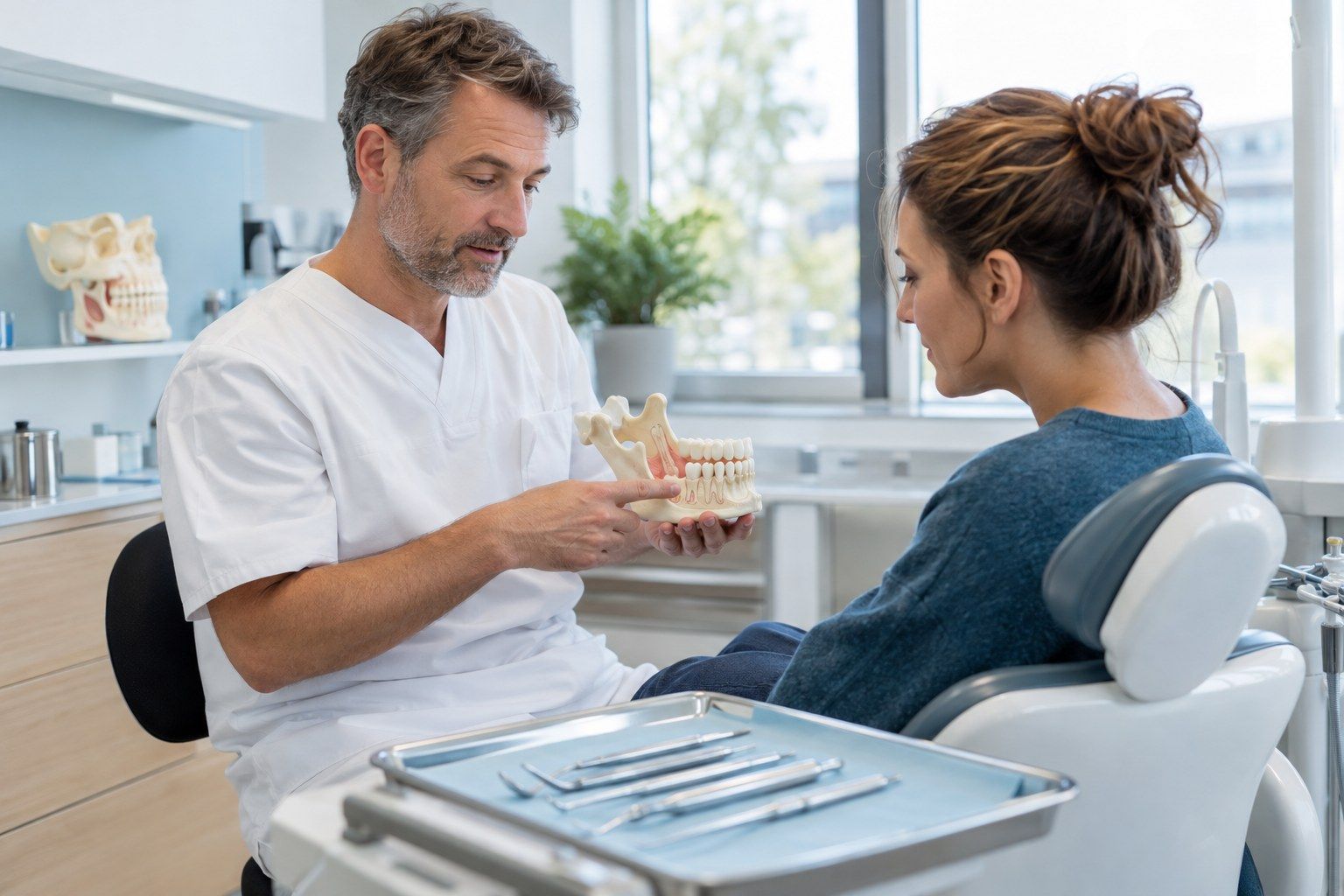
Image generated by AI
What is wisdom tooth surgery?
In the permanent set of teeth, each wisdom tooth is the rearmost molar in a row of teeth. It may be located in the upper or lower jaw. Not everyone has wisdom teeth. Any wisdom teeth present may only erupt partially or not at all.
In wisdom tooth surgery, such a tooth is surgically removed. This distinguishes it from the simple extraction of a tooth that is already accessible. If the wisdom tooth is still embedded in the jawbone, the dentist must first create access to it.
The procedure is a form of dental surgery. This also encompasses other procedures involving teeth and the surrounding tissue. This section focuses on the removal of wisdom teeth.
When do wisdom teeth need to be removed?
Wisdom tooth surgery may be considered if a dental examination reveals that removal is necessary. The diagnosis and the individual situation of the tooth are decisive factors. The tooth’s position alone does not determine whether wisdom teeth should be extracted.
The decision is more difficult in the case of a symptom-free, healthy tooth that has not yet erupted. Whether its preventive removal is more beneficial in the long term than leaving it in place cannot be determined with certainty on the basis of studies to date.
The dentist assesses the specific findings and the expected benefits. Personal risk is also taken into account in the decision. Pain or other abnormalities may prompt an examination, but they do not replace a dental diagnosis.
How do you prepare for wisdom tooth surgery?
Before the procedure, the treating dentist will need full details of your health. Please also mention any over-the-counter medicines and any medicines you take only occasionally.
- Pre-existing conditions: state any existing physical conditions
- Allergies: list any known reactions to medicines or other substances
- Blood clotting disorders: disclose any existing disorders
- Medicines: list all medicines, including blood thinners
This information is required prior to an operation. The oral and maxillofacial surgeon will discuss with you in advance which type of anaesthesia is suitable.
Usually, a local anaesthetic – that is, anaesthesia of the surgical area – is sufficient. General anaesthesia is not the standard procedure. Whether it is medically appropriate in individual cases depends on your personal situation and will be clarified before the procedure.
How is the removal of wisdom teeth carried out?
The surgical removal of wisdom teeth is usually carried out on an outpatient basis. If a tooth is still embedded in the jaw, it is exposed by cutting through the gum and the surrounding bone.
- Anaesthesia: The surgical area is usually numbed with a local anaesthetic.
- Access: The dentist makes an incision in the gum over the tooth.
- Exposure: The tooth embedded in the jaw is exposed within the bone.
- Removal: The wisdom tooth is then removed from the jaw.
The local anaesthetic is intended to ensure that the procedure in the surgical area is pain-free. Dental treatment under general anaesthesia differs from this standard procedure.
How long do the operation and wound healing take?
The duration of a wisdom tooth operation depends on the position of the tooth and the extent of the procedure. The German Society for Oral and Maxillofacial Surgery estimates around 15 to 30 minutes per wisdom tooth. If several teeth are being extracted, it is not possible to give a general estimate of the total duration.
The procedure is usually carried out on an outpatient basis. An inpatient stay is not required. According to the professional association, wound healing takes about a week. How long you need to take it easy depends on the extent of the operation.
After the operation, you may experience swelling and limited mouth opening.
Specific guidelines on eating and drinking – including what you may eat and how you should chew in the first few days after the operation – will depend on your individual recovery. The same applies to brushing your teeth, physical activity and taking painkillers. Please follow the instructions provided by the dental practice carrying out the operation.
What complications are possible?
Temporary discomfort following the extraction is not automatically a complication. Pain and swelling may occur as a reaction to the procedure. A restricted range of mouth opening is also possible.
- Pain: Discomfort at the surgical site
- Swelling: a reaction of the tissue following the procedure
- Limited mouth opening: temporary difficulty in opening the mouth
- Sensory disturbance: a potential long-term problem following nerve damage
Up to 1 in 100 people treated may experience long-term problems. These include sensory disturbances and damage to neighbouring teeth. The individual risk depends, amongst other things, on the position of the tooth in relation to the mandibular nerve.
The aim of the operation is to remove a tooth that has been identified as problematic. No general success rate is given. In the case of a symptom-free, healthy wisdom tooth that has not erupted, it remains unclear whether preventive surgery offers more long-term benefit than leaving the tooth in place.
What alternatives are there to complete removal?
Depending on the findings, leaving the tooth in place or performing a coronectomy may be alternatives to the complete removal of a wisdom tooth. In a coronectomy, only the crown of the tooth is removed. The root remains in the jaw.
The options vary depending on the initial situation and the expected risk.
| Procedure | Who is it suitable for? | Advantages and limitations |
|---|---|---|
| Complete removal | In the event of a finding requiring treatment following a dental diagnosis | The tooth is completely removed; permanent loss of sensation or damage to neighbouring teeth is possible. |
| Coronectomy | In the case of an impacted lower wisdom tooth, particularly where there is a high risk to the inferior alveolar nerve | The crown is removed. In a review, the risk of nerve injury was lower than following complete extraction. |
| Leaving the tooth in place | In the case of a symptom-free, healthy and unerupted tooth | Surgery is not required for the time being. Studies do not allow us to determine with certainty which option is better in the long term. |
What does the health insurance cover?
If a tooth is not worth preserving, statutory health insurance will cover its extraction as part of dental treatment. In the case of additional or requested services, you should establish before treatment what proportion you will have to pay privately.
There is no standard price list for additional medical services that must be paid for privately. It is therefore not possible to quote a standard total price for wisdom tooth surgery. If health insurance does not cover the treatment, the dental practice must estimate the expected private costs as accurately as possible in advance.
Ask for a written cost estimate and an invoice after the treatment. A dental cost estimate is not a price guarantee. The invoice may deviate from it by up to 20 per cent only in justified cases.
Those with private insurance should discuss the cost estimate with their insurer in advance. You will usually pay for dental treatment yourself initially and then submit the invoice for reimbursement.
Elective general anaesthesia for children that is not medically necessary is a special case: parents must pay for this themselves. If general anaesthesia is medically necessary, the health insurance provider will cover the costs.
Which doctors perform wisdom tooth surgery?
Wisdom teeth are removed by specialists in oral and maxillofacial surgery. Dentists who have undertaken further training in oral surgery are also qualified to perform operations on teeth and the surrounding jaw area.
A reputable practice will explain clearly why the operation is recommended and which type of anaesthesia is suitable. Your personal risk should also be discussed during the consultation. For private treatment, a breakdown of costs should be provided before treatment begins.
You can ask the following questions during your initial consultation:
- Why does this wisdom tooth need to be removed?
- Can a tooth that is not causing any problems be left in the jaw?
- Is a local anaesthetic sufficient?
- How close is the tooth to the mandibular nerve?
- Is a coronectomy a viable alternative?
You can find specialists in wisdom tooth surgery at the end of this text.
Frequently asked questions about wisdom tooth surgery
Does everyone have wisdom teeth?
No, not everyone has wisdom teeth. Those that are present may erupt only partially or not at all.
Should a wisdom tooth that is not causing any problems be removed as a precaution?
This cannot be generally recommended. For a healthy, symptom-free wisdom tooth that has not erupted, there is insufficient evidence to support preventive removal rather than leaving it in place.
Do I need a general anaesthetic for wisdom tooth surgery?
Usually not, as the tooth is normally removed under local anaesthetic. The type of anaesthesia best suited to you will be discussed before the procedure.
How long does wisdom tooth surgery take?
The duration depends on the complexity of the procedure. As a rough guide, the professional body estimates around 15 to 30 minutes per tooth.
How long does it take to recover after the operation?
The wound takes about a week to heal. The recovery period required depends on the extent of the procedure.
Is there an alternative if a tooth is close to a nerve?
Yes, a coronectomy may be an option for an impacted lower jaw wisdom tooth. In this procedure, only the crown of the tooth is removed. In a systematic review, this approach was found to reduce the risk of nerve injury where there is a high risk to the inferior alveolar nerve.
What are the long-term risks?
Long-term consequences affect up to 1 in 100 people. Possible complications include sensory disturbances or damage to neighbouring teeth.