
This is not an isolated case. It is a pattern that occurs daily in geriatric diabetes care. Treatment for younger patients that follows guidelines becomes a danger for older patients—because the risk equation is reversed.
As a geriatrician, I’ve learned: With diabetes in older adults, less is often more. Less stringent targets. Fewer medications. Less fear of slightly higher HbA1c levels—more respect for hypoglycemia.
How common is diabetes among older adults?
- Ages 60 to 69: about 15 percent
- Ages 70 to 79: about 20 percent
- Over 80 years old: 25 percent or more
- Nursing homes: up to 30 percent
The prevalence of diabetes increases significantly with age. At the same time, its clinical significance changes: While the focus for younger patients is on preventing complications over the next 10 to 30 years, the current quality of life takes precedence for older patients.
Why Guidelines for Younger Patients Don’t Apply to Older Adults
The UKPDS study established the following principle in the 1990s: Every one percentage point reduction in HbA1c reduces diabetes-related complications by about 25 percent. For a 55-year-old with a life expectancy of 30 years, this is a clear recommendation for strict glycemic control. For an 85-year-old with a life expectancy of 5 years, the calculation looks different:
- Long-term effects take years to manifest: reductions in retinopathy, nephropathy, and neuropathy only become apparent after 10 to 15 years. Many older patients do not have that much time.
- Hypoglycemia has immediate effects: Low blood sugar can lead to falls, delirium, and cardiac arrhythmias within minutes—and increase short-term mortality.
- Symptoms of hypoglycemia are atypical in older adults: Sweating, trembling, and palpitations—the classic warning signs—are often less pronounced in older people. Hypoglycemia manifests as confusion, a fall, or impaired consciousness.
- Long-term cognitive consequences: Severe hypoglycemia accelerates cognitive decline and increases the risk of dementia in older adults.
- Autonomic neuropathy: Exacerbates the problem—the body’s own warning system for hypoglycemia is absent.
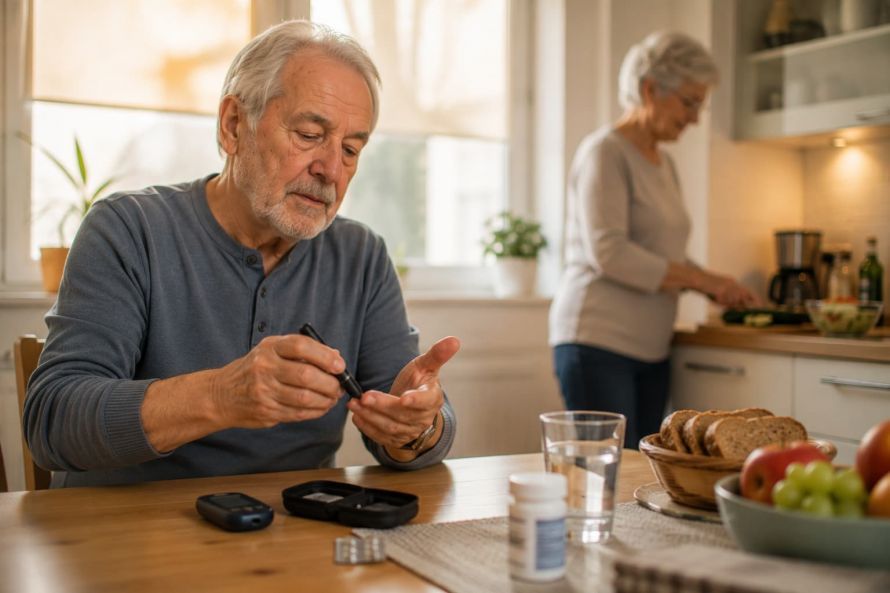
Individual Blood Glucose Targets: The FORTA Principle
International guidelines have evolved in recent years. Today, a stratified approach based on overall health status is recommended:
- Robust, good life expectancy, low comorbidity: HbA1c target 6.5 to 7.0 percent
- Moderately frail, multiple comorbidities: HbA1c target 7.0 to 7.5 percent
- Frail, limited life expectancy, dementia: HbA1c target 7.5 to 8.5 percent; avoiding hypoglycemia is a priority
The principle: The more challenging the baseline situation, the more lenient the target. Not because diabetes is any less important—but because the harm caused by an overly strict target outweighs the benefits.
→ For the frailty assessment underlying this classification: Frailty syndrome.
Choosing Medications—What’s Appropriate in Old Age?
Suitable to well-suited
- Metformin: The classic first-line therapy. Safe and effective as long as eGFR is above 30 ml/min. Low risk of hypoglycemia.
- SGLT2 inhibitors (dapagliflozin, empagliflozin, canagliflozin): Approved for diabetes, heart failure in older adults, and chronic kidney disease. Strong cardioprotective and nephroprotective effects. Use with caution in cases of dehydration, urogenital infections, and risk of diabetic ketoacidosis.
- GLP-1 agonists (semaglutide, dulaglutide, liraglutide): Weekly or daily injection. Cardioprotective, weight-reducing. A good option for older adults who are overweight. Side effects: Nausea, gastrointestinal symptoms.
- DPP-4 inhibitors (sitagliptin, linagliptin, vildagliptin): Well tolerated, low risk of hypoglycemia. Moderate effect.
Use with caution
- Insulin: Often necessary, but dosing requires special caution in older adults. Once-daily basal insulin is safer than complex multiple injections.
- Pioglitazone: Effective, but should be avoided in older adults due to the risk of edema and fractures—and thus an increased risk of osteoporosis in older adults.
To be avoided in frail older adults
- Sulfonylureas (glibenclamide, glimepiride): High risk of hypoglycemia. On the PRISCUS list. Particularly problematic in cases of renal insufficiency.
- Glinides: Similar risk of hypoglycemia.
- Alpha-glucosidase inhibitors (acarbose): Gastrointestinal side effects limit tolerability.
→ For a structured medication review in older adults: Polypharmacy in older adults and deprescribing.
Hypoglycemia—the Underestimated Emergency
Hypoglycemia is the most common and dangerous acute complication of diabetes treatment in older adults. Classic symptoms are often absent. What family members should know:
- Atypical warning signs: sudden confusion, unsteady gait, dizziness, visual disturbances, unusual fatigue.
- Falls as a symptom of hypoglycemia: Not every fall assessment considers this—but it should. More on the consequences: Falls in older adults.
- Nocturnal hypoglycemia: Often goes unnoticed but manifests in the morning as morning confusion, poor sleep, and headaches.
- Acute response: For a conscious patient: fast-acting carbohydrates—dextrose, fruit juice, sugar. For an unconscious patient: call emergency medical services; administer an emergency glucagon injection if available.
???? Whenever an older person with diabetes falls, checking blood sugar should be part of the routine. Unrecognized hypoglycemia is the most common overlooked cause of falls.
→ For investigating falls in older adults: Falls in older adults and fall prevention.
Non-pharmacological pillars — more important than ever
- Nutrition: Not a strict diabetic diet, but a balanced, protein-rich diet—especially important for older patients at risk of sarcopenia and to protect against malnutrition in older adults.
- Exercise: Strength training and aerobic exercise improve insulin sensitivity. They also protect against sarcopenia, falls, and depression in older adults.
- Weight management: A moderate weight reduction is advisable for those who are overweight; avoid weight loss for those of normal weight or slightly underweight—being underweight in old age is a risk factor in its own right.
- Foot care: Diabetic neuropathy combined with frailty results in a high risk for diabetic foot complications. Regular inspections, proper footwear, and referral to a specialist if problems arise.
→ On the independent significance of muscle loss: Sarcopenia.
→ On nutrition in older adults: Malnutrition in older adults.
When should you see a doctor or consult a geriatrician?
- Recurrent hypoglycemia, even mild episodes
- Unexplained falls in patients with existing diabetes — evaluation via frailty screening
- HbA1c below 6.5 percent in a frail patient — a reason to reassess, not a cause for celebration
- Deterioration of kidney function
- New cognitive impairments — possible indications of mild cognitive impairment (MCI)
- Signs of diabetic foot syndrome
- Insulin therapy with uncertainty regarding daily management
→ For a structured overall evaluation: Geriatric Assessment.
Share this article
Sources
- American Diabetes Association (2023): Older Adults: Standards of Care in Diabetes. Diabetes Care.
- German Diabetes Society (DDG): S2k Guideline on the Diagnosis, Therapy and Follow-up of Diabetes Mellitus in Old Age. AWMF Register 057-017.
- Sinclair A, Dunning T, Rodriguez-Mañas L (2015): Diabetes in older people: new insights and remaining challenges. The Lancet Diabetes & Endocrinology.
- Mann NK, Mathes T, Sönnichsen A, et al. (2023): Potentially Inadequate Medications in the Elderly: PRISCUS 2.0. Deutsches Ärzteblatt International.
