What is myelitis?
The term “myelitis” is derived from Greek (“myelos” meaning “marrow”) and describes inflammation of the spinal cord. This inflammation can be limited to a small area or affect large sections of the spinal cord. Anatomically speaking, the spinal cord connects the brain to the peripheral nervous system. Damage at this site prevents information from being transmitted correctly.
A specific and common form is transverse myelitis. In this condition, the entire cross-section of the spinal cord at a specific level becomes inflamed, leading to symptoms similar to those of a spinal cord injury, even though there is no mechanical injury present.
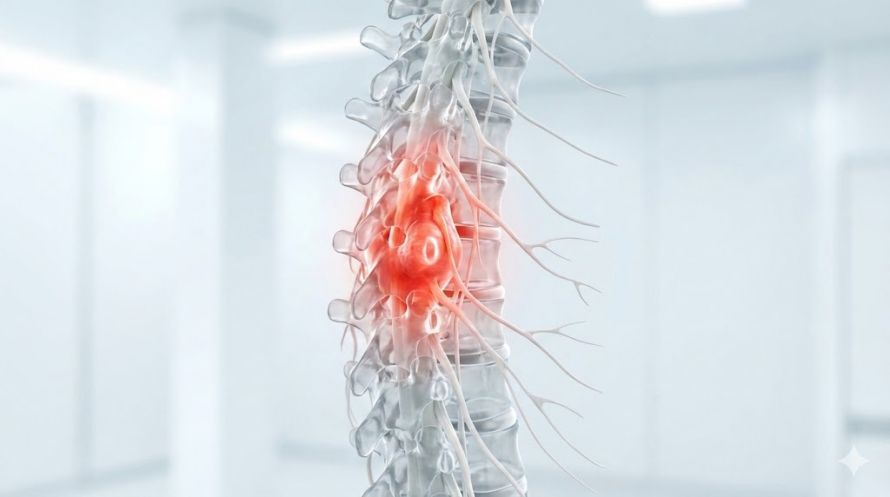
Acute myelitis of the thoracic spine: The reddish swelling and lesion of the spinal cord can interrupt nerve signals, leading to typical symptoms such as paralysis and sensory disturbances.
Causes: How does the inflammation develop?
The triggers of myelitis are complex and are divided into various categories:
- Infectious causes: Viruses, bacteria, or fungi can directly infect the spinal cord or trigger an excessive immune response. Common pathogens include herpesviruses (e.g., varicella-zoster), enteroviruses, the HIV virus, or bacteria such as Borrelia (Lyme disease) and Treponema pallidum (syphilis).
- Autoimmune diseases: In many cases, the immune system mistakenly attacks the body’s own tissue.
- Multiple sclerosis (MS): Myelitis is often the first relapse or a concomitant symptom of MS.
- Neuromyelitis optica (NMO): A rare disease that specifically attacks the optic nerve and the spinal cord.
- Systemic lupus erythematosus: A rheumatic disease that can also affect the nervous system.
- Idiopathic myelitis: In some patients, no specific cause can be identified despite extensive diagnostic testing. It is believed that this is often a post-infectious immune reaction in which a previous, harmless infection has triggered an abnormal immune response.
Symptoms: The Body’s Warning Signs
Symptoms depend heavily on which area of the spinal cord is affected. They can develop within hours or days. The main symptoms include:
- Motor deficits: This often begins with weakness in the legs (paraparesis) and can progress to complete paralysis. If the cervical vertebrae are affected, the arms may also be affected.
- Sensory disturbances: Patients often report numbness, tingling (“pins and needles”), burning, or a feeling as if the torso were tightly constricted (belt-like sensation).
- Autonomic nervous system disorders: Bladder and bowel dysfunction is very common. This can manifest as urinary retention, incontinence, or constipation. Sexual dysfunction is also possible.
- Pain: Many patients suffer from sharp back pain at the site of the inflammation or from nerve pain that radiates into the arms and legs.
Diagnosis: Locating the Site of Inflammation
If myelitis is suspected, prompt action is essential. The neurologist will first conduct a clinical examination to determine the level of the lesion.
The most important diagnostic tool is magnetic resonance imaging (MRI). With the use of contrast dye, areas of inflammation in the spinal cord—and often in the brain as well—can be visualized. This also helps rule out other causes, such as tumors or herniated discs.
A lumbar puncture is almost always performed as a supplementary test. During this procedure, cerebrospinal fluid (CSF) is extracted from the spinal canal. In the laboratory, this fluid is examined for inflammatory cells, protein content, and specific antibodies (oligoclonal bands), which provide clues to MS or infections. Blood tests also help detect specific antibodies (e.g., aquaporin-4 in NMO).
Treatment and Rehabilitation
The treatment of myelitis aims to stop the inflammation as quickly as possible and restore nerve function.
Acute Treatment In the acute phase, especially when there is no infectious cause, the standard treatment is high-dose intravenous corticosteroids (cortisone) administered as a pulse therapy. Cortisone has strong anti-inflammatory and decongestant effects.
If cortisone does not produce a sufficient effect, plasmapheresis (blood purification) or immunoadsorption is often used. These procedures filter harmful antibodies and inflammatory factors out of the blood. If the cause is infectious, antiviral drugs or antibiotics are administered instead.
Rehabilitation After the acute phase, long-term rehabilitation is crucial. Since nerve tissue recovers only slowly, patients need to be patient. Physical therapy helps with paralysis and spasticity, occupational therapy supports the return to daily life, and speech therapy can help with rare swallowing disorders. Medications may also be used to treat neuropathic pain or bladder dysfunction.
FAQ: The 8 Most Important Questions About Myelitis
What is the difference between myelitis and transverse myelitis?
Myelitis is the umbrella term for any inflammation of the spinal cord. Transverse myelitis is a specific form in which the inflammation affects the entire cross-section of the spinal cord at a specific level. This results in impaired functions (motor and sensory) below this level on both sides of the body.
Is myelitis curable?
The prognosis varies. About one-third of patients with idiopathic transverse myelitis make a full recovery. Another third are left with moderate limitations (e.g., unsteady gait, urinary urgency), while the remaining third must live with permanent, severe disabilities. Early treatment significantly improves the chances of recovery.
Can myelitis be contagious?
Myelitis itself is not contagious. It is an inflammatory reaction within the body. However, if myelitis is caused by a virus (such as enteroviruses or polio), the pathogen itself may be contagious, but it does not necessarily lead to myelitis in other people.
How do you distinguish myelitis from multiple sclerosis?
Myelitis is often a symptom or a “relapse” associated with multiple sclerosis (MS). If myelitis occurs only once and no other lesions are found on an MRI of the brain, it is referred to as isolated myelitis. However, if lesions are also found in the brain or if inflammation recurs, a diagnosis of MS is more likely.
How long does a myelitis relapse last?
The acute phase, when inflammation is at its peak, usually lasts a few days to weeks. The recovery phase often begins after 2 to 12 weeks and can last up to two years. The most rapid progress is usually made in the first three to six months after starting treatment.
What long-term effects can occur?
The most common long-term effects include permanent spasticity (muscle stiffness), chronic neuropathic pain, bladder and bowel dysfunction, and sexual dysfunction. Fatigue may also persist.
Can vaccination trigger myelitis?
There are very rare reports of myelitis cases following vaccinations. However, experts believe that the risk of myelitis from the natural infection (against which the vaccine is administered) is far higher than the extremely low risk of a vaccine side effect. In most cases, it is a misdirected immune response.
Which doctor treats myelitis?
The appropriate specialist to consult is a neurologist. In acute cases, you should always go to a hospital with a neurology department. For follow-up care, rehabilitation specialists, physical therapists, and urologists (for bladder problems) are also important.
Share this article