Placenta previa is a condition in which the placenta is abnormally located near the internal os of the cervix. It manifests in three different forms: total placenta previa, partial placenta previa, and marginal placenta previa.
Below you will find further information as well as a selection of specialists in placenta previa.
Background Information on the Placenta
The placenta is a vital organ that supplies growing babies with nutrients inside the uterus.
The embryo is connected to the placenta via the umbilical cord. Another important function of the placenta is the production of the hormones estrogen and progesterone to maintain the pregnancy.
In the placenta, the maternal and fetal circulatory systems are connected via a multilayered filter membrane known as the placental barrier.
This is where precise control takes place over which substances pass into the baby’s bloodstream, for example:
- Oxygen
- Glucose or
- Immune system substances
When fully developed, the placenta weighs about 500 grams and measures approximately 15 to 20 centimeters in diameter. Normally, the placenta is located in the upper part of the uterus.
During pregnancy, the placenta moves upward, clearing the birth canal for the unborn child.
In cases of placental malposition, this upward migration of the placenta does not occur. The placenta remains in the lower part of the uterus. As a result, the natural birth canal may be completely or partially covered.
Placenta previa: When the placenta is malpositioned in the uterus
Placenta previa is a condition in which the placenta is located in the area of the internal os of the cervix (internal cervical opening).
It manifests in three different forms:
- Placenta previa totalis: The placenta completely covers the internal os (ostium uteri internum)
- Partial placenta previa: The internal os is only partially covered by placental tissue
- Marginal placenta previa: The placenta only touches the internal os
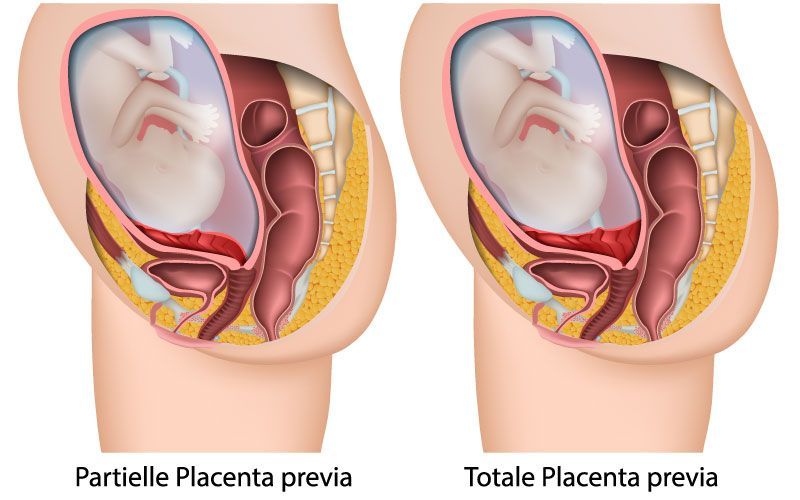
Placental malposition in placenta previa: The natural birth canal is blocked by the low-lying placenta. © bilderzwerg / Adobe Stock
Common to all forms is a placenta that is positioned too low in the internal os. As the uterus continues to grow, the placenta may shift into the uterine body.
If the birth canal remains obstructed by placental tissue, delivery must be performed via cesarean section.
Typical signs of placenta previa
A typical sign—and often the only indication—is sudden, painless, bright-red bleeding from the vagina (vaginal bleeding). This usually occurs starting in the 20th week of pregnancy (second half of pregnancy).
Vaginal bleeding is not necessarily caused by a malpositioned placenta. Placenta previa can only be detected through an ultrasound examination.
Prenatal care also includes two ultrasound examinations, during which doctors can detect placental abnormalities. Therefore, regular prenatal checkups during pregnancy are very important.
Causes, Risks, and Course of Pregnancy
In placenta previa, the blastocyst implants near the cervix. Normally, this should occur on the back or front wall of the uterus.
The blastocyst forms from the fusion of an egg and a sperm cell to create a zygote. This divides several times and travels as a morula (cluster of cells) through the fallopian tube into the uterus.
There, it implants itself as a blastocyst into the uterine lining (endometrium). The causes of this abnormal implantation near the internal os are unknown.
Risk factors that increase the likelihood of placenta previa include:
- Smoking
- Inflammation of the uterine lining (endometritis)
- Advanced maternal age
- Abortions
- Previous cesarean section
- Endometrial scraping (curettage)
If there is no bleeding associated with placenta previa, the pregnancy proceeds without complications. However, there are precautions for cooperative patients.
The following should be avoided:
- Lifting heavy loads
- Sexual intercourse and vaginal manipulation
- Long-distance travel
Diagnostic methods for bleeding and suspected placenta previa
Pregnant women are urged to keep their prenatal checkup appointments and to visit the clinic immediately for evaluation if they experience vaginal bleeding.
Before the 20th week of pregnancy, an examination of the vagina and the external os is performed to locate the source of any bleeding and determine its cause and severity.
Starting in the 20th week of pregnancy, the first and most important method is an ultrasound examination (sonography) of the abdomen and pelvic area.
It provides a visual representation of the placenta’s position and leads to a diagnosis of placenta previa.
For further diagnosis, the doctor may use a transvaginal ultrasound or color Doppler ultrasound (color imaging of blood flow).
Due to the high risk of bleeding, the doctor should not perform a vaginal examination or palpate the cervix.
What treatment options are available?
If vaginal bleeding occurs after the 20th week of pregnancy, clinical, conservative treatment is recommended.
This is performed on an inpatient basis and initially aims to continue the pregnancy until at least the 34th week of pregnancy.
To achieve this, the bleeding must be controllable.
Management includes the administration of:
- corticosteroids to accelerate fetal lung maturation, e.g., betamethasone
- Tocolytics to inhibit uterine contractions and reduce the risk of preterm birth
- Antibiotics to prevent infections
- Transfusions to compensate for blood loss and stabilize the mother’s circulation
If the risk of recurrent bleeding decreases as the pregnancy progresses, reaching the 37th week of gestation is the goal.
In cases of total placenta previa, delivery by cesarean section takes place one to two weeks before the estimated due date.
In the active management of placenta previa, doctors perform a cesarean section regardless of the gestational week.
The specialists responsible for caring for pregnant women with placenta previa are obstetricians and gynecologists.
They are available at the maternal-child and perinatal centers of various hospitals.
In addition to prenatal care, they also specialize in obstetric emergencies.
If you experience bleeding during pregnancy, go to the hospital immediately. Do not hesitate to call emergency services.
How effective are the various treatment methods?
These treatment methods result in a maternal mortality rate of less than one percent.
The infant mortality rate within the first 7 days of life is approximately 3%. This is about three times higher than with a normal placental location.
With very few exceptions, patients with placenta previa undergo a cesarean section.
Summary
All forms of placenta previa share the common feature of a placenta that is positioned too low in the internal os. If the birth canal remains obstructed by placental tissue, delivery must be performed via cesarean section.
A typical symptom—and often the only sign—is sudden, painless, bright-red vaginal bleeding.
If there is no bleeding with placenta previa, the pregnancy proceeds without complications.
Regular prenatal checkups are important for the course of the pregnancy. If you experience vaginal bleeding, you should go to the clinic immediately for evaluation.
The goal of clinical, conservative treatment is to continue the pregnancy until the baby’s lungs are fully developed.
Lung maturity is generally achieved by the end of the 34th week of pregnancy.
In the active management of placenta previa, delivery takes place immediately after the pregnant woman’s circulatory status has been stabilized, regardless of the gestational week.
With very few exceptions, patients with placenta previa undergo a cesarean section.
Share this article

Sources
- https://www.bggf.de/cms/index.php
- https://flexikon.doccheck.com/de/Placenta_praevia
- https://deximed.de/home/b/schwangerschaft-geburtshilfe/patienteninformationen/komplikationen-in-der-schwangerschaft/placenta-praevia/
- Dr. med. Schoppmeyer, Marianne: Lehrbuch für Pflegeberufe. Anatomie und Physiologie. München: Urban & Fischer Verlag/Elsevier, 2017