Expert Interviews
A Trauma Center Par Excellence: An Interview with Prof. Kröber
Claudia Dechamps ·
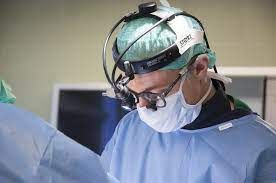
Prof. Dr. med. Markus Kröber, Chief of the Department of Orthopedics, Trauma, and Spine Surgery at Helios Clinic Rottweil, is one of Germany’s leading spine specialists. The specialized clinic he heads at Helios Clinic Rottweil focuses on three main areas: the treatment of spinal deformities, spinal tumor surgery, and trauma care. The clinic’s certified trauma center is part of the Black Forest-Baar Trauma Network and thus plays a major role throughout the region. In an interview with Leading Medicine Guide, Prof. Kröber provides insights into the work of his specialized clinic—and explains what a trauma center actually does.

Leading Medicine Guide: A traffic accident, a sports injury, or a workplace accident—and suddenly you’re being rushed by ambulance or helicopter to a hospital or a specialized trauma center. As the person involved, you’re barely aware of all the processes that are professionally coordinated in that acute situation. What exactly is a certified trauma center?
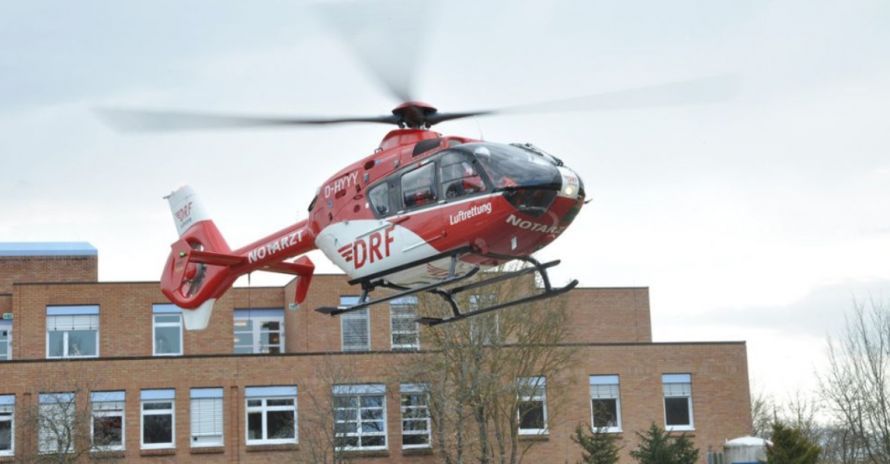
Prof. Dr. med. Markus Kröber: The Helios Clinic Rottweil is part of the Black Forest-Baar Trauma Network within the German Society for Trauma Surgery. We cover a large service area and have proven expertise in treating seriously injured patients. Among other things, our hospital treats patients with complex spinal injuries according to the latest standards. We are regularly certified as a trauma center by the German Society for Trauma Surgery, which attests to our exceptional quality of care. Our clinic has a helipad, so emergency patients can also be transported quickly by air. In the Central Emergency Department, we have a trauma resuscitation room and a CT scanner that is on standby 24 hours a day.
Leading Medicine Guide: The large service area also means long travel distances. Are trauma patients with spinal injuries brought directly to you at the Helios Clinic Rottweil, or do they sometimes take a detour via a smaller, general hospital?
Prof. Dr. med. Markus Kröber: That depends on the situation. Often, the emergency physician on the scene decides right away to transport the patient to Helios Klinik Rottweil. Incidentally, some of our own physicians also respond to emergency calls. Or the patient may first be taken to a hospital that isn’t specialized in spinal injuries, and initial examinations then reveal that they would be better cared for here. Using telemedicine, we doctors exchange information based on X-rays and test results and jointly assess the situation. The Helios Clinic Rottweil invested in these technologies early on; telemedicine makes our work more efficient and easier, especially in our large service area.
Leading Medicine Guide: You and your team are on call 24/7, 365 days a year, to treat critically injured patients. Surely there are often situations that trigger a rush of adrenaline, aren’t there?
Prof. Dr. med. Markus Kröber: Adrenaline, yes—but chaos, no. That’s because we work according to clearly defined, internationally established procedures. Every step is precisely defined, and everything fits together seamlessly. With our highly experienced team, we can quickly assess the overall situation and act accordingly. We’re able to treat all spinal injuries around the clock.
Leading Medicine Guide: A second focus of the Department of Orthopedics, Trauma, and Spinal Surgery at Helios Clinic Rottweil is the treatment of spinal deformities. What does this include?
Prof. Dr. med. Markus Kröber: Spinal deformities primarily include scoliosis and kyphosis. Surgical treatment of these conditions is a major focus of our clinic, and we have patients who come to us from all over for this reason. In medicine, we use the term “scoliosis” to describe lateral curvatures of the spine. We primarily treat scoliosis in adults; these cases either originated in childhood or adolescence and only became clinically significant later in life. Alternatively, they may have developed as a result of wear and tear—in which case it is known as degenerative scoliosis. Trauma, a tumor, inflammation, or osteoporosis can also lead to scoliosis. Unfortunately, we are seeing an increase in cases of scoliosis, which is also colloquially referred to as spinal curvature. Kyphosis is what is commonly known as a hunchback—a convex curvature of the spine. Kyphosis often develops in older age due to vertebral fractures resulting from osteoporosis. Because it primarily affects women, the condition was formerly often referred to as “widow’s hump.”
Leading Medicine Guide: When do scoliosis patients come to see you in Rottweil?
Prof. Dr. med. Markus Kröber: They come to us once they have exhausted all conservative treatment options—that is, when physical therapy and pain management can no longer improve their overall condition. At that point, surgical treatment makes sense and restores quality of life for those affected. If no action is taken, the condition and pain levels will unfortunately continue to worsen.
Leading Medicine Guide: What does the surgical procedure for scoliosis involve?
Prof. Kröber: Spinal surgery requires a great deal of experience, technical skill, state-of-the-art equipment in the operating room, and an experienced, specialized team. After all, we’re dealing with a very delicate surgical area, and precision down to the millimeter is essential. During the procedure, we straighten the spine and stabilize it with a screw-rod system. Patients subsequently experience significantly less pain, walk upright, and enjoy a marked improvement in their quality of life over the long term.
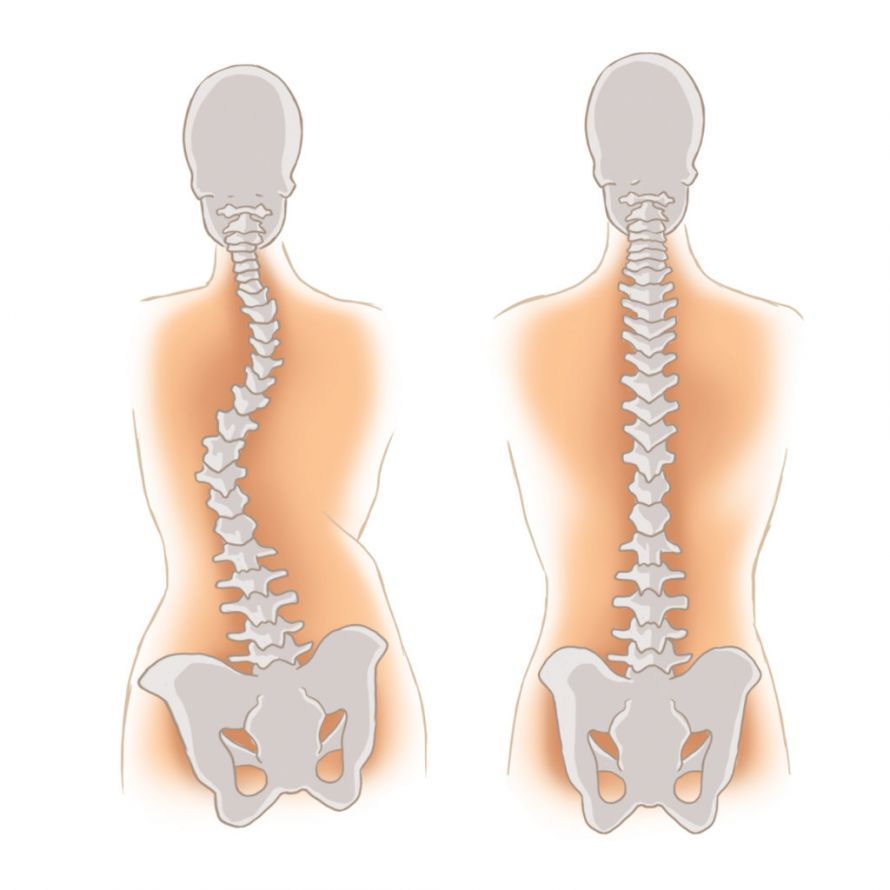
Left: Schematic representation of scoliosis. Right: Healthy spine © Koterka Studio / AdobeStock
Leading Medicine Guide: Do you follow a similar approach for kyphosis?
Prof. Dr. med. Markus Kröber: Here, too, we perform a spinal realignment surgery. The individual segments of the spine are realigned and stabilized like a string of pearls. Sometimes it may also be necessary to build up bone; in such cases, we transplant the patient’s own bone or insert bone substitute material. A bone density test helps determine whether it makes sense to follow up with osteoporosis treatment after the procedure.
Leading Medicine Guide: What does rehabilitation look like after spinal surgery?
Prof. Dr. med. Markus Kröber: It’s somewhat different from, for example, rehabilitation after joint replacement surgery. This is because the healing process is simply different, and bone healing should be complete first. Our patients can get back on their feet after two to three days, and we discharge them home after ten to fourteen days. Once home, however, they should allow themselves about six weeks of rest before beginning rehabilitation. After three weeks of rehabilitation, the process is usually complete, and we then see the patients again for regular follow-up visits.
Leading Medicine Guide: Spinal tumor surgery is the third area of focus at your clinic.
Prof. Dr. med. Markus Kröber: Exactly. Many tumors metastasize to the spine, and we can treat that today—something that wasn’t possible in the past. This allows us to give patients a better quality of life. There are two types of procedures for spinal metastases. One is tumor ablation combined with bone cement injection—a minimally invasive procedure. In this procedure, we insert a probe into the vertebral body and destroy the tumor tissue using high-frequency electrical current waves. We then inject bone cement into the resulting cavity to close it. In the other method, tumor-affected vertebrae are replaced with artificial vertebrae. With the exception of the top two cervical vertebrae, we can replace any vertebra—even up to three at a time. The replacement vertebrae are made of plastic or titanium and are, so to speak, virtually indestructible and capable of withstanding heavy loads.
Leading Medicine Guide: Removing a vertebral body and replacing it with an implant certainly requires complex surgical skill.
Prof. Dr. med. Markus Kröber: Yes, it requires specialized surgical techniques; after all, we are operating in an extremely sensitive area, and the spinal nerves and spinal cord must not be damaged during the procedure. I have also published several articles on this topic in medical journals.
Prof. Dr. med. Markus Kröber, we would like to express our special thanks for your detailed description of your interesting and extremely important work at the Trauma Center of the Helios Clinic in Rottweil. You can contact the specialist directly via his profile page on the Leading Medicine Guide.
Prof. Dr. med. Markus Kröber has earned a reputation among experts through his numerous publications and has consistently set new standards. Here we have compiled a small selection of his most important publications:
- M. Kröber, T. Gühring, F. Unglaub, L. Bernd, D. Sabo. Comparison of surgical and non-surgical approaches for spinal metastases: A retrospective study of 259 patients. Z Orthop. July–August 2004. 142(4):442–448.
- M. Kröber. Surgical Treatment of Spinal Metastases. JATROS Orthopedics and Rheumatology 6/2012. pp. 34–38.
- P. Zwolak, M. Kroeber. Acute neck pain caused by atlantoaxial instability secondary to a pathological fracture involving the odontoid process and C2 vertebral body: treatment with radiofrequency thermoablation, cement augmentation, and odontoid screw fixation. Arch Orthop Trauma Surg (2015) 135:1211–1215 DOI 10.1007/s00402-015-2266-y
- P. Zwolak, M. Kroeber. Management of Metastatic Tumors to the Cervical Spine. J Spine 2015. Vol. 4, Issue 5. pp. 4–5.
- Kröber M. Back Pain Caused by Vertebral Metastases. Orthopress 2016. pp. 6–7.
Share this article
About the medical author
Claudia Dechamps
Editor
Claudia Dechamps – medical author: expert articles, professional insights and medical knowledge in the Leading Medicine Guide.
More about the medical author →HELIOS Clinic Rottweil
ProfileExpert Interviews
Read next
- Expert interview
Cardiogeriatrics: Significance and benefits in the context of hospital reform
Sep 21, 2026
Cardiogeriatrics: Significance and benefits in the context of hospital reform
Read more - Expert interview
Expert Interview with Professor Dr. Amadeus Hornemann, MPH
Sep 18, 2026
Prof. Amadeus Hornemann on Precision Medicine in Gynecology: Modern Surgery, New Techniques, Better Quality of Life
Read more - Expert interview
Expert Interview with Professor Dr. Konstantinos Anagnostakos
Sep 15, 2026
Prof. Anagnostakos on Painful Knee Replacements
Read more