Expert Interviews
An Interview with Prof. Düx: MRgFUS—Pain-Free Treatment with Ultrasound Waves

Sabine Schneider ·
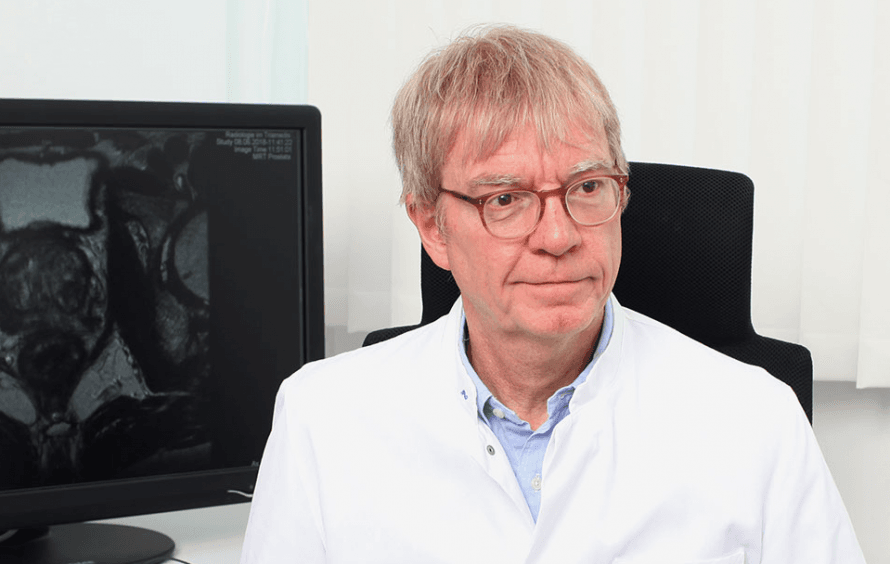
Strength lies in heat: Using a particularly gentle procedure, Prof. Dr. med. Markus Düx is able to successfully treat conditions such as fibroids, bone tumors, or painful facet joint osteoarthritis—without any surgical intervention whatsoever. How does it work? Through a very special and highly innovative ultrasound method: it’s called MRgFUS, and it’s being applied in an exemplary manner in Frankfurt. More specifically: at the MRgFUS Center of Radiology led by Prof. Dr. Markus Düx, with locations in Frankfurt and Königstein im Taunus. When the renowned radiologist Prof. Düx explains it, this forward-looking yet complex method becomes surprisingly easy to understand. And it becomes clear: Here, highly specialized, world-class international medicine is pointing decisively toward a fascinating future.
Instead of Surgery: Gentle Therapy with Heat
Leading Medicine Guide: Professor Düx, what exactly is MRgFUS? How should we picture it?
Prof. Dr. med. Markus Düx: Perhaps I’ll start by saying a few words about the history of highly focused ultrasound. This technology has been used clinically since the early to mid-1990s, for example in urology—purely from a physical standpoint and, of course, without MRI guidance. It has also long been known that magnetic resonance imaging (MRI) can be used to measure temperatures. Combining both methods in a single therapeutic unit, however, is new: High-intensity focused ultrasound generates heat, and MRI measures that heat—to date, there are only two systems capable of doing this. The system we use in the radiology department in Frankfurt is manufactured by Insightec in Israel, a company with decades of experience in advancing highly focused ultrasound into an MRI-guided therapeutic procedure. In 2014, we acquired the so-called Body System in Frankfurt, a unit in which the ultrasound source is integrated into the MRI table. You’re surely familiar with what an MRI looks like; perhaps you’ve even been inside one before...
Leading Medicine Guide: … of course…
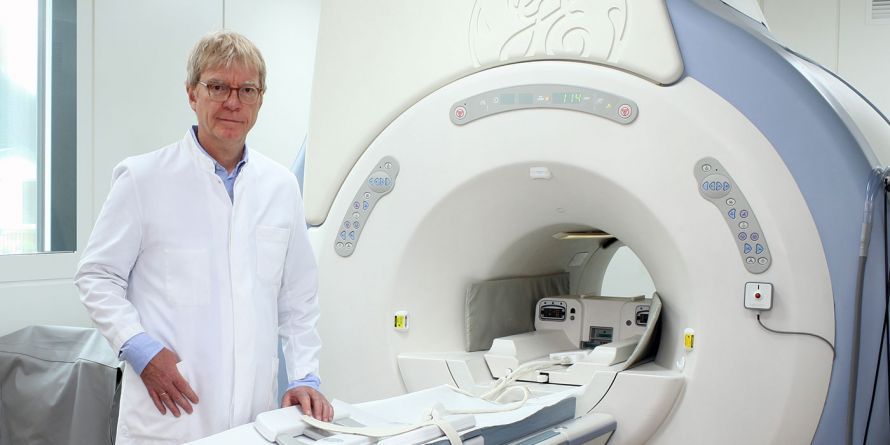
Prof. Dr. med. Markus Düx: The large tunnel that the patient enters—that’s the magnet. The patient is positioned on a table that moves into the magnet. With diagnostic machines, patients enter the tube and are examined. In our therapeutic system, the diagnostic table is disconnected and replaced with a therapy table. The ultrasound source is integrated inside the table—in a water bath, so to speak...
Leading Medicine Guide: A water bath?
Prof. Dr. med. Markus Düx: Yes, the transducer is located inside the table, and the entry surface for the ultrasound is created via a water bath and so-called coupling media—for example, gel pads. A patient who is to be treated in a specific area of the body is “coupled” using positioning aids and degassed water before entering the device, so that the ultrasound is directed precisely into the body. With a standard diagnostic ultrasound, you also have gel applied to your abdomen, for example.
Think of it this way: The ultrasound source looks like a telescopic dish. It’s slightly curved, and several hundred individual ultrasound transducers are mounted on it. They’re all movable within the dish, so the ultrasound waves emitted by the individual transducers can be focused—at a single focal point.
Leading Medicine Guide: So, at a single focal point?
Prof. Dr. med. Markus Düx: Yes, that’s why it’s called focused ultrasound. Strictly speaking, highly focused ultrasound, because technically speaking, we can generate heat of up to one hundred degrees Celsius. So we generate the focused ultrasound and direct it at a target structure. With the help of MRI, which simultaneously captures images of the target region, we can measure the temperature profile: How is the energy distributed? How much energy are we generating in the tissues? Then, depending on the situation, we decide what to do.
Leading Medicine Guide: For example?
Prof. Dr. med. Markus Düx: When it comes to destroying a tumor, we can induce cell death. Or we can stimulate cells to trigger regenerative processes, for example through hyperthermia—that is, overheating. To do this, we very precisely raise the body temperature in specific regions, which can be helpful in cancer therapy, for example. Another current area of research is using MRgFUS to bypass the blood-brain barrier. This allows medications to cross that barrier. This is a major field of research dedicated primarily to the treatment of brain tumors. So far, we in Frankfurt have not used HIFU for basic research; we exclusively perform therapies that are approved and that we then also use to treat diseases. We have a CE mark for this.
Leading Medicine Guide: And in which area do you primarily use MRgFUS?
Prof. Dr. med. Markus Düx: One area of our practice is pain management. For example, we treat back pain by thermally desensitizing painful joint osteoarthritis, using heat to treat the nerves that transmit this pain. This is highly effective. Today, this is still often done with needles, but with that method, it’s possible to accidentally treat the nerve in the wrong place—something that is technically and physically impossible with our system. MRgFUS is fundamentally noninvasive, so patients have no scars and no changes to their skin after treatment. We work at depth, where we focus the ultrasound.
Leading Medicine Guide: What other treatments do you perform?
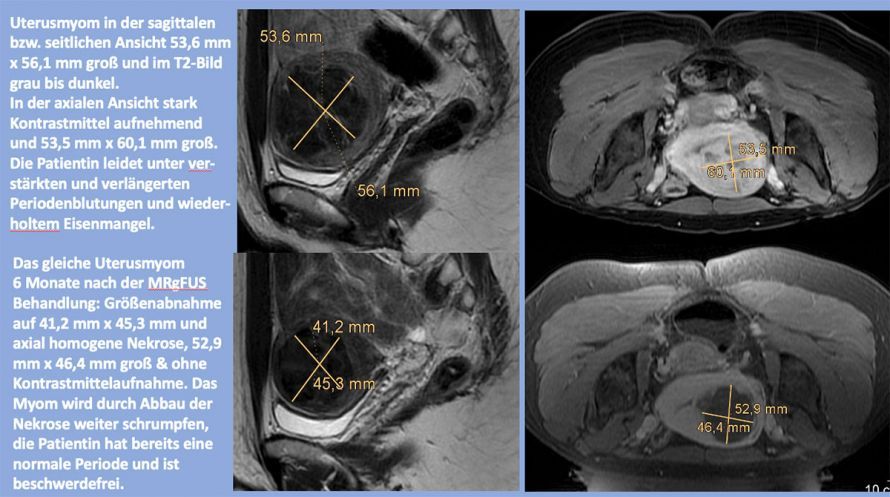
Prof. Dr. med. Markus Düx: We have the ability to treat tumors. One of the longest-established treatment approaches using MRgFUS involves benign fibroids, which are, after all, the most common type of tumor found in women. Of course, fibroids can be treated surgically, but they can also be treated without surgery—namely through thermal ablation, which simply burns away the fibroid.
Leading Medicine Guide: Is it as simple as it sounds?
Prof. Dr. med. Markus Düx: Almost. Because the intestines must not be in the way, the patient lies on her stomach during treatment so that the uterus rests against the abdominal wall. And the fibroid must also meet certain morphological criteria to be treatable. It should not have excessive blood flow, and the MRI images we take for planning must show no signs of malignant disease in the uterus or ovaries. The majority of fibroids we see have a structure that allows us to achieve good results. The goal is to destroy 70 to 80 percent of the fibroid; it then shrinks and is broken down naturally. And the patients’ symptoms subside.
Leading Medicine Guide: And what about the remaining fibroid?
Prof. Dr. med. Markus Düx: We generally treat symptoms as they arise. A fibroid that causes bleeding is largely destroyed. As a result, the woman’s menstrual cycle usually returns to normal. Other patients suffer from pressure-related symptoms such as back pain, urinary incontinence, and digestive problems. After MRgFUS treatment, patients no longer experience fibroid-related symptoms. There is no wound, and we generally treat patients on an outpatient basis. The patient goes home after the procedure—and feels fine. Over the many years that thermal treatment of fibroids using MRgFUS has been performed, tens of thousands of patients worldwide have undergone this treatment. While there aren’t very many centers that perform this therapy, we know a great deal about it. And everyone sees the positive results: First and foremost, it’s a huge success that patients are back on their feet the very next day.
Leading Medicine Guide: Does it really happen that quickly?
Prof. Dr. med. Markus Düx: The treatment takes about three hours. The patient is given a mild sedative or pain medication, so she is barely aware of it—which also makes the treatment period seem shorter to her. Afterward, she rests for another hour or two—and goes home symptom-free. With surgery, even if the procedure is performed laparoscopically, the patient experiences longer-lasting issues—and our patients don’t have that. So they don’t need a recovery period at all. Many are able to go about their daily lives on their own and lose just one day of work.
Leading Medicine Guide: Those are all advantages. So why is this procedure so little known?
Prof. Dr. med. Markus Düx: The G-BA, the Joint Federal Committee, as the highest approval authority for healthcare services in Germany, has designed a pilot study that is currently recruiting patients. We’re testing our procedure in comparison to myomectomy—that is, the surgical removal of fibroids—with the goal of proving that we achieve the same level of effectiveness in symptom control. In conventional surgery, the fibroid is cut out; with MRgFUS, it is ablated. Both methods result in the disappearance of symptoms. But the question is also: Can women return to their daily routines and work more quickly after our treatment?
Leading Medicine Guide: Isn’t that obvious?
Prof. Dr. med. Markus Düx: Based on the data we have, we can unequivocally say yes. But this must always be proven through a study. Ultimately, this clinical trial will also serve as a regulatory trial. If the results turn out as we expect, this method will be approved for coverage by health insurance. Then the public health care system will reimburse these services on an outpatient basis.
Leading Medicine Guide: And until then?
Prof. Dr. med. Markus Düx: If the procedure is approved, that will be a huge step toward integrating MRgFUS into healthcare. Until then, our treatment method is a private service that is covered by many private health insurers—but it is not yet a standard service covered by statutory health insurance. We are accredited as a study center by the organization responsible for conducting and evaluating the study data, and we are authorized to perform MRgFUS treatments for uterine fibroids as part of the study. In this case, the treatment is reimbursed by the health insurance provider.
Leading Medicine Guide: But the benefits are immense, aren’t they?
Prof. Dr. med. Markus Düx: Especially when it comes to fibroids, which affect so many women, our procedure is of great significance in several respects. For one thing, it could drastically reduce the number of hysterectomies—a view shared by some gynecologists, by the way. This also includes the common complications that can result from a hysterectomy—such as pelvic floor problems. If our procedure is approved, it would represent an enormous advance for gynecology. Incidentally, our treatment would also have major economic significance. On the one hand, because the method is more cost-effective than surgery—but also because the recovery period is virtually eliminated, thereby preventing lost work time.
Leading Medicine Guide: And that only addresses the issue of fibroids—but you also treat other conditions.
Prof. Dr. med. Markus Düx: Exactly. In Frankfurt, we also treat bone tumors. Here, too, the primary goal is to alleviate the pain caused by a bone tumor. In most cases, these are advanced tumors that have metastasized. The goal is to relieve the pain! The standard treatment in such cases is radiation therapy, sometimes in combination with chemotherapy. When patients develop new pain after such treatment because the bone tumor is growing again, they come to us. Our treatment has a very rapid and clearly noticeable effect for these suffering patients! Within a few days, our patients notice a marked reduction in tumor-related pain—which also makes sense from an oncological perspective, since these individuals sometimes still have a good prognosis—but the pain in their bones makes life unbearable. We assess on a case-by-case basis whether we can treat them. If so, our treatment usually achieves a great deal—pain control and an improved quality of life. Studies also confirm this.
Leading Medicine Guide: So you also ablate bone tumors?
Prof. Dr. med. Markus Düx: Of course! A bone tumor destroys the trabecular bone, leads to instability, and infiltrates the periosteum. When a tumor breaks through the periosteum, patients experience severe, severe pain. We can desensitize the periosteum using ultrasound by selectively ablating the nerves that transmit this pain—and we often succeed in stabilizing the bone as well by ablating tumor tissue, just as we do with fibroids. Within a short time, patients feel better; they experience less pain and can move much more easily again. This doesn’t mean that people are completely pain-free, but they do enjoy a vastly different quality of life for weeks, sometimes months, and further treatment is also possible. The goal here is not a cure.
Leading Medicine Guide: Is there another area in which you are active?
Prof. Dr. med. Markus Düx: There is another field in which we are active in Frankfurt—we are among the centers worldwide that perform this procedure most frequently: We treat osteoid osteomas.
Leading Medicine Guide: What are osteoid osteomas?
Prof. Dr. med. Markus Düx: These are small bone tumors that mainly occur in children and adolescents. Most tumors appear by the age of thirty. It is a benign condition—but it is extremely painful. Essentially, they are small clusters of cells that can appear anywhere in the body. Although they are most commonly found in the long bones—such as the legs or pelvis—they can also, though much less frequently, occur in the skull or spine. Young patients have sometimes endured a years-long ordeal because the osteoid osteoma is either not diagnosed at all or is diagnosed only by chance. The osteoid osteoma is the only tumor that can be identified solely on the basis of imaging and typical symptoms; it cannot be confirmed histologically.
Leading Medicine Guide: And do you remove these small tumors?
Prof. Dr. med. Markus Düx: In the past, osteoid osteomas were frequently treated surgically, but there is a high risk of damaging surrounding muscle tissue. The surgeon must first locate this small area, which is only a few millimeters in size. I’ve seen many patients who underwent unnecessary surgery, after which the tumor naturally remained—and that’s particularly dangerous in children. Unfortunately, surgery is still offered, even though heat therapy is now the treatment of choice according to the literature. This is usually done using hot needles.
Leading Medicine Guide: Hot needles?
Prof. Dr. med. Markus Düx: Yes, heat-generating needles that are then inserted. We also use heat—but, of course, without needles. After our MRgFUS treatment, patients simply have no externally visible signs, and we can precisely target the tumor. However, due to the incredible pain involved, the treatment can only be performed under brief general anesthesia. Our MRI room is equipped for general anesthesia! We treat bone tumors exclusively under general anesthesia and work with anesthesiologists who put the patients to sleep and manage the anesthesia. This allows us, as therapists, to focus entirely on visualizing the tiny tumor on the MRI and destroying it thermally. The procedure is usually completed in just under an hour. Our patients come from all over because we’re leaders in this field—including in terms of experience. Many of our patients are children, and the treatment is extremely gentle. Since we use MRI, we don’t need harmful X-rays or contrast agents. This is particularly pleasant for such young patients: the children or adolescents who were constantly plagued by pain wake up from general anesthesia—and are truly pain-free after a short time.
Leading Medicine Guide: Is this also an outpatient treatment?
Prof. Dr. med. Markus Düx: Yes, that’s also the beauty of the treatment: We can work very efficiently, there are no visible traces—and all treatments are outpatient. Patients generally go home with a very good clinical outcome.
Leading Medicine Guide: Cured in that case?
Prof. Dr. med. Markus Düx: Exactly, cured in this case. These are also approaches that we really enjoy. Thanks to these successes, we’re also seeing patients who would hardly have found their way to us in the past. Word gets around, and then many patients with these issues come to us and are treated.
Leading Medicine Guide: So is the pioneering work starting to pay off?
Prof. Dr. med. Markus Düx: We’re still a long way from that. But yes: what we’re doing is indeed pioneering work. This is evident not only from the G-BA study, which will hopefully soon give our treatment method a firm footing in the generally recognized healthcare system. Until then, we can indeed consider ourselves pioneers.
Dr. Daniel Düx also joined the conversation, which took place via videoconference. The professor’s son is currently at Stanford University in California, where he is conducting research that could be of crucial importance for MRgFUS—for example, in the area of the blood-brain barrier and in prostate cancer. What Daniel Düx has to say, along with Prof. Dr. med. Markus Düx’s further insights into the real-world benefits of MRgFUS—for example, in the treatment of prostate cancer—and the broader future prospects, which could also include therapies for Parkinson’s disease, will be covered soon in a second part. We are very grateful for the interview! Anyone interested in learning more about this specialist and MRgFUS is welcome to contact Prof. Düx directly.
Share this article
Expert Interviews
Read next
- Expert interview
Expert interview with Professor Dr Elmar Herbst, PhD
Oct 15, 2026
Patient-centred and personalised knee surgery
Read more - Expert interview
Cardiogeriatrics: Significance and benefits in the context of hospital reform
Sep 21, 2026
Cardiogeriatrics: Significance and benefits in the context of hospital reform
Read more - Expert interview
Expert Interview with Professor Dr. Amadeus Hornemann, MPH
Sep 18, 2026
Prof. Amadeus Hornemann on Precision Medicine in Gynecology: Modern Surgery, New Techniques, Better Quality of Life
Read more