Expert Interviews
Prof. Amadeus Hornemann on Precision Medicine in Gynecology: Modern Surgery, New Techniques, Better Quality of Life

Alexandra Pfitzmann · September 18, 2026
Today, gynecologic surgery encompasses a broad spectrum of highly specialized surgical procedures on the female reproductive organs. The focus is on a precise, minimally invasive approach that incorporates modern minimally invasive techniques as well as complex tumor surgery and reconstructive procedures.
The goal of all these methods is to precisely treat conditions such as endometriosis, fibroids, pelvic organ prolapse, or tumors—while keeping the physical strain on patients as low as possible.

In recent years, gynecological surgery has made significant progress thanks to innovative techniques that substantially improve both patient safety and recovery.
“A significant transformation has taken place in surgical gynecology in recent years: Modern minimally invasive procedures have become increasingly gentle, enabling surgeries with significantly less damage to surrounding tissue, lower complication rates, and barely visible scars. At the same time, the introduction of 3D visualization in laparoscopy has noticeably increased the precision of surgical steps, further improving patient safety.
In parallel, robot-assisted surgery has become established; through more precise instrument control and optimal visibility, it enables operations that are particularly gentle on the tissue and accelerates recovery. These technical advances are accompanied by a fundamental shift in approach: Today, surgeons operate with much greater restraint. Whereas a hysterectomy was once quickly recommended, doctors now carefully assess whether surgery is even necessary. Just a few years ago, approximately 200,000 hysterectomies were performed annually in Germany—that number has since dropped to about half.
This is because many symptoms, such as bleeding disorders, can now be successfully treated with hormonal or other conservative methods. Even fibroids can often be removed today while preserving the uterus. At the Bürgerhospital, this modern approach is consistently followed: Each patient is assessed individually, and a careful evaluation is made to determine whether surgery is truly necessary. “If surgery becomes necessary, it is performed using the least invasive, gentlest method possible—supported by the latest technological advancements that promote safety, precision, and a speedy recovery,” says Prof. Dr. Hornemann.
3D visualization in laparoscopy has established itself as a modern advancement in minimally invasive gynecological surgery and now enables significantly more precise procedures than earlier 2D-based methods.
“Laparoscopy has undergone a remarkable transformation in gynecological surgery. In its early years, it was highly controversial, and the medical community reacted with skepticism. A major point of criticism was the lack of a third dimension: operating within a two-dimensional field of view is as challenging as working with only one eye.
This is precisely where the spatial representation provided by 3D visualization in laparoscopy—which I introduced in Germany in 2012—comes into play. It makes spatial depth visible and enables a representation that comes much closer to human natural perception. This technique offers decisive advantages over conventional two-dimensional methods, particularly in the case of complex gynecological conditions such as endometriosis, fibroids, or urogynecological findings. Thanks to the realistic sense of depth, blood vessels, nerves, and fine layers of tissue can be identified and distinguished from one another with much greater precision.
Improved orientation within the surgical field leads to safer dissection, reduces the risk of injury, and allows for a gentler overall approach. In addition, 3D technology enables finer, more controlled movements and more precise instrument guidance. For patients, this means less blood loss, less postoperative pain, and a faster recovery. Today, 3D laparoscopy is well established in many hospitals and has long been the standard in robot-assisted surgery—such as with da Vinci systems.
Strangely enough, there are still a few surgeons who continue to rely on two-dimensional systems, even though the advantages of the third dimension are obvious. “The entire operation proceeds more smoothly with 3D technology because you no longer have to laboriously visualize spatial depth,” explains Prof. Dr. Hornemann.
3D laparoscopy plays a crucial role in making procedures safer, gentler on tissue, and more successful in the long term—an advancement that has permanently transformed surgical gynecology.
The focus on minimally invasive techniques has permanently transformed gynecological surgery and has a direct impact on patients’ postoperative recovery and quality of life. Because procedures today are performed through very small incisions and the surrounding tissue is largely spared, patients recover faster, experience less pain, and can resume their daily lives sooner.
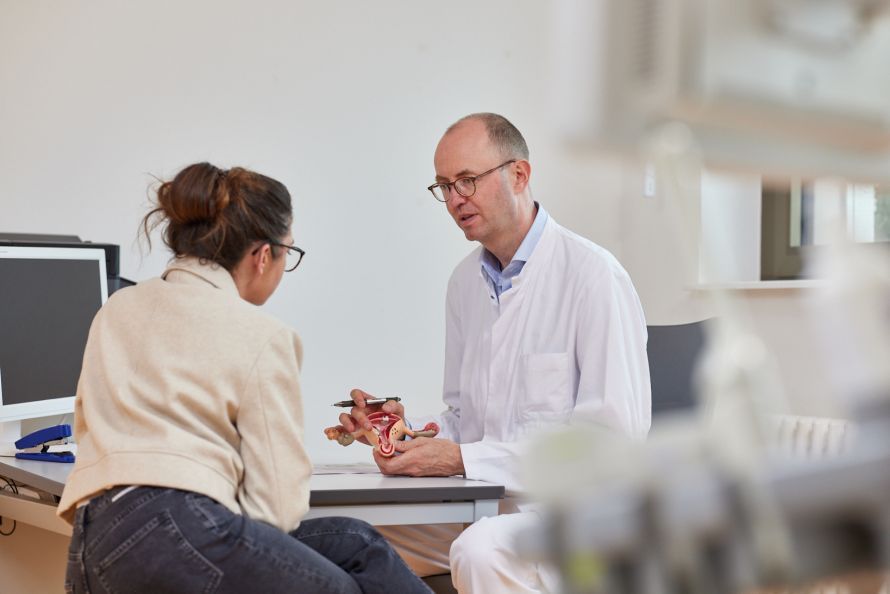
“The choice of access always depends on the type of surgery planned, as there are different ways to enter the abdominal cavity. A transverse incision—similar to that used in a cesarean section—provides good access to the organs in the pelvis. In cases of very large lesions, such as extensive tumors, however, a longitudinal incision is necessary. Even though the body is generally able to heal such incisions well, scar tissue is always less resilient than the original tissue.
Therefore, it is a major advantage if such open approaches can be avoided. In addition, an abdomen opened via an incision provides only a limited view. However, if the abdominal cavity is filled with carbon dioxide—as in a laparoscopy—a spacious, clearly visible working area is created. This allows all structures to be clearly identified and assessed with much greater precision, which significantly improves the safety and accuracy of the procedure,” explains Prof. Dr. Hornemann.
The fine, barely visible scars resulting from minimally invasive procedures are not only medically beneficial but also significantly less noticeable aesthetically than the larger incisions associated with traditional surgical techniques. At the same time, numerous studies show that minimally invasive procedures are generally associated with a lower rate of complications. Fewer postoperative symptoms, in turn, mean less physical and logistical strain, lower follow-up costs, and, above all, less psychological stress for the patients.
Prof. Dr. Hornemann illustrates this with an example: “An open hysterectomy involves an abdominal incision approximately 15 cm long—a procedure that requires a correspondingly long and careful healing phase. In contrast, the minimally invasive technique involves several small skin incisions ranging from 5 to 10 mm. This significantly reduced tissue trauma leads to much faster and more uncomplicated wound healing.
A large abdominal incision must be kept still for an extended period so that it can heal properly. Minimally invasive procedures, on the other hand, place far less strain on the body. Many surgeries that used to require a hospital stay of several weeks—including hysterectomies—can now even be performed on an outpatient basis.”
Endometriosis: a silent disease that needs attention.
“Endometriosis is one of the most common gynecological conditions and can cause significant discomfort for affected women. A major reason for its increasing prevalence lies in changing lifestyle and family planning patterns. Biologically, the female body is designed to be pregnant frequently or to breastfeed during childbearing years—phases during which menstruation does not occur. Today, however, pregnancies are consciously planned or delayed through contraception, so that women experience significantly more menstrual cycles than previous generations.
With each menstrual period, the likelihood increases that endometrial tissue—the tissue involved in endometriosis—will implant outside the uterus in the abdominal cavity. These scattered pockets of endometrial tissue are often found near the uterus but can also affect other areas. The problem arises because this tissue continues to respond to hormonal signals but cannot shed as it would inside the uterus. This leads to inflammation, pain, and the typical cycle-related symptoms.
To effectively alleviate these symptoms, it is crucial to surgically remove the affected tissue lesions. Following surgery, specialists generally recommend continuous hormonal therapy without a monthly break. “The goal is to prevent further menstrual bleeding and thereby reduce the risk of new endometriosis lesions. Ideally, this treatment should be continued until menopause or until a planned pregnancy to support long-term freedom from symptoms,” explains Prof. Dr. Hornemann regarding the issue of endometriosis.
Endometriosis means that tissue similar to the uterine lining grows outside the uterus—for example, in the abdominal cavity or on the ovaries. This tissue reacts to the menstrual cycle just like the normal uterine lining and can cause pain, inflammation, and adhesions. Typical symptoms include severe menstrual cramps, pain during sex or bowel movements, and difficulty conceiving.
The treatment of uterine prolapse presents a number of unique challenges that relate to both the patient’s individual anatomy and her personal needs. Every woman has different anatomical conditions and a unique degree of prolapse, which requires a very precise diagnosis and a personalized treatment plan.
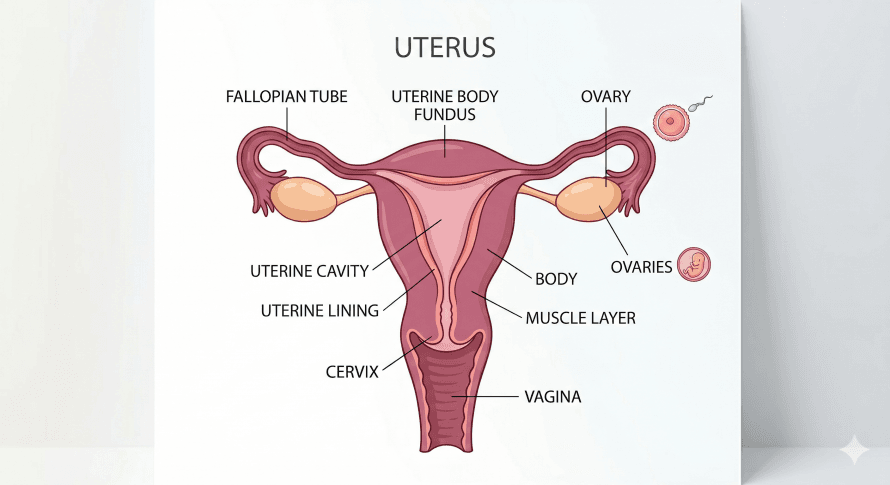
Photo of the uterus generated by AI
“The incidence of uterine prolapse—similar to endometriosis—has been increasing for years, a trend primarily linked to the fact that many women are older at the time of their first birth. As women age, connective tissue changes: It loses firmness and elasticity, which can be seen externally as wrinkles or a general loss of tissue tone. At the same time, many women over the age of 30 or 40 still wish to give birth vaginally, which places additional strain on the already weakened tissue.
If prolapse occurs, most women initially notice an uncomfortable sensation of a foreign object in the vagina. Often, additional symptoms such as difficulty urinating or passing stool also occur. The goal of surgical treatment is to stabilize or replace the weakened structures. However, many of the surgical methods developed over the years failed to prove effective in the long term.
Consequently, surgeons began reinforcing the weakened tissue with synthetic meshes—an approach that initially seemed very promising and worked well in many cases. It was only after several years that it became apparent that these meshes could cause previously unknown complications. When attempts were made to remove the meshes, it became clear how strongly they had fused with the surrounding tissue, making removal virtually impossible.
“I, too, used this method for many years because there simply was no better alternative,” says Prof. Dr. Hornemann, describing the particular difficulty in treating uterine prolapse and how these challenges ultimately led him to a completely new approach:
“I first became aware of tendon harvesting from the thigh when observing a friend who is a trauma surgeon: He harvested a tendon from a patient through a small incision in the back of the knee to replace a torn cruciate ligament—and he did so from the already injured leg, without causing the patient any additional harm. This observation made a lasting impression on me. It demonstrated just how robust—and yet dispensable—certain tendons in the body can be.
This gave rise to the idea of applying this principle to the treatment of pelvic organ prolapse. If tendon tissue is so readily available and resilient, why not use it to restabilize prolapsed structures in the pelvis? In fact, the tendon is ideally suited for this purpose: it can be used to return the uterus to its anatomically correct position or—if the uterus has already been removed—to securely stabilize the vagina. The key advantage is that only the body’s own tissue is used, with no foreign material.
This eliminates the risks associated with synthetic meshes, such as adhesions or subsequent complications. Technically speaking, I simply combined two already established procedures—which had the major advantage that the method was immediately ready for clinical use. This procedure is now being used in six hospitals in Germany, as well as in one hospital each in Switzerland and Austria. The results so far have been consistently positive, and demand from patients is growing steadily.”
At the Department of Surgical Gynecology at Frankfurt’s Bürgerhospital, the focus is on an integrative strategy to directly incorporate the latest findings from research and technology into the care of women with urogynecological conditions. The focus is on utilizing innovative procedures—ranging from minimally invasive techniques to modern imaging and new reconstructive methods—in such a way that diagnosis and treatment are optimally tailored to the individual needs of patients.
In particular, women with uterine conditions, endometriosis, or benign tumors such as fibroids find modern and individually tailored treatment options here. Special attention is given to the treatment of uterine prolapse, which is one of the most common conditions among women aged 50 and older, but can also affect younger women following pregnancy or due to other physical stresses.
“The current hospital reform is changing the framework conditions for many hospitals, and during this phase, it is a great advantage for hospitals to specifically bring additional expertise into their teams. This was exactly the case at the Bürgerhospital Frankfurt—and here, the collaboration has worked out perfectly. The Bürgerhospital has the largest obstetrics department in Germany, with over 4,000 births annually. This creates a very harmonious complement: the hospital’s strong focus on obstetrics meets a highly specialized surgical gynecology program, which meaningfully expands its existing profile. “The close collaboration with my team, which has trusted me for many years, is particularly valuable,” emphasizes Prof. Dr. Hornemann, and with that, we conclude our conversation.
- Head of the Department of Surgical Gynecology at Bürgerhospital Frankfurt since October 2024
- Specialist in gynecologic oncology and minimally invasive surgery with proven expertise in endometriosis, fibroids, and complex gynecologic conditions
- Many years of leadership experience as a senior attending physician at the University Hospitals of Lübeck and Mannheim
- Adjunct professor at Heidelberg University—with a proven scientific track record and strong research background
- Focus on minimally invasive surgical techniques at the new clinic, including 3-D laparoscopy to enhance precision and safety
- Innovative surgical methods, including a technique he developed for treating uterine prolapse using the patient’s own tissue
- Broad range of surgical procedures: treatment of endometriosis, fibroids, prolapse symptoms, and other gynecological conditions
Share this article
About the medical author
Alexandra Pfitzmann
Editor
Alexandra Pfitzmann – medical author: expert knowledge, professional articles and medical insights in the Leading Medicine Guide.
More about the medical author →Expert Interviews
Read next
- Expert Interviews
Expert Interview with Professor Dr. Konstantinos Anagnostakos
Sep 15, 2026
Prof. Anagnostakos on Painful Knee Replacements
Read more - Expert Interviews
Expert Interview with Professor Karl Philipp Kutzner, M.D.
Sep 11, 2026
Prof. Kutzner on Cutting-Edge Endoprosthetics at ENDOPROTHETICUM Mainz
Read more - Expert Interviews
Expert Interview with Dr. Emanuel Stutz, M.D.
Sep 9, 2026
Hyperthermia Treatment for Cancer
Read more