Expert Interviews
Prof. Kutzner on Cutting-Edge Endoprosthetics at ENDOPROTHETICUM Mainz
Sabine Schneider ·
The ENDOPROTHETICUM Rhein-Main is a world leader in hip and knee joint replacement. Under the direction of Prof. Dr. med. Karl Philipp Kutzner, a recognized expert in modern joint replacement procedures and short-stem prostheses, the center offers highly specialized care at the highest level.
With precise diagnostics, minimally invasive techniques, and a clear focus on individualized, patient-centered care, the ENDOPROTHETICUM is a center that enjoys a reputation for trust far beyond the region—and increasingly on an international level.
From the initial examination through precise surgical planning to postoperative care, the ENDOPROTHETICUM Rhein Main provides its patients with personalized and structured support. The goal is always to reduce pain, restore mobility, and sustainably improve quality of life. International patients often have different expectations than those treated within the German healthcare system.
They seek seamlessly organized care, clear processes, and a high level of personalized support—especially because they must coordinate travel, their stay, and follow-up care across national borders. At the same time, they specifically seek out internationally recognized specialty centers, state-of-the-art, minimally invasive techniques whenever possible, and care that combines medical excellence with comfort. The ENDOPROTHETICUM Rhein-Main is specifically designed for this purpose: Its structures are organized so that consultation, digital planning, surgery, and rehabilitation flow seamlessly into one another.
Its proximity to Frankfurt Airport makes travel easy, and surgical care at the modern curaparc-clinic on the curaparc campus in Mainz provides an environment that international patients experience as safe, high-quality, and comfortable. Thanks to its clear specialization in hip and knee joint replacement as well as short-stem prostheses, patients receive highly personalized treatment tailored to their anatomy, activity level, and long-term expectations.
International patients seek something different in joint replacement than those who are part of the German healthcare system. For them, predictability, safety, specialization, and a seamlessly managed treatment process are paramount—and it is precisely these factors that make the ENDOPROTHETICUM particularly attractive to this target group.
“It’s now clear that elective joint replacement surgeries are becoming increasingly globalized. It’s really hard to imagine how things work in countries like Canada, the U.S., or even England in some cases—there, patients now wait a year and a half or longer for an appointment, both in the public and private sectors. Canada, in particular, has surprised me several times in recent months: Its healthcare system isn’t all that different from ours, but the pricing structure is completely different, and wait times are often extreme.
This means that people with serious conditions—such as avascular necrosis of the femoral head or advanced osteoarthritis—are stuck there and have to wait for months despite severe pain, even though they would be willing to pay 40,000 to 50,000 Canadian dollars out of pocket. And even then, the appointment is sometimes canceled or rescheduled at the last minute. I just had two patients from Canada. One of them waited half a year for his surgery appointment, which was canceled a week before and rescheduled for a later date. He would have paid for everything out of pocket.
Then he did some research online, decided he wanted a short-stem prosthesis—and ultimately flew directly from Vancouver to Frankfurt. The flight cost him perhaps 2,000 to 3,000 euros, and here he’s getting an excellent hip replacement for a fraction of the price in Canada. After 1–2 weeks of follow-up care in Germany, he’ll fly back. “This has actually become a path that people worldwide are willing to take,” explains Prof. Dr. Kutzner at the start of our conversation, adding: “The time factor is truly enormous.
There are waiting times in Germany, too, but not on this scale. Depending on the region, it can take a few months here—in some areas even half a year—but certainly not a year and a half, as is the case in Canada, for example. Expectations depend heavily on where people come from. Patients from Canada, for example, often don’t have particularly high expectations because they come from a system where care is centralized, distances are long, and the quality isn’t consistently high everywhere.
In the end, these people are simply exhausted and just want to have their surgery. If they’re paying for it out of pocket, they tend to focus more on things like good organization, comfortable accommodations, or the food—though we’re pretty spoiled in that regard in Germany anyway. It’s a completely different story for patients from the Middle East or Saudi Arabia. There, money often plays hardly any role, and expectations are correspondingly high: cleanliness, perfect organization, high-quality infrastructure, hotel-like accommodations, and fine dining. That’s exactly what the new apartments on the curaparc campus are ideal for.
These apartments are a major advantage, especially for people from other cultural backgrounds who travel with their families. Patients often arrive in groups of three or four, and it’s a huge plus to be able to say: “The family is staying right next to the clinic, and the patient can pop over to the apartment at any time.” This infrastructure is truly well-suited for international patients—and is now firmly established.”

Apartment Photo
The location in the Rhine-Main metropolitan region, in close proximity to Frankfurt Airport, makes travel much easier. Surgical care at the modern curaparc-clinic on the curaparc campus in Mainz offers an environment that international patients perceive as safe, high-quality, and comfortable—an aspect that carries significant weight in medical tourism.
In endoprosthetics, international patients need, above all, guidance, predictability, and security—and this is precisely what the ENDOPROTHETICUM Rhein-Main is structurally designed to provide. Despite differences in healthcare systems, languages, and expectations, a consistently high-quality and transparent treatment process is ensured because all steps are clearly guided, communicated in an understandable manner, and tightly integrated from an organizational standpoint.
Treatment begins with a structured, digital pre-treatment assessment that establishes a shared understanding even before the patient arrives. Findings are clearly explained, treatment options are presented in a transparent manner, and realistic expectations are set. This ensures transparency, regardless of which healthcare system the patients come from. Language barriers are mitigated through clear communication, easy-to-understand documentation, and dedicated points of contact who guide patients through the entire process.
“When it comes to language, expectations vary widely. Many international patients, for example, come through intermediaries who are then present on site to facilitate and translate. In addition, a great many people today also speak English, including those from the Arab world, for instance. This makes it easy to connect with them.
We now have a ‘diverse team,’ and I’m often surprised by who speaks which languages. For example, we’ve had several patients from Ukraine, and although our staff aren’t from Ukraine, they were able to communicate very well through Russian or various dialects. Generally, we try to speak English or bring in someone to interpret.
In addition, there are modern technical options: There are apps where you speak into the device, and the phone translates the sentence directly into the desired language. That works really well now. And in most cases, a family member is there anyway who can translate—international patients rarely travel alone,” explains Prof. Dr. Kutzner regarding the language options.
Today, international patients find their way to specialized centers through a wide variety of channels—and it often all starts with a simple online search. Visibility, digital accessibility, and a reliable initial exchange play a decisive role in this process.
“How international patients become aware of ENDOPROTHETICUM is basically a matter of online visibility. People use search engines, type in things like ‘endoprosthesis in Germany’ or ‘specialized center in Europe,’ and then several clinics appear. They often contact several of them right away.
The initial contact is then crucial—whether communication goes smoothly, and whether the price and facilities are a good fit. Wherever a clinic is visible online, people take notice, check it out, and reach out if it appeals to them. Many international patients now simply reach out via WhatsApp. For example, I’m currently receiving messages from Guatemala, where someone is sending an X-ray for his father, who has severe avascular necrosis of the femoral head. Through the practice’s WhatsApp Business account, you can message the landline number directly, and I see the message immediately on my phone. Then we schedule an online meeting, clarify prices, and discuss the findings. That’s how the connection is established—often across time zones.
Communication via email remains a common method, but WhatsApp has become almost just as important because most people use their cell phones to look up information. One click on the button on the homepage, and the chat opens right away. Once you reply, request a photo, and start a conversation, the connection is established. After that, much of the communication takes place via email, phone, or video call,” explains Prof. Dr. Kutzner, citing specific examples:
“I had a Nigerian patient with whom I recently had an online meeting—the whole family was there, seven people, even the family doctor. For an hour, we discussed and considered how to proceed. And that’s exactly how many people envision it: Before they pack their bags and invest a lot of money and effort, they want to see the doctor once, get to know each other, and build trust. Today, that’s easily done via video calls. Of course, it all depends on whether someone has the necessary funds to travel and pay for surgery in Germany. But it’s surprising how many people worldwide are theoretically able to do this. And it also happens that patients from abroad come to us after unsuccessful surgeries.
Take the Nigerian patient mentioned earlier, for example: she had a broken femoral nail—a complicated situation that had shaken her confidence in local medical care. Or a patient from Norway who walked on crutches for years because no one recognized her psoas impingement, a painful mechanical irritation of the hip flexor. She found us through our website, and we were able to successfully replace the hip socket, thereby resolving the problem.
Even in Norway, access to care isn’t always easy—patients often have to pay for many services out of pocket, which can naturally be a barrier. But cases like these show just how much healthcare is becoming globalized and how important it has become for many people to look for solutions internationally.”
Thanks to the close collaboration between the center and the curaparc clinic in Mainz, patients benefit from streamlined processes, specialized minimally invasive surgical techniques, and directly integrated rehabilitation without the need for additional travel. The team assists with travel planning, accommodations, and visa issues, and prepares individualized treatment plans and cost estimates in advance. Modern apartments are available for the duration of the stay right on campus—comfortably furnished and located in close proximity to the operating room area and therapy facilities. They enable structured, personalized follow-up care without the need for traditional rehabilitation and are particularly well-suited for international patients who desire a closely supervised recovery. This creates a true “all-in-one” concept that combines safety, comfort, and high-quality medical care.
For international patients, the entire follow-up care process continues directly on the same premises—which is exactly what the apartments and the second practice location are designed for.
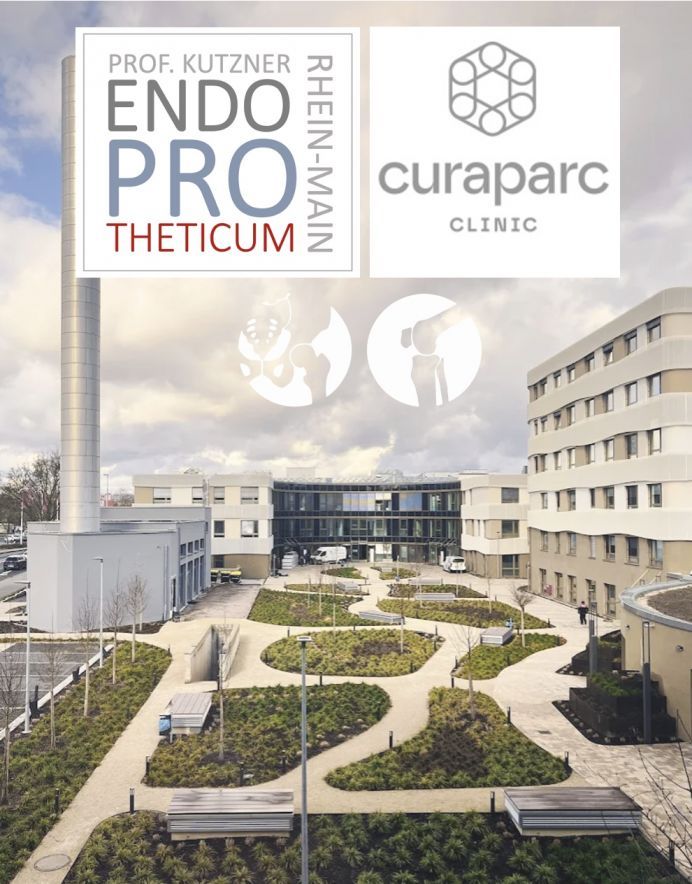
ENDOPROTHETICUM Mainz curaparc2
Here, Prof. Dr. Kutzner explains: “So if our example patient from Canada receives a hip or knee replacement, he can simply stay in one of our apartments on campus after the surgery and doesn’t have to travel anywhere else. The campus has a dedicated area with physical therapists, several treatment rooms, and a large exercise area. That’s where the entire post-operative care takes place. It’s not really traditional rehabilitation, but rather individualized post-operative care that serves as a partial substitute for rehab.
Patients remain in the same environment, with the same people who performed their surgery and already cared for them in the hospital. That’s a major advantage—especially for international patients who want to fly back home after two to three weeks. These days, the hospital stay after hip or knee surgery usually lasts only two to five days if everything goes smoothly. Afterward, it’s very beneficial to be able to stay in the same “vicinity” for another one to two weeks.
The apartments have kitchens, so you can even cook for yourself if you’d like, or take advantage of the clinic’s meals, and there’s even a supermarket right across the street. There are various ways patients can structure their daily lives there. For international patients, this is ideal: they don’t have to worry about a thing, have their surgery, follow-up care, and accommodations all in one place, and can travel directly back home once their care is complete.
Many patients from Mainz and the surrounding area also take advantage of outpatient follow-up care—but for people coming from far away, the all-in-one solution on-site is particularly valuable.”
International medical tourism in joint replacement is changing noticeably—and in a way that is increasingly putting specialized centers like the ENDOPROTHETICUM in the spotlight. However, international treatments always raise questions about costs and individualized care plans. Especially in a private practice, it’s important to understand that financial models aren’t rigid and that behind every decision is a person with their own story.
“In a private practice, ‘private’ doesn’t automatically mean that only wealthy people come here. On the contrary: we see perfectly ordinary patients here, including those we know don’t have much. And that’s exactly what’s so wonderful about this profession—you can tailor many aspects to the individual. I do the same with international patients. I ask about their financial situation, assess their circumstances, and set prices flexibly. Of course, there’s a difference between, say, someone from a royal family and someone scraping together their last bit of money. In my view, that’s something you can take into account.
International patients always mean a bit more effort, more organization, and more responsibility—and accordingly, the price is higher than under the German statutory health system. But it’s flexible. Not everyone pays the same amount. Fundamentally, Germany is a very attractive country for such patients: We still have one of the best healthcare systems in the world, high hygiene standards, a stable political situation, and—in the case of ENDOPROTHETICUM Rhein-Main—logistically ideal proximity to Frankfurt Airport,” emphasizes Prof. Dr. Kutzner, adding at the conclusion of our conversation:
“If Germany weren’t so highly regarded in the field of medicine, we wouldn’t even be having this conversation about international patients. People come to us specifically because they’ve heard that our practice is very good and the care is outstanding—care that is sought after internationally because it is professionally sound, works reliably, and gives patients from all over the world the confidence to travel long distances for a procedure.”
- Expert in hip and knee joint replacement and a leading specialist in short-stem prostheses.
- Director of Endoprotheticum Rhein-Main—a specialized practice for joint replacement in Mainz.
- Many years of experience as a senior physician in endoprosthetics at St. Josef’s Hospital in Wiesbaden.
- Habilitation in orthopedics (University of Mainz); internationally published researcher.
- Hip Specialties: Total hip replacement (THR), short-shaft prostheses, revision surgeries, minimally invasive procedures (AMIS/ALMIS).
- Knee Specialties: Total knee replacement (TKR), sled prostheses, patellofemoral implants, partial knee replacement, revision surgeries.
- Leading researcher in short-shaft prostheses; recipient of several awards.
- Surgical care at the modern curaparc-clinic Mainz.
- Patient-centered: personalized consultation, conservative treatment options, high-quality outcomes.
Share this article
Expert Interviews
Read next
- Expert interview
Expert interview with Professor Dr Elmar Herbst, PhD
Oct 15, 2026
Patient-centred and personalised knee surgery
Read more - Expert interview
Cardiogeriatrics: Significance and benefits in the context of hospital reform
Sep 21, 2026
Cardiogeriatrics: Significance and benefits in the context of hospital reform
Read more - Expert interview
Expert Interview with Professor Dr. Amadeus Hornemann, MPH
Sep 18, 2026
Prof. Amadeus Hornemann on Precision Medicine in Gynecology: Modern Surgery, New Techniques, Better Quality of Life
Read more