Expert Interviews
Complex Shoulder Surgery

Alexandra Pfitzmann ·
Complex shoulder surgery plays a major role, as shoulder pain is one of the most common musculoskeletal conditions. Studies show that up to 70 % of people are affected at some point in their lives—which corresponds to over 60 million people in Germany, Austria, and Switzerland.
The challenge: The shoulder is the most mobile and, at the same time, the most unstable joint in the body. Complex injuries such as rotator cuff tears, instabilities, or combined soft tissue and cartilage damage therefore require precise diagnosis, highly specialized surgical techniques, and individually tailored postoperative care to restore function and stability in the long term.
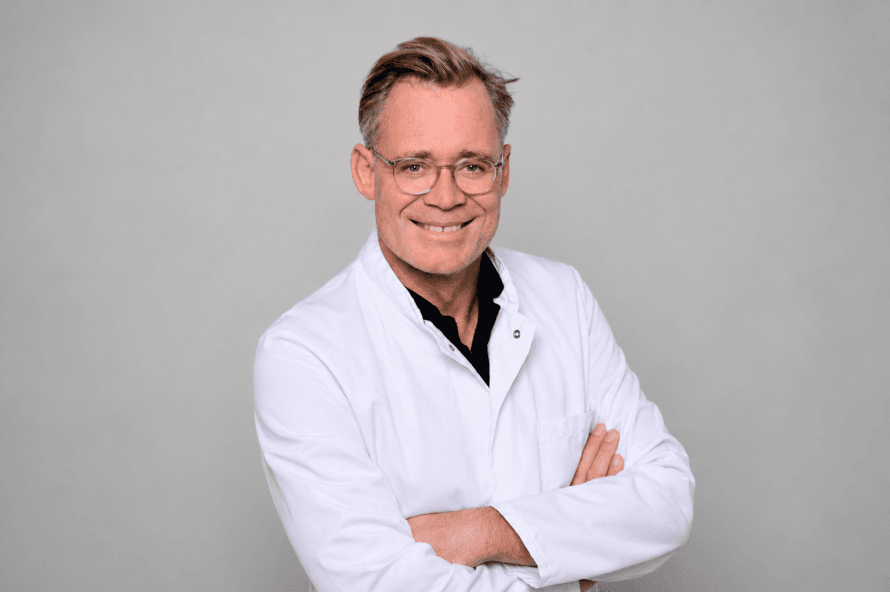
“The shoulder is the most mobile joint in the human body. This enormous range of motion allows us to move the arm in almost any direction, but at the same time comes at the expense of stability. Unlike the hip joint, which sits deep within a bony socket, the shoulder is stabilized primarily by muscles, tendons, and ligaments. This makes it particularly susceptible to wear and tear, overuse, and injuries. Modern lifestyles also play a role.
Many people spend a large part of their day at the computer, engage in repetitive, one-sided movements, or participate in sports that involve high overhead stress, such as tennis, golf, volleyball, or handball. As we age, the quality of tendons and cartilage tissue also declines. For treatment purposes, this means that not all shoulder problems are the same. The causes range from inflammation and tendon tears to complex joint damage.
“That’s why every treatment is preceded by a careful analysis of the individual situation. Only when conservative measures such as physical therapy, targeted exercise, or injections are no longer sufficient—or when structural damage is present—is reconstructive surgery considered,” explains Prof. Dr. Hoffmann at the start of our conversation.
Many symptoms arise from impingement mechanisms such as impingement syndrome, in which tendons and bursae are constricted beneath the acromion. This is exacerbated by degenerative changes, calcium deposits, or inadequate centering of the humeral head. Studies emphasize that, due to its exceptional range of motion, the shoulder is particularly susceptible to wear and tear, coordination problems, and tendon tears.
The high prevalence of shoulder complaints is a direct consequence of the complex anatomy, the high biomechanical demands, and modern lifestyle and work habits. In terms of determining the indication, this means that only a precise differentiation between functional, inflammatory, and structural causes can determine whether conservative therapy is sufficient or whether a complex reconstructive procedure is necessary.
Complex rotator cuff tears and combined soft tissue and cartilage damage represent two distinct pathological conditions, each requiring its own therapeutic strategies, prognoses, and surgical planning approaches. Crucially, a rotator cuff tear primarily involves a tendon and force-transmission problem, whereas combined soft-tissue and cartilage damage represents a joint problem in which the entire shoulder mechanics are affected.
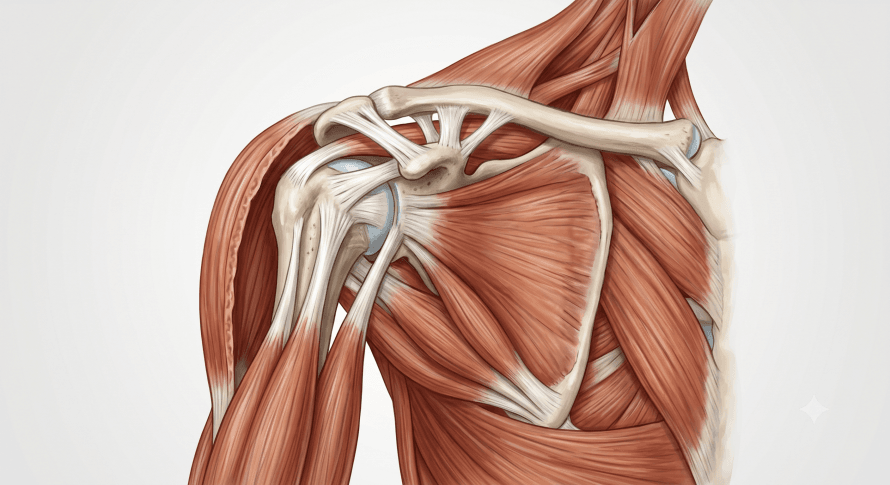
Prof. Dr. Hoffmann explains: “A rotator cuff tear involves a tear in one or more tendons responsible for guiding and stabilizing the shoulder joint. The primary goal of surgery is to restore tendon function. The earlier a major tear is treated, the better the chances of healing are, as a general rule. The situation becomes significantly more complex if there is additional cartilage damage or existing osteoarthritis. In such cases, the goal is not only to repair a tendon but also to preserve or restore overall joint function.
In such cases, several factors often must be considered simultaneously: the quality of the tendons, the condition of the cartilage, the joint alignment, and the patient’s expectations. The prognosis therefore depends less on a single injury than on the overall condition of the shoulder.
While many patients can regain a near-normal level of function after successful tendon reconstruction, combined injuries often require individually tailored solutions, which can range from biological reconstructions to modern shoulder prostheses.”
While complex rotator cuff tears often allow for stable restoration of function when tendon quality is good and treatment is initiated early, the prognosis for combined soft tissue and cartilage damage depends heavily on the condition of the joint. The more severe the arthropathy, the more likely it is that a total shoulder replacement will be necessary to ensure long-term freedom from pain and mobility.
Due to its exceptional range of motion and limited bony guidance, the shoulder poses special biomechanical challenges that make reconstructive procedures complex and significantly influence the choice of surgical technique.
“The shoulder functions as a highly complex interplay of joint, muscles, tendons, and ligaments. Even minor changes can disrupt this delicate balance. You can think of the shoulder as a precisely calibrated pulley system: if one component fails, the load on the entire joint changes. During reconstruction, it is therefore not enough to simply close a defect.
It is crucial to restore the natural biomechanics as precisely as possible. This includes ensuring the correct tension of the tendons, centering the humeral head, and restoring the muscle lines of force. The choice of surgical method therefore always depends on the individual injury. Modern arthroscopic techniques often allow for very precise reconstruction with minimal stress on the surrounding tissue.
In other cases, open techniques may be necessary to safely repair larger defects or perform complex tendon transfers,” says Prof. Dr. Hoffmann.
If the rotator cuff is irreparable but the joint itself is still intact, replacement mechanisms such as tendon transfers or “superior capsular reconstruction” (a biological reconstruction procedure) are used to biomechanically compensate for the lack of centering. If, on the other hand, the cartilage, joint geometry, or glenoid stability are also compromised, soft-tissue reconstruction is no longer sufficient, and the reverse shoulder prosthesis becomes the most sensible option because it replaces the missing rotator cuff with an altered force transmission while simultaneously addressing the arthritic joint surfaces.
Thus, the biomechanical characteristics of the shoulder directly influence every surgical decision and determine whether reconstruction, replacement, or a combination of both is necessary to achieve stable function in the long term.
Glenoid stability describes how securely the head of the humerus is held within the shoulder socket (glenoid). It is a central principle of shoulder biomechanics because the glenoid is very shallow, and the joint would easily dislocate or “tip out of place” without additional stabilization.
Arthroscopic treatment is always the preferred option when complex shoulder pathologies, while structurally challenging, fall within a range that allows for precise, soft-tissue-sparing, and functionally oriented reconstruction.
“Arthroscopy has fundamentally transformed shoulder surgery over the past few decades. Through a few small skin incisions, a camera and instruments can be inserted into the joint. This significantly spares muscles and soft tissues, reduces pain, and often accelerates rehabilitation. Arthroscopy is particularly advantageous for rotator cuff tears, shoulder instabilities, labral injuries, or many forms of shoulder impingement. It also provides excellent visualization of nearly all joint structures.
Arthroscopy reaches its limits primarily in cases of very large tissue defects, severe bone damage, or complex revision surgeries following previous operations. In such situations, open surgery can offer greater safety and provide better options for reconstruction. “Ultimately, what matters is not the size of the skin incision, but the method that is expected to yield the best long-term outcome for the individual patient,” explains Prof. Dr. Hoffmann.
Arthroscopy takes advantage of the fact that the shoulder is a joint primarily supported by soft tissues: Through small incisions, tendons, capsular structures, the labrum, and subacromial impingement (narrowing of the space between the humeral head and the acromion) can be assessed and treated with millimeter precision without extensively opening the surrounding tissue. This results in less scarring, reduced postoperative stiffness, and faster functional rehabilitation.
Arthroscopy is the preferred approach as long as the joint’s basic architecture is intact and the pathology remains primarily soft-tissue-based or amenable to reconstruction. It reaches its limits when the joint fails as a functional unit, because structural restoration, bony reconstruction, or prosthetics then become necessary.
Degenerative changes, the quality of the soft tissues, and a person’s biological age are so closely intertwined in shoulder conditions that they fundamentally determine the choice between reconstruction, a partial prosthesis, and a total endoprosthesis. The shoulder is a soft-tissue-guided joint; as soon as tendons, cartilage, and joint geometry are simultaneously affected, the therapeutic approach shifts from organ-preserving procedures to prosthetic solutions.
Prof. Dr. Hoffmann comments: “Chronological age alone is now only a limited factor in decision-making. Much more important are the biological quality of the tissue, physical activity, and the patient’s individual expectations. In younger and active patients, we generally strive to preserve and restore the body’s own structures as much as possible.
Even major tendon injuries can often still be reconstructed if the tissue quality is sufficiently good. However, in cases of advanced osteoarthritis, irreparable tendon tears, or significant joint destruction, reconstruction reaches its limits. In such cases, modern shoulder prostheses can be a very successful solution. Various implants are available—ranging from partial prostheses to anatomical or inverse shoulder prostheses.
The decision is always made on a case-by-case basis. The goal is not only a good X-ray image, but above all the best possible function and quality of life for the individual patient.”
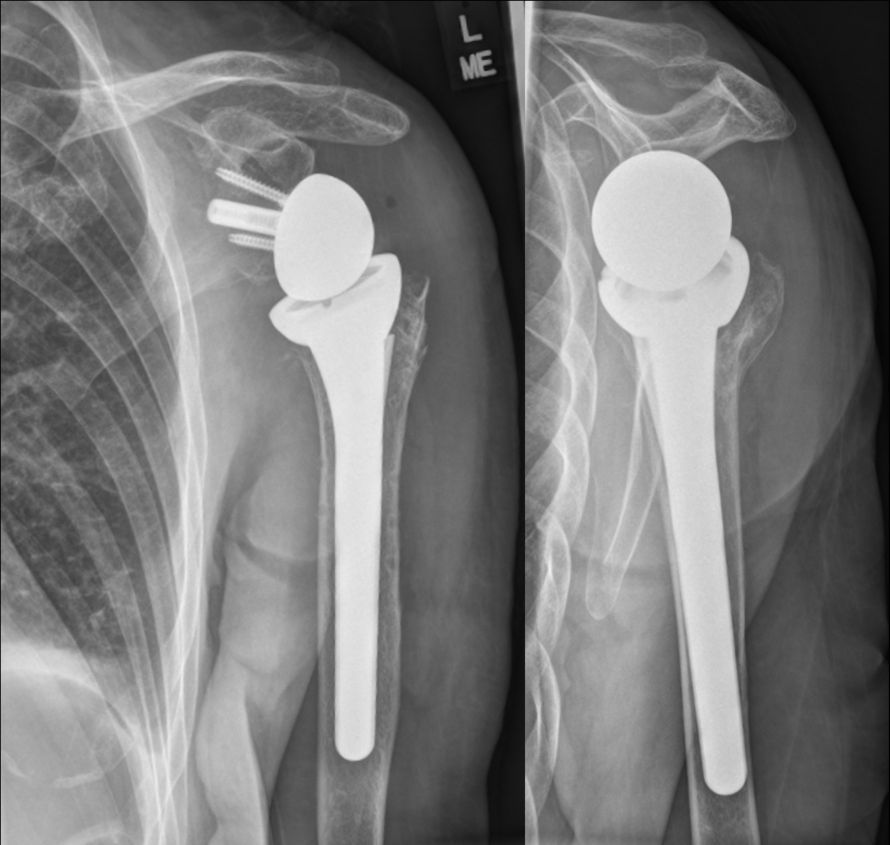
Image: Inverse Prosthesis
Reconstruction is advisable if the joint architecture is preserved and the tissue can withstand stress. A partial prosthesis may be considered if the rotator cuff is irreparably damaged but the joint has not yet completely degenerated. A total shoulder replacement becomes necessary when both soft tissues and joint surfaces have failed and biomechanical alignment can no longer be restored.
Long-term functional success following complex shoulder surgery results from the interplay of biological healing processes, precise surgical technique, consistent rehabilitation, and the patient’s ability to reestablish load-adaptive movement patterns.
“The success of shoulder surgery does not end in the operating room. The subsequent rehabilitation is at least as important as the procedure itself. Key factors for success include an accurate diagnosis, precise surgical technique, the quality of the tissue, and the patient’s active cooperation. Especially after tendon reconstructions, the body needs time for the tendon to heal firmly in place. Placing too much strain on the joint too soon can jeopardize the outcome, while resting it for too long can lead to restricted movement.
That is why modern rehabilitation programs follow clearly defined phases. The initial focus is on protecting the reconstruction, followed by restoring mobility, and finally, the targeted development of strength and function. Patience is crucial for returning to daily life, work, and sports. Many patients notice significant progress after just a few weeks; however, full recovery can take six to twelve months, depending on the initial condition.
“Those who consistently follow this process have a very good chance today of achieving a long-term pain-free and fully functional shoulder,” explains Prof. Dr. Hoffmann, and with that, we conclude our conversation.
- Internationally recognized specialist in reconstructive knee, shoulder, and hip surgery
- Chief Physician at the Dr. Schenk Sanatorium in Schruns, Austria
- Has headed the Surgery & Sports Department since 2026
- Focus on arthroscopic surgery (knee & shoulder)
- Extensive expertise in joint-preserving surgeries and ligament reconstructions
- Specialist in modern joint replacement (partial and total knee, shoulder, and hip replacements)
- Experienced in treating cruciate ligament tears, cartilage damage, and shoulder instability
- Experience in complex lower limb alignment corrections
- Proven expert in revision surgery following prosthesis malfunctions
- Treats elite athletes and patients with degenerative joint diseases
- Advocates for evidence-based, patient-centered orthopedics at the highest level
- International training, experience at renowned centers, active participation in medical conferences
Share this article
Expert Interviews
Read next
- Expert interview
Expert interview with Professor Dr Elmar Herbst, PhD
Oct 15, 2026
Patient-centred and personalised knee surgery
Read more - Expert interview
Cardiogeriatrics: Significance and benefits in the context of hospital reform
Sep 21, 2026
Cardiogeriatrics: Significance and benefits in the context of hospital reform
Read more - Expert interview
Expert Interview with Professor Dr. Amadeus Hornemann, MPH
Sep 18, 2026
Prof. Amadeus Hornemann on Precision Medicine in Gynecology: Modern Surgery, New Techniques, Better Quality of Life
Read more