Expert Interviews
Complications in Joint Replacement Surgery (Hip and Knee)

Alexandra Pfitzmann ·
In Germany, many people are affected by joint wear and tear each year, and estimates suggest that approximately 250,000 to 300,000 patients require a hip or knee replacement annually. These procedures aim to significantly improve the quality of life for those affected by alleviating pain and restoring mobility. Continuous advances in joint replacement surgery are helping to sustainably optimize patient outcomes and quality of life. Nevertheless, complications can occur. The editorial team of the Leading Medicine Guide spoke with joint replacement specialist Dr. Thorsten Gehrke about this.

Various specific complications can arise during the implantation of hip and knee replacements. Among the most common are infections, which can occur both immediately after surgery and at a later date. According to estimates, the incidence of wound infections following hip and knee replacement surgery is approximately 1–2%.
To help understand the potential complications, Dr. Thorsten Gehrke explains the danger posed by bacteria that can multiply within a biofilm: “In joint replacement surgery, one must first distinguish between hip and knee replacements, as both areas have their own typical complications. At the same time, there are problems that can occur with all prostheses. This does not refer to general risks such as thrombosis or embolism, but rather to complications that are so severe that the prosthesis must be repaired or even replaced. The most important—and at the same time most feared—complication affects the hip, knee, and shoulder—in other words, any type of prosthesis: infection. In this process, bacteria attach themselves to the prosthesis, which, as a foreign body, has no defense mechanism of its own. The bacteria adhere to the metal, forming a slimy protective layer—known as a biofilm—where they can multiply unchecked. This biofilm gradually covers the entire prosthesis. Eventually, the bacteria break out of this protective space, invade the surrounding tissue, and damage muscles, tendons, and connective tissue. In the worst-case scenario, they enter the bloodstream and trigger a severe, life-threatening infection—even sepsis—in which the entire body is affected and organs may fail. This extreme case is very rare, but it illustrates just how serious a prosthetic infection can become,” he adds:
“For decades, efforts have been made to coat prostheses with antibacterial coatings—such as antibiotics, copper, iodine, or silver—to prevent bacteria from adhering to the implant. The fundamental problem, however, is that these substances, at concentrations that reliably kill bacteria, are often harmful to the surrounding tissue as well. Bone and connective tissue are sensitive, and a toxic coating would severely impair the healing of the prosthesis. Many implants must be firmly anchored in the bone, and for this to happen, it is crucial that the bone be able to grow into the surface of the prosthesis. This is precisely what many of these coatings prevent. Despite decades of research, no solution has yet emerged that is both effective against bacteria and still allows for stable osseointegration of the prosthesis. When a prosthesis becomes loose, it loses its firm hold in the bone—even if it was originally cemented in place. This loosening causes pain and damages the surrounding tissue, making it necessary to replace the implant. An infection cannot simply be treated with antibiotics because the bacteria are embedded in a protective biofilm on the prosthesis. Within this mucus layer, they are up to a thousand times more resistant than when free in the tissue and are virtually inaccessible to medication. Therefore, mechanical removal is the only option: The prosthesis must be removed and the infected tissue thoroughly cleaned—a major and often technically demanding procedure.”
Possible complications include thrombosis and pulmonary embolism, particularly in patients who are less mobile after surgery—without preventive measures, deep vein thrombosis occurs in about 15–20 % of cases. Bone or soft tissue damage may also occur during the procedure (approximately 2–4 %). With hip prostheses, there is a risk of dislocation of about 1–5 %, especially in cases of insufficient stability or unfavorable movements. Tissue perforations occur rarely.
Worldwide, an infected prosthesis is typically treated in two stages: First, the implant is removed; the patient remains without a prosthesis for two to three months; and only then is a new implant inserted. This method is considered the standard because it reliably eliminates the infection.
“At the ENDO Clinic in Hamburg, however, we have been successfully using a one-stage approach for about 50 years, in which the prosthesis is removed and immediately replaced with a new one during the same surgery. This spares patients a long period without a prosthesis, is significantly less invasive, and yields results with a success rate just as high as that of the two-stage procedure. Infections are among the most feared complications in endoprosthetics, but fortunately they occur rarely—in about one to two percent of cases during the first year after surgery. The risk is slightly higher for revision surgeries, at three to five percent. Certain factors further increase the risk: A BMI over 40 increases the risk of infection eight- to tenfold, and patients with weakened immune systems—such as those with autoimmune diseases—are also at greater risk. In such cases, it is often recommended to lose weight before surgery—whether through diet, bariatric surgery, or modern drug therapies such as GLP-1 analogs. In addition to infections, there are other complications that affect both hip and knee replacements. A rare but possible general complication is a periprosthetic fracture—that is, a bone fracture around the prosthesis—caused, for example, by a fall or weakened bone. In the hip in particular, dislocations also occur occasionally. In such cases, the artificial femoral head slips out of the acetabulum—usually because the components do not fit together optimally or because certain movements, such as twisting the leg forcefully or bending over to care for one’s feet, place undue stress on the joint. Reducing the dislocation is extremely painful and sometimes even requires surgery. If dislocation occurs repeatedly, the implant components must be repositioned or replaced with special models. Overall, however, this complication remains rare and affects only one to two percent of patients,” explains Dr. Gehrke.
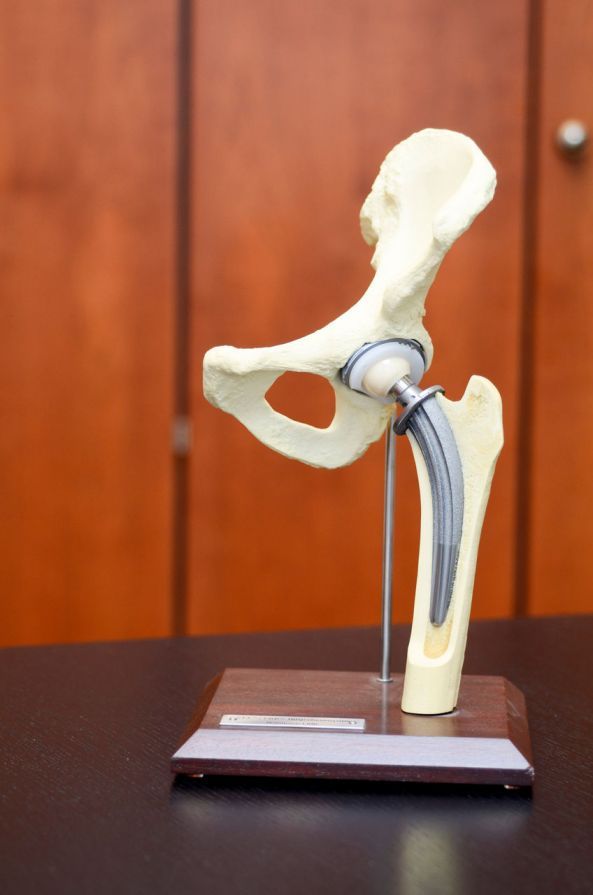
Another issue—which, while not medically classified as a classic complication, is extremely distressing for those affected—involves leg-length discrepancies following hip surgery. Often, the operated leg is unintentionally lengthened by one to two centimeters; less commonly, it is shortened.
Dr. Gehrke explains: “Although the patient can walk pain-free afterward and the actual goal of the surgery has been achieved, a persistent feeling of ‘uneven walking’ arises, as if one were constantly walking over a small hill. This discrepancy forces many to wear a shoe insert, which is perceived as very bothersome in everyday life—for example, at the beach, at home barefoot, or when wearing dress shoes. In most cases, this is a preventable surgical error, as there are rarely medical reasons to intentionally lengthen one leg. Along with hip dislocation, this leg-length discrepancy is one of the most common specific problems following hip replacement surgery. Different challenges arise with the knee, as the joint is biomechanically more complex. Proper balancing plays a central role: the knee must be both stable and highly mobile. If it is set too tight, it loses mobility; if it is too loose, however, instability results. A wobbly knee prosthesis or a persistent feeling of the knee buckling is experienced by patients as extremely unpleasant and is one of the most common reasons for dissatisfaction after knee surgery. In addition, pain around the kneecap can occur if it is not positioned exactly over the center of the joint. This, too, is a point that requires special attention during surgery. Another common complication is arthrofibrosis, in which the knee becomes increasingly stiff. It leads to pain and significant functional limitations: climbing stairs, cycling, or even normal walking become difficult when the knee can no longer be bent sufficiently. The causes are varied and often not directly attributable to the surgery. Treatment is challenging and ranges from intensive physical therapy to medication and even repeat surgeries in which the scar tissue is surgically released.”
Patients can worsen their symptoms by forcing a stiff knee to move—this often leads to even greater stiffness. Instead, a gentle, well-coordinated therapy is needed. In addition, every prosthesis eventually loosens after many years, which causes pain and necessitates replacement.
Studies show that after ten years, about 95 percent of implants are still functioning; after twenty years, around 90 percent; and after thirty years, still about 80 to 85 percent. Prehabilitation also plays an important role here.
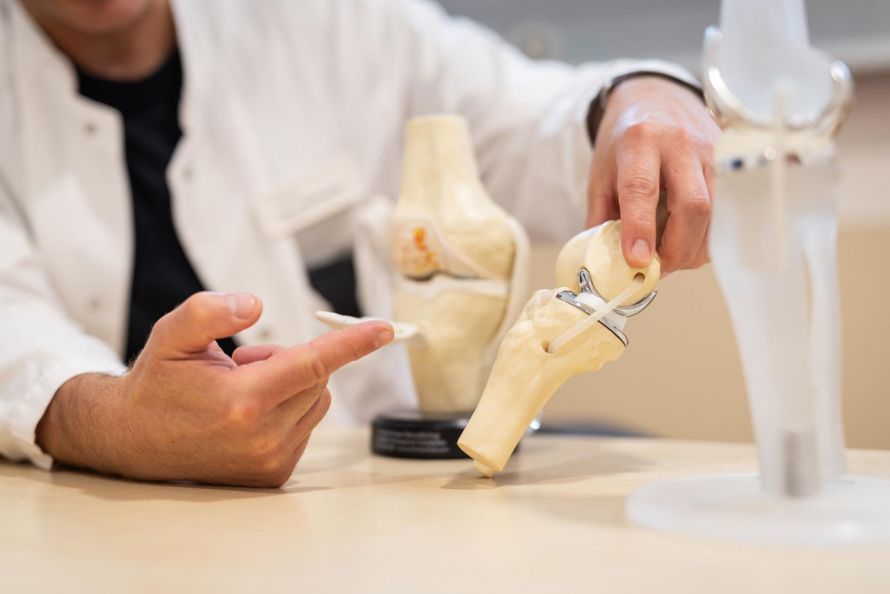
“Given that the materials used thirty years ago were significantly inferior to those available today—both plastics and ceramics have made enormous strides—one can realistically expect a lifespan of 25 to 30 years. To further reduce the risk of complications, patients can take certain steps themselves. Weight loss plays a major role, and this is almost always accompanied by a recommendation for a healthy diet. The gut microbiome—that is, the totality of bacteria in the gut—is particularly important here. A fiber-rich, balanced diet promotes “good” bacteria that can strengthen the immune system and even reduce the risk of cancer. An unhealthy diet, on the other hand, favors “bad” bacteria that weaken the immune system. Since the microbiome has been shown to influence infection rates, changing one’s diet before surgery is advisable. In addition, a targeted exercise program is recommended to improve muscle strength and mobility. The fitter a patient is going into surgery, the faster and more smoothly the recovery will proceed afterward. Most patients do not react to this with surprise, but with understanding—especially people who are severely overweight are aware of their situation. In this context, there is increasing talk today of “prehabilitation”: targeted preparation for surgery, which has established itself as a very effective means of preventing complications,” explains Dr. Gehrke.
After joint replacement surgery, patients should watch for various symptoms that may indicate potential complications.
Dr. Gehrke explains: “After hip surgery, the most important warning sign is always pain. If a patient is doing well at first and then suddenly develops symptoms or significant discomfort again, that’s an indication that something is wrong. Other possible signs include swelling or warmth in the joint, as can occur with infections. In most cases, patients themselves quickly sense that their prosthesis is ‘no longer functioning properly.’ Such problems do not have to occur immediately after surgery—they can also develop many years later. Infections, for example, can occur even decades after the procedure, such as when bacteria from a urinary tract infection travel through the bloodstream to the prosthesis. Dislocations or instability can also occur long after an initially uneventful period. It is important to note: These complications have nothing to do with patients having to move particularly carefully or “as if walking on eggshells” after surgery. On the contrary—today, most patients are mobilized on the very day of surgery and are allowed to put their full weight on the new joint in order to quickly regain a normal gait.”
The choice between different surgical techniques—particularly between minimally invasive and traditional (open) methods—can significantly influence the risk of complications during and after joint replacement surgery.
Minimally invasive techniques, such as arthroscopic surgery, offer the advantage of requiring smaller incisions and thus causing less tissue damage. This can lead to a faster recovery, less postoperative pain, and a shorter hospital stay. Reducing the invasiveness of the procedure also lowers the risk of infections and other complications, such as bleeding or wound healing disorders. Generally, patients undergoing minimally invasive procedures are able to become mobile more quickly, which further reduces the risk of thromboembolic events, such as deep vein thrombosis.
“Minimally invasive and open surgeries present different typical complications, but neither method is clearly superior overall. Minimally invasive procedures carry a slightly higher risk of nerve damage, fractures, or suboptimal implant positioning because the surgeon’s field of view is more limited. Open surgeries have fewer of these problems, but dislocations occur slightly more often with them. However, when considering the total number of complications, both procedures perform similarly. In contrast, the influence of a hospital’s experience is significantly greater. The correlation between case volume and outcomes—the so-called volume-outcome effect—is well documented: The more frequently a team performs joint replacement surgeries, the lower the complication rate. That is why minimum volume requirements exist—for example, for knee replacements—and many hospitals with low case volumes are no longer permitted to offer such surgeries at all. Approximately 7,000 joint replacement procedures, performed by about 20 surgeons, take place annually at the ENDO Clinic in Hamburg. “This makes the clinic one of the leading institutions in this field across Europe,” emphasizes Dr. Gehrke, and at the conclusion of our conversation, he highlights the absolute importance of a high level of expertise, which is particularly necessary in revision arthroplasty:
“Revision surgeries are significantly more complex than initial surgeries and therefore place particularly high demands on the surgeon. They require a great deal of experience, specialized instruments, and implants, which only specialized centers have in sufficient variety in stock. This is precisely why revisions should be performed exclusively at such specialized clinics—otherwise, the risk of serious complications increases significantly. The importance of a well-coordinated, multidisciplinary team is particularly evident in cases of infected prostheses: surgeons, microbiologists, infection specialists, internists, experienced nurses, and physical therapists work closely together and regularly discuss cases as a team. This is the only way to safely manage such complex treatment. The Endo-Klinik Hamburg is one of the world’s leading centers in this field and performs over a thousand revision surgeries annually. Particularly noteworthy is its specialization in infected prostheses, which can often be successfully treated there in a single operation—without the prosthesis-free period of several months that is otherwise typical.”
Thank you very much, Dr. Gehrke, for this in-depth look into the world of endoprosthetics!
- Medical Director of the HELIOS ENDO Clinic in Hamburg since 2005.
- Head of the Department of Orthopedic Joint Surgery and Endoprosthetics.
- Areas of expertise: Hip and knee joint replacements (implantation/replacement, aseptic/septic), realignment osteotomies, arthroscopies, ligament reconstructions, shoulder and elbow joint replacements, foot and spine surgery.
- Clinic Profile: Leading specialty clinic for bone and joint surgery, with over 200,000 joint prostheses implanted since 1976 and more than 8,200 endoprosthetic procedures performed annually.
- Focus on restoring mobility and reducing pain
Share this article
Expert Interviews
Read next
- Expert interview
Expert interview with Professor Dr Elmar Herbst, PhD
Oct 15, 2026
Patient-centred and personalised knee surgery
Read more - Expert interview
Cardiogeriatrics: Significance and benefits in the context of hospital reform
Sep 21, 2026
Cardiogeriatrics: Significance and benefits in the context of hospital reform
Read more - Expert interview
Expert Interview with Professor Dr. Amadeus Hornemann, MPH
Sep 18, 2026
Prof. Amadeus Hornemann on Precision Medicine in Gynecology: Modern Surgery, New Techniques, Better Quality of Life
Read more