Expert Interviews
Thyroid Surgery: When to Operate, How Much to Remove—and What Are the Risks?

Alexandra Pfitzmann ·
Thyroid surgery is considered whenever nodules or functional disorders can no longer be adequately treated with conservative measures, or when malignant tumors are present. The key question is whether only part of the thyroid needs to be removed or whether a complete removal is more appropriate and safer. The choice of the extent of surgery depends on the findings, risk assessment, and individual factors—as well as the assessment of potential complications, which should be clearly discussed before any procedure.

Thyroid surgery is not performed “just like that,” but is almost always the result of a clear risk-benefit assessment: The decision to proceed with surgery is made when the thyroid gland is altered in such a way that it either poses a health risk, causes symptoms, or presents a significant risk of cancer—or when medication is no longer sufficient.
“Thyroid surgery is primarily used for three clinical conditions. The most common reason is the presence of nodules—single or multiple, in one or both lobes. Surgery is performed if malignancy is suspected, if nodules are growing rapidly, or if their size or location causes symptoms, such as a feeling of pressure, frequent throat-clearing, or breathing difficulties in cases of very large nodules. The second most common indication is hyperthyroidism.
Graves’ disease, an autoimmune disorder, in particular, may require surgery—especially when medication is not sufficiently effective or cannot be taken long-term. So-called autonomous adenomas—lumps that produce excessive amounts of hormones on their own—may also require surgical treatment. The third category encompasses malignant conditions. “Thyroid cancer is generally a clear indication for surgery,” explains Dr. Kern, adding:
Thyroid nodules can occur at any age. The cause is unclear, though certain family histories may play a role. Small nodules usually go unnoticed or are discovered incidentally during an ultrasound examination. Larger nodules can cause symptoms such as a feeling of pressure or frequent throat-clearing. They may also be visible and cause cosmetic concerns. “Graves’ disease is an autoimmune disorder whose cause remains unknown to this day.
Younger people are particularly often affected. As a general rule, the first line of treatment is always conservative—that is, with medication. Surgery is usually necessary if medication fails, if the patient wishes to have children, or if there is severe eye involvement.”
Graves’ disease is an autoimmune disorder in which the immune system mistakenly stimulates the thyroid gland. As a result, the thyroid produces too many hormones, leading to hyperthyroidism. Typical symptoms include a rapid heartbeat, weight loss, nervousness, sleep disturbances, and sometimes changes in the eyes. The cause is unknown. Family history, environmental factors, and smoking may play a role.
Surgery is recommended if a nodule is of uncertain nature and the risk of cancer cannot be definitively ruled out. Large benign nodules or a goiter (the term for a pathologically enlarged thyroid gland) must also be surgically removed if they press on the windpipe, make swallowing difficult, or grow into the chest cavity. Functional disorders such as autonomous (“hot”) nodules or Graves’ disease may also require surgery—especially when medication or radioiodine therapy is not effective. Rare inflammatory conditions or mixed forms involving goiter, nodules, and functional disorders may also make surgery the most stable long-term solution.
Whether thyroid surgery is necessary or whether conservative treatment is sufficient always depends on the extent to which the thyroid’s structure, function, and growth are altered and the risks that result from these changes.
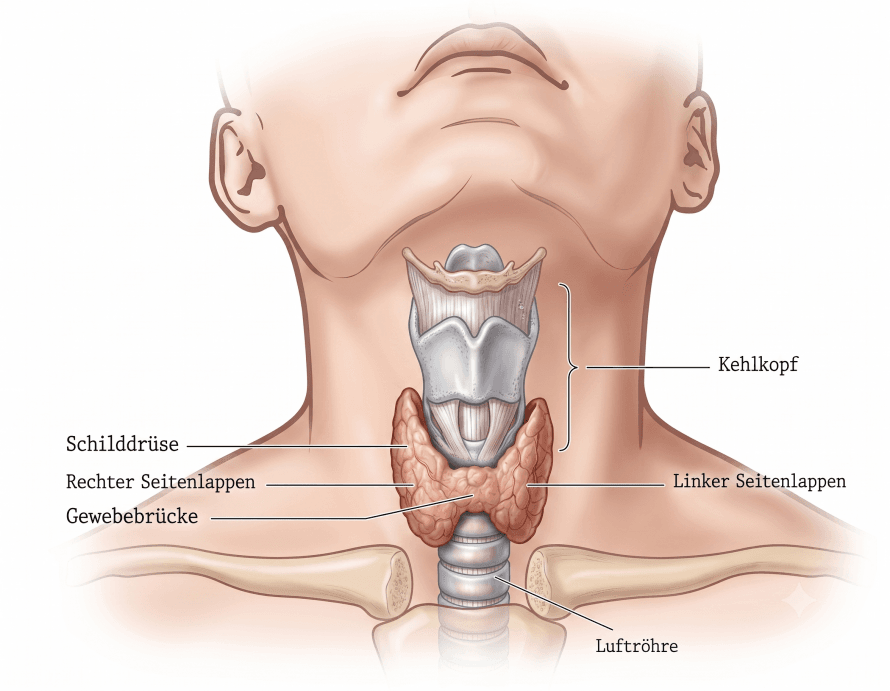 Thyroid Diagram
“Conservative treatments can regulate thyroid dysfunction, but nodules themselves cannot be eliminated with medication. Unremarkable or non-suspicious nodules are typically monitored with ultrasound over the course of several years—usually at one- to two-year intervals. Diagnostic evaluation always includes a blood test to assess metabolic status, as well as an ultrasound to visualize the size, structure, and any possible abnormalities of the nodules. Depending on the ultrasound findings, a fine-needle aspiration may be necessary, in which individual cells are extracted and evaluated according to the international Bethesda system.
This procedure indicates how suspicious a lump is, although there is a certain gray area between normal and clearly malignant. The number of lumps does not play a role in determining the next steps. The decisive factors are size and morphology: A fine-needle aspiration is recommended for nodules measuring approximately two centimeters or larger—or for smaller nodules if the findings are abnormal. “Emergency procedures are extremely rare in thyroid surgery; most operations can be scheduled and are performed based on diagnostic criteria and individual risk assessment,” explains Dr. Kern.
The Bethesda System is an internationally recognized classification scheme that pathologists use to categorize the results of a fine-needle aspiration (FNA) of the thyroid. It consists of six categories, each indicating a different risk of thyroid cancer and thus helping to plan the appropriate treatment.
- Bethesda I: Uninterpretable
- Bethesda II: Benign
- Bethesda III: Atypical findings of uncertain significance
- Bethesda IV: Suspected follicular tumor
- Bethesda V: Suspected cancer
- Bethesda VI: Malignant (evidence of cancer)
The higher the category, the more likely the finding is malignant—and the more likely surgery will be recommended.
Ultrasound is the most important test for assessing the appearance of a thyroid nodule. Certain features—such as very dark tissue, irregular margins, microcalcifications, increased blood flow, or an unusual shape—raise suspicion of malignancy and influence whether further testing (e.g., fine-needle aspiration) is necessary or whether surgery is recommended immediately. In addition, the ultrasound shows whether the thyroid is affected on one or both sides and whether large nodules are compressing the trachea.
Scintigraphy shows how active a nodule is. “Hot” nodules produce hormones uncontrollably and are almost always benign. “Cold” nodules are inactive and carry a slightly higher risk of cancer—in these cases, ultrasound and cytology results determine whether surgery is necessary. Scintigraphy also clarifies whether hyperthyroidism is caused by a single autonomous adenoma or by multiple nodules.
Fine-needle aspiration provides cells from the nodule and shows whether it is benign, of uncertain nature, or suspicious. Depending on their size and the symptoms they cause, benign nodules may be monitored or surgically removed. If, in cases of unclear findings, the nodule is confined to only one lobe, only that lobe needs to be removed to obtain clarity through definitive tissue examination. If findings are present in both lobes or if the findings are malignant, complete removal of the thyroid gland is usually recommended to ensure safety and, if necessary, to allow for subsequent radioiodine therapy.
The decision between complete removal of the thyroid gland (thyroidectomy) and a partial resection (hemithyroidectomy or nodule excision) always depends on the underlying findings and the goal of treating the condition in accordance with current guidelines and the best approach for the patient.
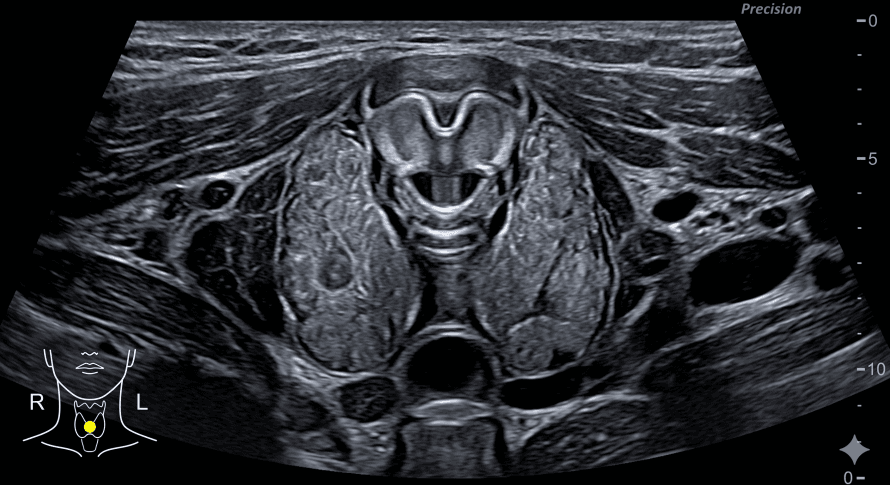 Ultrasound image
“In modern thyroid surgery, either the entire thyroid gland is removed (total thyroidectomy) or just one lobe (hemithyroidectomy). The earlier approach of excising individual nodules is now considered outdated. Which option is appropriate depends on the underlying problem: If there are large or conspicuous nodules on both sides, complete removal is usually recommended. If the findings are limited to one lobe, the other side can be preserved.
In the case of Graves’ disease, however, the autoimmune disorder affects the entire organ, which is why complete removal is necessary to permanently resolve the hyperthyroidism. Although these procedures are very safe today, there are two anatomically related risks that require special care. The most important risk involves the recurrent laryngeal nerve, which runs directly behind the thyroid gland and is only about one millimeter wide. It is not the vocal cords that are damaged, as is often assumed, but the nerve itself can be compromised, which can affect the voice.
To minimize this risk, extensive surgical experience, a tissue-sparing technique, loupes to magnify the surgical field, and the intraoperative use of neurostimulation to monitor nerve function are required. As a result, the risk of injury is now less than one percent. The second risk concerns the parathyroid glands, which produce a hormone that regulates calcium balance. The parathyroid glands also require a gentle surgical technique.
In addition, a device that utilizes the autofluorescence of the parathyroid glands is frequently used today. As a result, the risk of permanent parathyroid hypofunction is also approximately one percent. “This technology is fully available at the hospitals where I perform surgery,” Dr. Kern clarifies, adding regarding the aesthetic outcome:
“Surgical access is gained through a small incision above the clavicular fossa along the natural skin creases. This usually results in very inconspicuous scars that continue to fade within six to twelve months. Proper scar care—applying moisturizer, gentle massage, and protection from the sun—supports this process. The length of the incision depends on the size of the thyroid gland but is usually only a few centimeters long. In our part of the world, the scar does not pose an aesthetic problem for most patients.”
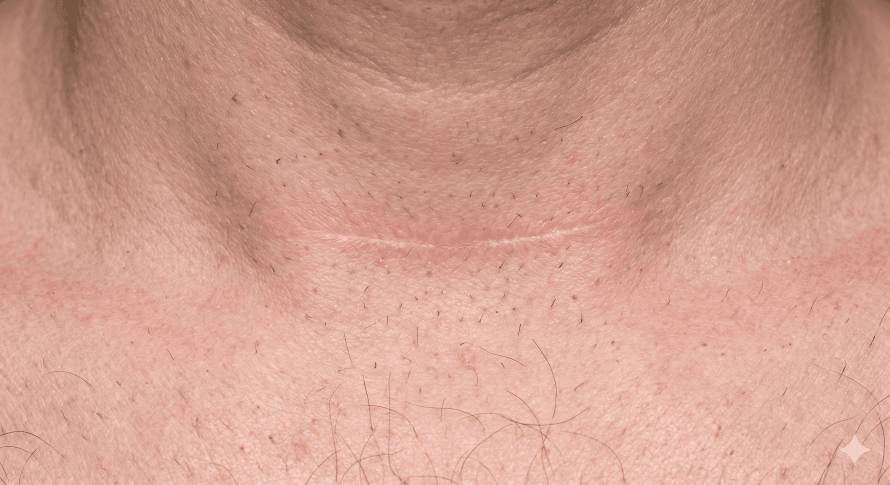 Photo: Scar
The choice between partial resection and complete removal of the thyroid gland depends largely on three diagnostic pillars: ultrasound, scintigraphy, and fine-needle aspiration—supplemented by laboratory test results and clinical symptoms. Each of these tests provides different information, which together determines how much thyroid tissue must be safely removed.
The long-term effects of thyroid surgery differ significantly depending on whether part of the thyroid is preserved or the entire organ must be removed.
Dr. Beatrice Kern explains: “After thyroid surgery, the neck is usually still swollen for the first few days, and many patients experience a feeling of pressure or a foreign body sensation. General anesthesia can also cause temporary discomfort. The recovery period ranges from two to four weeks, depending on the patient’s age and the extent of the procedure.
Nevertheless, patients can quickly resume their daily routines: As early as the day of surgery, they can get out of bed, move around normally, and eat and drink as usual—no special diet is required. Difficulty swallowing is common but subsides after three to four days, and pain at the incision site is usually minimal. Physical exertion and sports should be avoided for about two weeks. If the entire thyroid gland is removed, the body subsequently lacks the vital thyroid hormone. It must be permanently replaced with a synthetic preparation that corresponds to the natural hormone and is taken daily.
After a partial removal, the remaining thyroid gland continues to produce enough hormones in most people, so no replacement is necessary. About six to eight weeks after the procedure, hormone levels are checked to determine whether supplementation is required. In cases of total removal, annual checkups are recommended; for partial removal, the frequency depends on the individual’s course of recovery.”
Gender-specific differences do not play a role in surgical treatment. The required hormone dose after surgery depends on factors such as age, body type, and activity level—a young, strong construction worker usually needs more than a less active older female patient. It is possible to conceive without any problems while on hormone replacement therapy. However, the dose usually needs to be increased during pregnancy, as both the mother and the child depend on an adequate supply of thyroid hormones.
The relevant risks of thyroid surgery are well known, clearly definable, and—thanks to modern techniques—significantly less common today than in the past. A key factor is that potential complications stem from the anatomy of the neck: The thyroid gland lies in close proximity to the vocal cord nerves, parathyroid glands, blood vessels, and the trachea. Modern surgical techniques therefore aim to protect these structures as much as possible and actively minimize risks.
The most significant risk of thyroid surgery involves the vocal cord nerve. If it is irritated, temporary hoarseness or changes in the voice may occur. Permanent damage is very rare today because the nerve is visualized during surgery and monitored using neuromonitoring. Hypofunction of the parathyroid glands, requiring lifelong calcium supplementation, has also become rare.
Postoperative bleeding is possible but occurs very rarely due to modern instruments and close monitoring. Infections are very rare because of the good blood supply to the neck. Thanks to minimally invasive procedures, high-resolution optics, and tissue-sparing techniques, thyroid surgeries are now among the safest routine procedures in endocrine surgery.
“At our Chirurgie-im-Zentrum Basel, I perform approximately 50 to 60 thyroid procedures annually as an affiliated physician. And thanks to my many years of experience as a hospital physician, including as head of the endocrine surgery department, I have extensive expertise.
The number of cases is considerable relative to the regional population. In addition, Chirurgie-im-Zentrum Basel covers the entire spectrum of general and visceral surgical procedures—from gastric and intestinal surgery to liver and endocrine surgery, as well as pelvic floor and proctological surgeries,” emphasizes Dr. Beatrice Kern, and with that we conclude our conversation.
- Board-certified surgeon (FMH) specializing in visceral surgery; many years of leadership experience at Claraspital Basel
- Specialist in endocrine surgery with extensive expertise in the thyroid, parathyroid glands, and hormone-producing organs
- Experienced in small and large intestine surgery as well as gastric surgery
- Skilled in minimally invasive techniques for gentle, precise procedures
- Skilled in the treatment of inflammatory diseases of the entire gastrointestinal tract
- Experience in oncological visceral surgery for abdominal tumors
- High-level hernia surgery, including complex abdominal wall defects
- Minor surgical procedures such as abscesses, lipomas, atheromas, nail problems, or wound care
- Structured, guideline-based treatment planning
- Second opinions
Share this article
Expert Interviews
Read next
- Expert interview
Expert interview with Professor Dr Elmar Herbst, PhD
Oct 15, 2026
Patient-centred and personalised knee surgery
Read more - Expert interview
Cardiogeriatrics: Significance and benefits in the context of hospital reform
Sep 21, 2026
Cardiogeriatrics: Significance and benefits in the context of hospital reform
Read more - Expert interview
Expert Interview with Professor Dr. Amadeus Hornemann, MPH
Sep 18, 2026
Prof. Amadeus Hornemann on Precision Medicine in Gynecology: Modern Surgery, New Techniques, Better Quality of Life
Read more