Expert Interviews
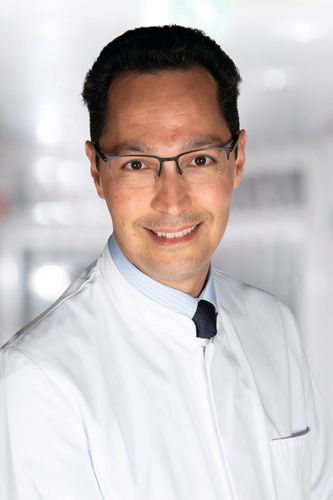
Dr. Patrick Stark: “Surgery on the aorta—that’s no walk in the park!”

Claudia Dechamps ·
As head of the Department of Vascular Surgery at the Catholic Hospital in Koblenz-Montabaur, Dr. Patrick Stark has earned a reputation as one of the leading specialists in the treatment of aortic aneurysms. He is a board-certified specialist in vascular surgery, general, visceral, and specialized visceral surgery, with the additional designation of “endovascular surgeon”—which means he has also mastered the rare art of performing surgery inside blood vessels. At the Catholic Hospital in Koblenz, Dr. Stark has access to state-of-the-art equipment. The Leading Medicine Guide spoke with the specialist about one of his areas of expertise: abdominal aortic aneurysms—and about people who go through life with a ticking time bomb in their abdomen. That’s how dangerous an aortic aneurysm is.
Leading Medicine Guide: How does one detect an aneurysm of the abdominal aorta—as doctors refer to this main artery?
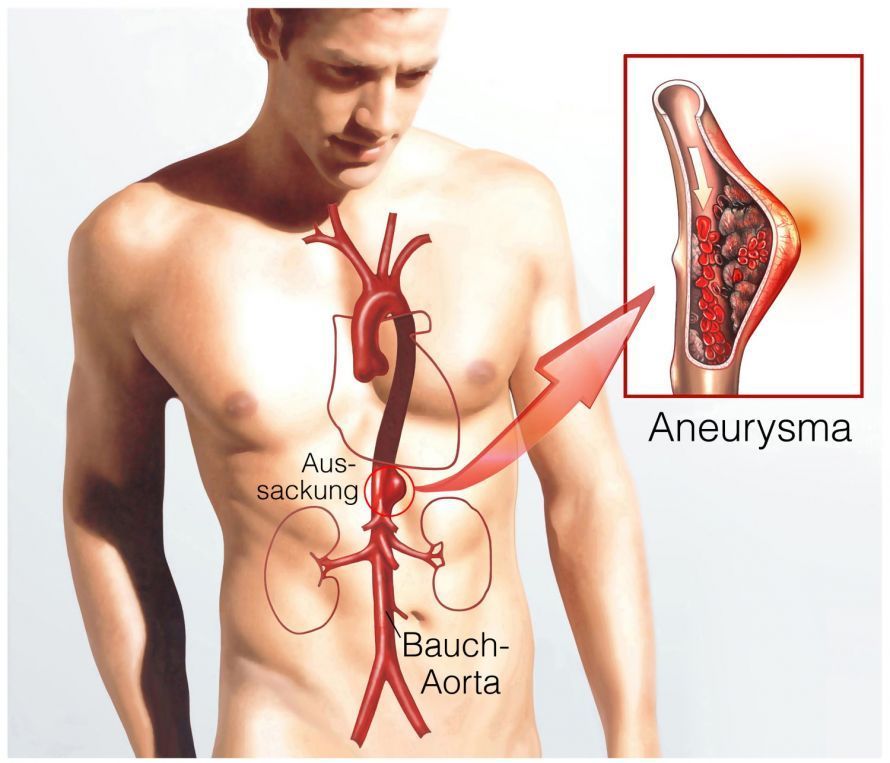
Dr. Patrick Stark: You don’t notice it; there are no signs. An aneurysm—a bulge in the abdominal aorta—is, unfortunately, a very insidious condition, and sometimes it isn’t detected until it’s already too late. “Too late” means that the aorta has ruptured at the bulge and is bleeding into the abdominal cavity; this affects about one-third of all patients. That, however, is the worst-case scenario. Two-thirds of abdominal aortic aneurysms bleed into the tissue behind the abdominal cavity when they rupture. This allows the bleeding to stop on its own. But even these patients have only a 50 percent chance of survival if they make it to the hospital alive.

Leading Medicine Guide: In an acute case, are there specific symptoms of a ruptured aortic aneurysm?
Dr. Patrick Stark: Those affected suddenly experience severe pain—a very sharp pain. This is accompanied by circulatory failure, which can progress to shock; at that point, it’s high time to call an ambulance. The ambulance then transports the patient with “acute abdomen” to our Department of Abdominal and Vascular Surgery; patients are taken immediately to the trauma room, where we can quickly determine what’s going on using ultrasound. If the patient’s circulation is stable, I also order a CT scan. Based on the images, I decide whether to proceed with a minimally invasive approach or schedule open surgery.
Leading Medicine Guide: Nevertheless, there are people who live their entire lives with an aortic aneurysm. Can you explain that to us?
Dr. Patrick Stark: The vast majority of aneurysms are discovered by chance. Often, it’s the urologist who, while performing an ultrasound of the bladder, briefly sweeps the probe toward the aorta and then detects abnormalities. Aortic aneurysms mainly affect men between the ages of 60 and 70; for every six to seven men, there is only one woman. If the aneurysm is less than 5.5 centimeters in size and does not grow by more than half a centimeter in six months, then no action is taken—except for regular checkups.
Leading Medicine Guide: But that sounds as if you have a ticking time bomb in your abdomen. Where does this confidence among doctors come from—to take no action but simply monitor the size and circumference?
Dr. Patrick Stark: The comparison to a time bomb is, of course, somewhat accurate, but there are many extensive studies on the risks posed by an aneurysm. And, of course, one must also keep in mind that surgery on the aorta is no walk in the park. The patients are no longer young; they’re rarely in perfect health, which is why, as a surgeon, you only want to intervene when there’s a real and immediate danger. But of course, there are people who simply cannot cope with the psychological strain. In such cases, I have occasionally—contrary to the medical guidelines of the professional association, which serve as a sort of roadmap for us doctors—scheduled surgery. In any case, extensive preoperative examinations must, of course, be conducted beforehand, such as an echocardiogram, lung function test, carotid artery examination, and sometimes even a cardiac catheterization.
Leading Medicine Guide: How do you proceed during the surgery? What procedure is used?
Dr. Patrick Stark: In about seventy percent of aortic procedures, we use an endovascular approach. This means we opt for a minimally invasive procedure. We make a small incision in the groin, access the aorta, and slowly advance the prosthesis—which is designed to reinforce the aortic wall from the inside—through the artery until it reaches the aneurysm. Endovascular aneurysm surgery has been continuously refined since the 1990s as an alternative to open surgery. It is much less taxing on the patient, but like any surgical method, it naturally has its drawbacks as well. Especially when treating younger patients, for whom the prostheses are expected to last 20 to 30 years, multiple procedures may become necessary over time.
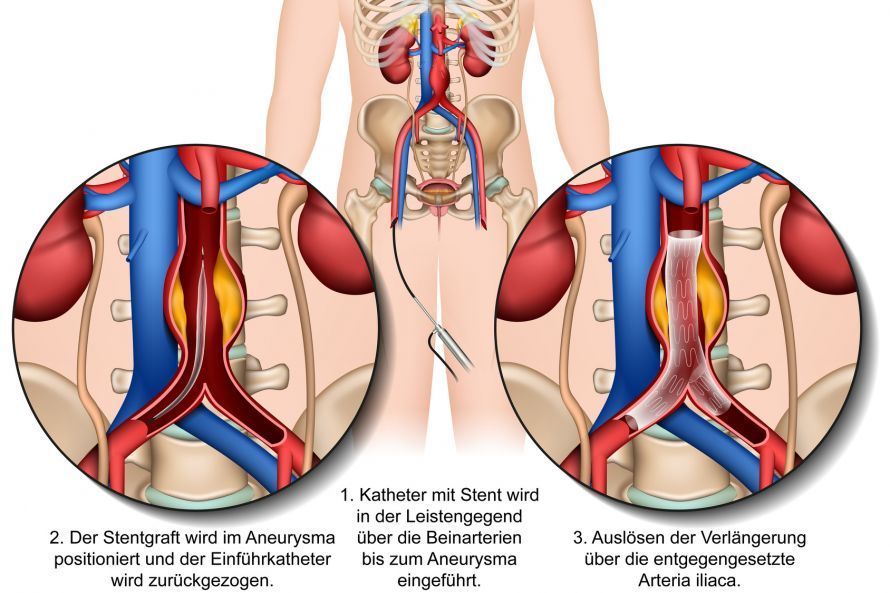
Minimally invasive stent surgery for an aortic aneurysm © bilderzwerg | AdobeStock
Leading Medicine Guide: In minimally invasive surgery, you work inside the vessel and insert a prosthesis that stabilizes the inner walls. What do you do during open aortic surgery?
Dr. Patrick Stark: In open aneurysm repair, we approach the vessel from the outside, which means we make an incision in the abdomen. If the aneurysm cannot be reached using a minimally invasive approach due to narrowings in the iliac artery, or if the aneurysm’s location—for example, in relation to the renal arteries—does not allow for this procedure, open surgery is indicated. In that case, I replace a section of the aorta with a prosthesis. That may sound fairly simple, but the aorta is covered by a dense network of nerves, and as a surgeon, I have to access and cut through that. This, in turn, can lead to erectile dysfunction. Patients must be fully informed about this.
Leading Medicine Guide: How do you go about getting an accurate picture of the aneurysm?
Dr. Patrick Stark: For diagnosis, we perform a comprehensive CT scan—a thin-slice CT—that captures images in millimeter or 0.5-millimeter increments. This allows us to measure the aorta with the utmost precision.
Leading Medicine Guide: What medical technology innovations are there in aortic care?
Dr. Patrick Stark: The materials are constantly being improved; they’re now much more slippery. Today, for extensive aneurysms, we can even have completely customized prostheses manufactured that are tailor-made to fit the patient—each one is unique.
Leading Medicine Guide: You have extensive expertise in the field of aortic care. Are there still cases that, so to speak, give you a headache?
Dr. Patrick Stark: Before an operation, we always discuss the case with many specialists. Vascular surgery is teamwork; at my clinic, decisions are always prepared and discussed as a team. For difficult and complex surgical indications, we sometimes run through the scenario for several days to develop the surgical strategy. And—in my experience—you always have to have a Plan B and even a Plan C in mind, because during surgery, unexpected situations can suddenly arise that require a quick change of course. As a surgical team, you have to be prepared for that.
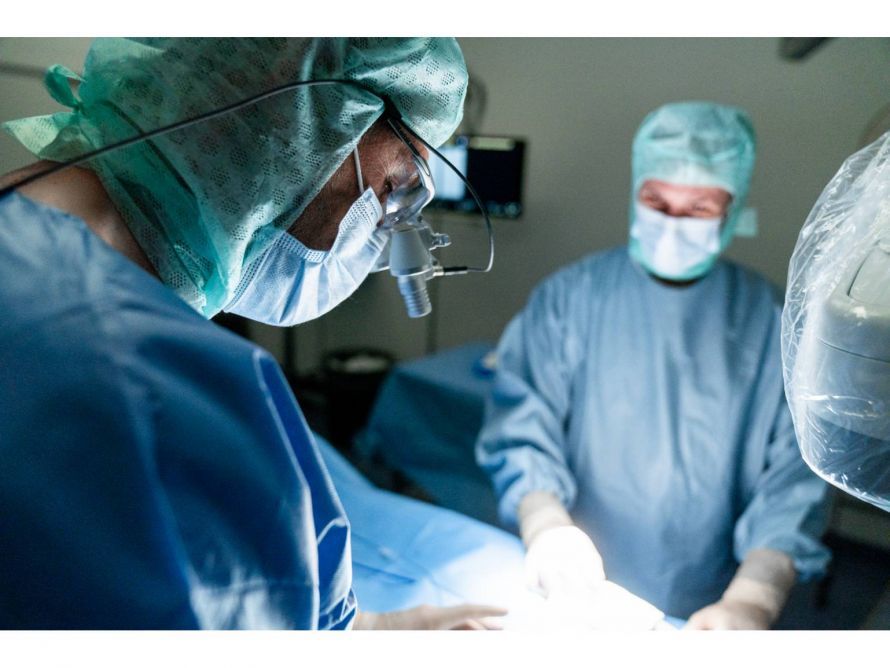 Leading Medicine Guide: How long do your surgeries take on average?
Dr. Patrick Stark: A complex endovascular procedure can easily take three and a half to four hours, while open surgery usually lasts between one and a half and two hours. But I recently had a patient whose surgical site was heavily scarred, and I had to operate on her for the third time—that procedure took a good nine hours. That really takes a toll on my stamina; it’s exhausting. But you don’t notice it while you’re working; the need to recover only sets in afterward. We often use two teams as well, which can then work in two different areas at the same time. That allows us to work faster, which shortens surgery times and is better for the patient.
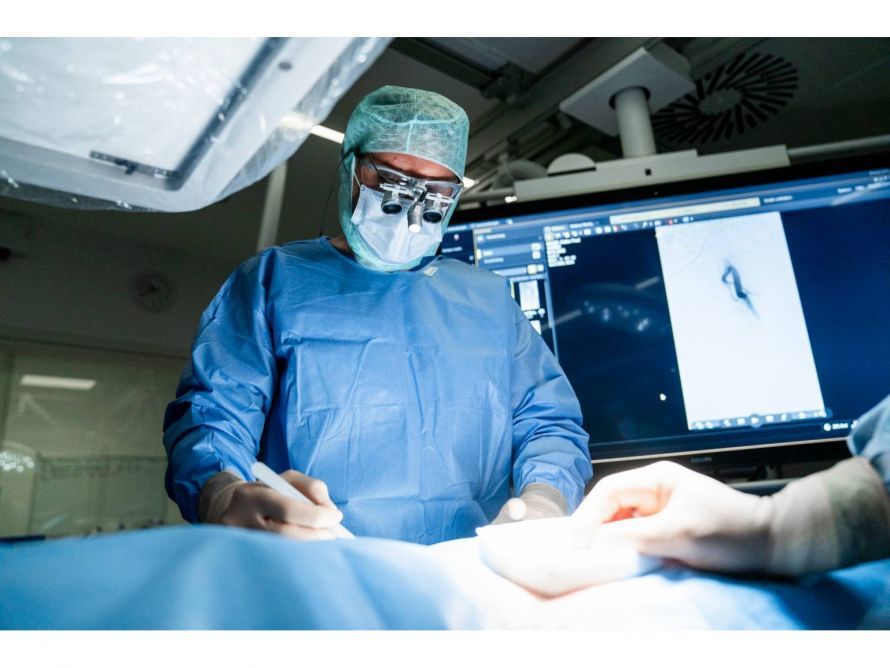 Leading Medicine Guide: Your profession is challenging and very diverse—what do you like best about your work?
Dr. Patrick Stark: There’s quite a lot. I simply enjoy working with people. I love working as part of a team; that’s extremely important to me and I really enjoy it. Here at the hospital, I have truly great teams. And then I enjoy the hands-on work—it’s a challenge every time, and one I’m happy to take on. It’s the mix of it all that makes it special for me. I’m not just in the OR; I’m also on the ward, caring for the patients there. I have office hours where I can devote my time to my patients. Last but not least, I really enjoy networking with other colleagues. The exchange provides new inspiration and broadens my horizons.
Dr. Stark, thank you for the interesting conversation and the insight into your field!
You can contact our specialist directly via his profile page on the Leading Medicine Guide.
Share this article
About the medical author
Claudia Dechamps
Editor
Claudia Dechamps – medical author: expert articles, professional insights and medical knowledge in the Leading Medicine Guide.
More about the medical author →Expert Interviews
Read next
- Expert interview
Cardiogeriatrics: Significance and benefits in the context of hospital reform
Sep 21, 2026
Cardiogeriatrics: Significance and benefits in the context of hospital reform
Read more - Expert interview
Expert Interview with Professor Dr. Amadeus Hornemann, MPH
Sep 18, 2026
Prof. Amadeus Hornemann on Precision Medicine in Gynecology: Modern Surgery, New Techniques, Better Quality of Life
Read more - Expert interview
Expert Interview with Professor Dr. Konstantinos Anagnostakos
Sep 15, 2026
Prof. Anagnostakos on Painful Knee Replacements
Read more