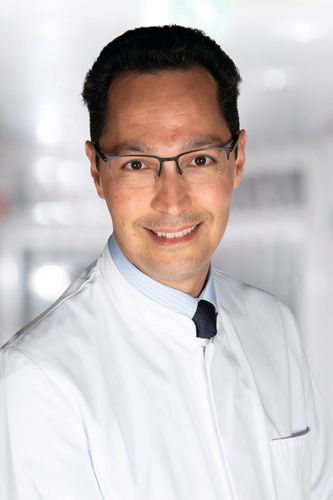
Expert Interviews
Dr. Wolfram Wenz, M.D.: “The feet are the foundation of movement!”
Claudia Dechamps ·
As a recognized specialist in foot and ankle surgery, Dr. Wolfram Wenz has earned an international reputation over the course of his decades-long career—particularly in the treatment of all types of injuries, diseases, and deformities of the foot. With his state-of-the-art specialty clinic, Experts First, founded in 2020, the orthopedic specialist in Heidelberg offers an excellent range of diagnostic and therapeutic services that benefit people from all over the world—including many children. There is hardly a doctor in the world who has more experience and expertise than Dr. Wenz, particularly when it comes to difficult and complex deformities. Thanks to his expertise, extensive experience, and specialization, he is often consulted when cases seem hopeless or when surgeries have not been successful. He shared insights into his extensive expertise with the Leading Medicine Guide.
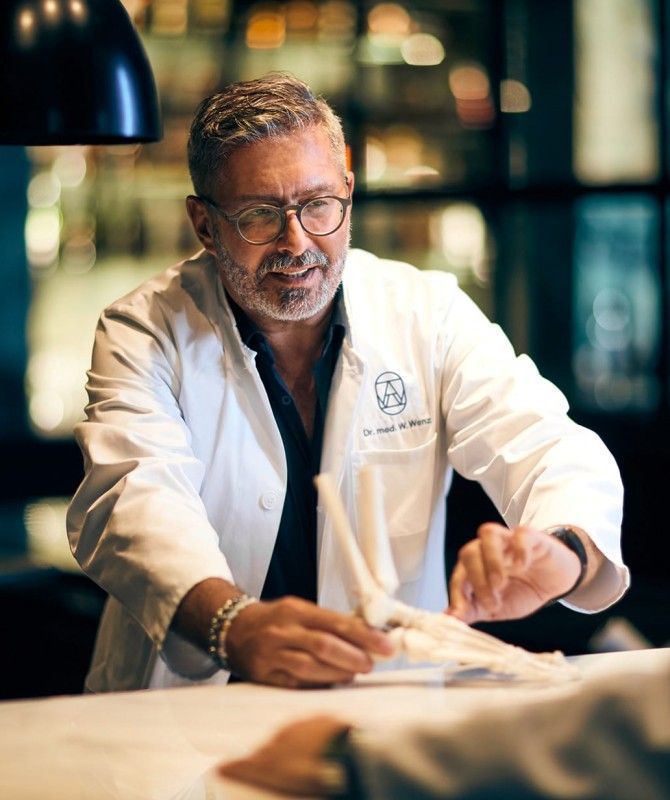
Leading Medicine Guide: Dr. Wenz, let’s start with a question to which you’ll probably give two answers: Do you think high heels are beautiful?
Dr. Wolfram Wenz: For me, as an orthopedic surgeon, there’s really only one answer. Sure, high heels are the only thing that goes with certain outfits, and I do like them for aesthetic reasons. But please, only once every two weeks—and under no circumstances day in and day out. That’s just incredibly bad for your feet. The higher the heel, the greater the strain on the ankle joints, especially in the forefoot area. The damage isn’t immediately noticeable; it only becomes apparent over the years. That’s why my earnest recommendation—and not just for women—is to wear comfortable, flat shoes.
Leading Medicine Guide: Actually, there’s hardly anyone—especially among the elderly—who doesn’t complain about foot problems, is there?
Dr. Wolfram Wenz: That’s a problem of our civilization. We don’t walk barefoot enough, and while we wear fashionable shoes, they’re often too tight. Our feet suffer as a result, and they change. Our foot is a highly complex unit consisting of 33 joints and over a hundred tendons, ligaments, and capsules. With standard footwear, this interplay isn’t exercised enough.
Leading Medicine Guide: You’re an internationally recognized specialist in specific foot problems. A few years ago, you were nicknamed “Dr. Foot” in a television documentary. In all your years as a specialist in foot and ankle surgery and pediatric orthopedics, you’ve surely seen cases that others wouldn’t even dream of—cases that would give them nightmares instead.
Dr. Wolfram Wenz: Indeed, I have truly been able to treat the most incredible medical cases. I dare say that I’ve seen the entire spectrum of foot abnormalities and deformities that exist in the world. And that’s precisely what’s so wonderful about my profession—I’ve been able to help these affected people. The results of my work are visible—that’s fantastic. A surgeon in internal medicine doesn’t experience this so directly. Everyone can see how the patient can move and walk pain-free again. Being able to walk—that’s quality of life. The feet are the foundation of movement. And when I can make that possible again, that’s truly something very beautiful.
Leading Medicine Guide: And you don’t just treat adults. Parents from all over the world bring their children to you because of your expertise.
Dr. Wolfram Wenz: Often, they’re still infants who are referred to me for treatment of specific orthopedic problems. And when I see them again as young adults, that really moves me. To see that I was able to help. That’s wonderful.
Leading Medicine Guide: What was perhaps your most spectacular case?
Dr. Wolfram Wenz: Oh, I could list many cases from my decades of clinical experience. One case, which was also featured in the documentary “Die Knochendocs,” is that of a girl named Veronika. She suffered from a very rare condition, Proteus syndrome, which causes the feet to grow abnormally large. I operated on her several times over the years; in the end, she was able to wear normal athletic shoes—that was her goal and a high bar for me. But we made it. Veronika was a wonderful girl—intelligent, strong, with a very special charisma. She went on to study law and was among the top students in her class. The story is tragic, because she died from complications following cosmetic surgery. I had to operate on her so many times, and nothing ever went wrong. And then something like this happened. It really saddens me.
Leading Medicine Guide: When you have such complicated cases, do you always know exactly how to proceed technically?
Dr. Wolfram Wenz: During my seventeen years at Heidelberg University Hospital, I certainly performed 450 surgeries per year. In the process, you really get to know the foot medically down to the smallest detail, and you learn what works and how, as well as what’s necessary for walking and what isn’t. Our feet are subjected to high levels of stress and demanding conditions. We have stance and swing phases, so our feet must be both very flexible and very stable at the same time. And surprisingly, we don’t need the middle toes at all for a smooth gait.
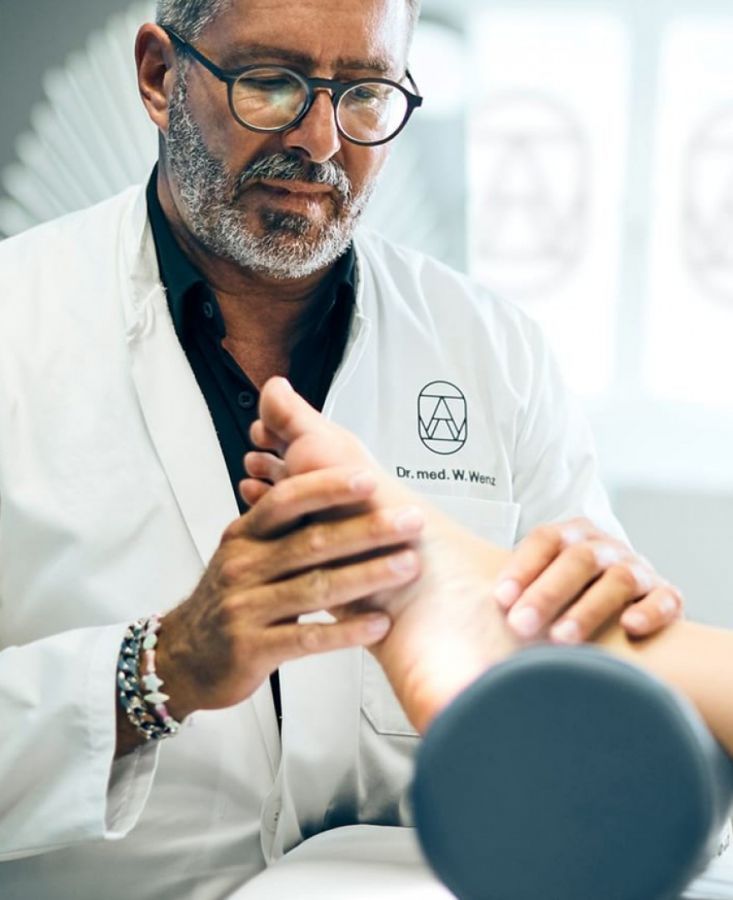
Leading Medicine Guide: Have you fulfilled a dream with your clinic, Experts First, in Heidelberg? To finally be able to practice the kind of medicine you want to practice?
Dr. Wolfram Wenz: Yes, you could say that. It applies in several ways. First of all, the ambiance has to be right: People should feel comfortable here; it doesn’t look like a typical doctor’s office. The lighting—the lighting design—has to be just right, and the scent has to be pleasant. It doesn’t smell like medicine here; it smells like Red Berry. The sounds have to be pleasant, too. Then the substance of the care has to be right. I bring nearly a decade of experience as an orthopedic surgeon specializing in the foot and ankle, and my practice partner, Professor Dr. Michael Akbar, brings his expertise in spinal and scoliosis surgery. This way, we complement each other well; we both have extensive experience in the high-end sector, and we know what we’re capable of. And thirdly: We work with state-of-the-art diagnostics and use the latest technologies. We always stay up to date, look at the most modern equipment, test it, and then decide what we want to use in our practice.
Leading Medicine Guide: Experts First in Heidelberg opened in 2020, right in the middle of the COVID-19 pandemic. How did the pandemic affect your practice operations?
Dr. Wolfram Wenz: First of all, we weren’t able to hold an opening ceremony. That was a shame. Then, of course, we had few patients at first, and they also had to keep their distance from one another. So we assigned patients hourly slots. And to be completely honest—I don’t want to go back from that now. When I take that much time for a patient, I really get to know them thoroughly, and I can treat them in a much more holistic and responsible way. I like that much better.
Leading Medicine Guide: Your patients are privately insured and self-paying—do you also accept patients with public health insurance?
Dr. Wolfram Wenz: Yes, patients come to us on a self-pay basis—a trend that, by the way, is growing rapidly. Or they’re privately insured patients. But because Prof. Akbar and I don’t want to exclude anyone, we also have an option for patients with public health insurance. If necessary, they can then undergo surgical treatment at one of our clinics that accepts public health insurance.
Leading Medicine Guide: Hallux valgus, commonly known as a bunion, is becoming something of a widespread condition. In this condition, the big toe shifts inward, the bunion protrudes, and it’s usually very painful. For you, hallux valgus is certainly one of the less challenging conditions—but still, how do you treat it?
Dr. Wolfram Wenz: Hallux valgus is another “disease of civilization,” and as I mentioned at the beginning, tight and ill-fitting shoes cause damage. When it comes to hallux valgus, many doctors in my field focus solely on the big toe. But the instability actually lies in the first metatarsal bone. I once saw an orthopedic surgeon at a conference who drew the Leaning Tower of Pisa on a picture of a crooked toe. I found that very striking, because you wouldn’t go up to the Leaning Tower and cut off a piece of the top to straighten it out. I use the Lapidus arthrodesis procedure on my patients, which corrects and stabilizes the joint in three dimensions. I don’t like to talk about “stiffening”—that always puts patients off. “Fusion”—in my experience—sounds better. When I show patients videos demonstrating all the movements that are possible again with a “fused” joint, they start to see things differently. With the Lapidus arthrodesis, I achieve long-term and lasting satisfaction among my patients.
Dr. Wenz, we’d like to thank you very much for this interesting conversation on a topic that’s of great importance to all of us. You can contact the specialist directly via his profile page on the Leading Medicine Guide.
Share this article
About the medical author
Claudia Dechamps
Editor
Claudia Dechamps – medical author: expert articles, professional insights and medical knowledge in the Leading Medicine Guide.
More about the medical author →Expert Interviews
Read next
- Expert interview
Cardiogeriatrics: Significance and benefits in the context of hospital reform
Sep 21, 2026
Cardiogeriatrics: Significance and benefits in the context of hospital reform
Read more - Expert interview
Expert Interview with Professor Dr. Amadeus Hornemann, MPH
Sep 18, 2026
Prof. Amadeus Hornemann on Precision Medicine in Gynecology: Modern Surgery, New Techniques, Better Quality of Life
Read more - Expert interview
Expert Interview with Professor Dr. Konstantinos Anagnostakos
Sep 15, 2026
Prof. Anagnostakos on Painful Knee Replacements
Read more