Expert Interviews
Have the courage to get a new hip!! “Can’t” doesn’t exist! — Expert interview with Peter Herrchen

Alexandra Pfitzmann ·
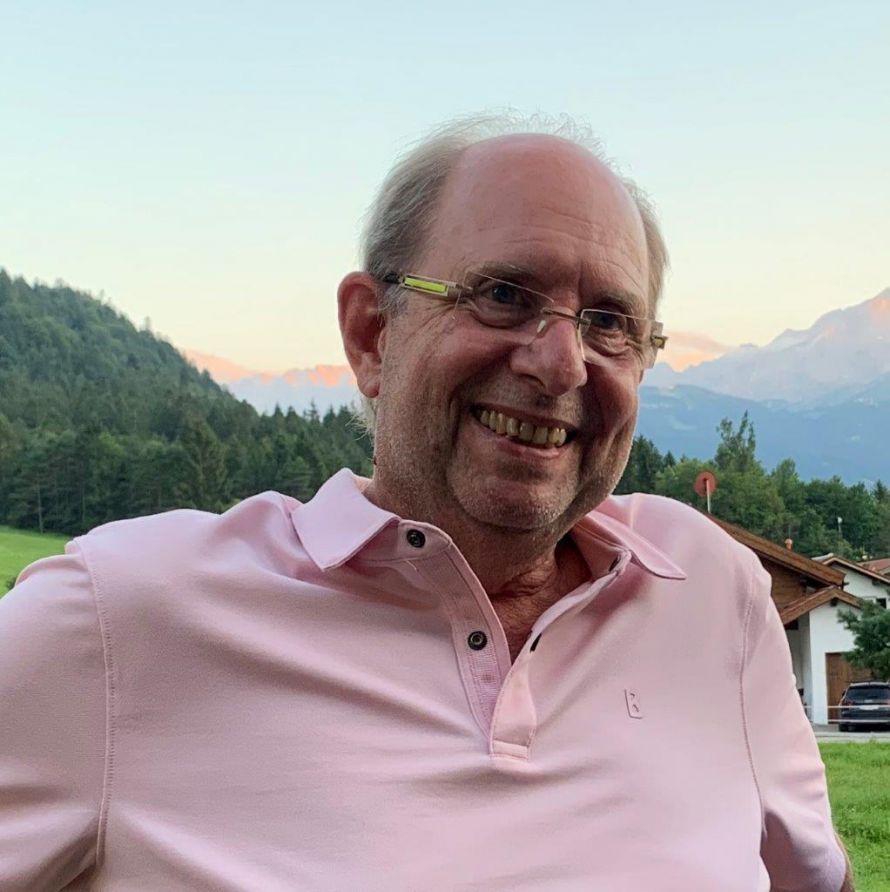
Peter Herrchen, born in Wiesbaden and holding a degree in business administration, remained active in sports—particularly table tennis and, later, triathlon—despite hip dysplasia that was diagnosed too late and led to two hip replacements. Peter Herrchen has been volunteering for decades; he served as department head at TuS Eintracht Wiesbaden and was awarded the Letter of Honor from the State of Hesse in 1996 for his service. He is co-author of the books “Mut zur neuen Hüfte!!” and “Mut zum neuen Knie!”, runs the blog TEPFIT® – Endoprosthesis and Sports, and manages the TEPFIT Facebook group, which has nearly 8,000 members as of August 2024.
In 2022, he founded the ArthroseKompetenzNetzwerk TEPFIT e.V. association and has established international partnerships with the Osteoarthritis Foundation International and the European Network on OsteoArthritis. Since 2023, he has also been running the YouTube channel ArthroseFIT. Since June 2024, he has been a founding member of the EU NetwOArk Patient Council. Despite his health challenges, he remains a role model for many people living with the condition and demonstrates that an active life is possible even with artificial joints.
The editorial team at Leading Medicine Guide had the opportunity to speak with Peter Herrchen and engage in a discussion on the topic of hip replacement surgery.
For many patients, the decision for or against joint replacement is a complex and challenging one. This procedure, in which the natural joint is replaced with an artificial one, can provide significant relief from chronic pain and improve quality of life. At the same time, however, there are risks involved that must be carefully weighed. Patients and doctors face the task of taking individual health conditions, life circumstances, and expectations into account in order to make the best possible decision. It is important for patients to be well-informed about where and by whom joint surgery should be performed.
“When I was affected myself and was experiencing significant pain due to hip dysplasia that was diagnosed too late, I naturally set out to find a suitable doctor. This was back in 1996; I was 39 years young, the internet was still in its infancy, and there were no quality reports available. All you could do was rely on one or two local orthopedic surgeons who gave you advice. I had 2–3 clinics in mind, since my orthopedic surgeon—with whom I was very satisfied—also worked at one of them. However, he didn’t want to perform the surgery, so I went to a well-known and renowned clinic in Hamburg that, even back then, performed by far the most hip surgeries. During the pre-surgery consultation, I was told that the hip replacement would be cemented and that I’d be fully recovered after six weeks, allowing me to resume playing table tennis. That sounded good to me, especially since, as a self-employed person, I wanted to minimize my downtime as much as possible. The surgery—which wasn’t yet minimally invasive at the time—went well (the hip did, after all, last 21 years), but the postoperative care back then was the exact opposite. Due to numerous holidays, there were hardly any doctors at the hospital during my stay, and I had developed a large hematoma (presumably something had been injured during the surgery after all). Without the help of my wife, who was working as a nurse at the time, things would likely have turned out even worse. I ended up in the intensive care unit, had a pulmonary embolism, a thrombosis, and needed blood transfusions. “Ultimately, we were able to discuss everything with the hospital and the chief physician, and we were on good terms again, but I had initially lost my trust in this hospital—even though I generally recommend it, as it has a proven track record of being one of the most expert centers for endoprosthetics,” Peter Herrchen explains at the beginning of our conversation.
Peter Herrchen has been an active athlete since the age of 9 and was ranked among the top 15 table tennis players in Germany during his youth. As an active player, he competed for many years in the regional league (3rd division).
Peter Herrchen stayed at the clinic for 14 days, and he received no rehabilitation or physical therapy there. Those were different times compared to today—nowadays, patients are usually back on their feet on the very day of surgery, thanks in part to minimally invasive surgical techniques. This technique results in less blood loss, faster wound healing due to the much smaller surgical incision, and an overall lower burden on patients. Thanks to rapid mobilization today, a patient is back to everyday life very quickly. In the U.S., it’s already common practice to perform hip surgeries on an outpatient basis, following the “Hip in a Day” approach. “I’m skeptical about that. You really should allow yourself a little time. In Germany, patients are usually allowed to leave the hospital after 3–4 days. Nevertheless, you should allow yourself enough time to recover. For me, the Austrian approach is the best. That’s because there, rehabilitation doesn’t begin until six weeks after surgery. Depending on the patient’s condition, starting rehabilitation too early can hinder proper healing and overwhelm the patient. Starting physical activity too soon can disrupt the healing process and increase the risk of early loosening. Everyday movements are more effective in this regard, and only after a few weeks does rehabilitation make sense to me,” explains Peter Herrchen, adding a comment about his personal situation as a table tennis player: “Of course, I wanted to be able to walk normally again as soon as possible and had set myself the personal goal of completing a short triathlon one year after the surgery. After a lot of training in the pool and at the gym, I was able to do just that—exactly one year later, to the day—without any limitations. However, due to the impact on my joints, I didn’t start jogging until half a year after the surgery and then gradually increased my activity level.”
In 2012, Peter Herrchen, together with Heidi Rauch (who also has two titanium hip replacements), published the book *“Mut zur neuen Hüfte!”* (Courage for a New Hip!), followed in early 2014 by the book *“Mut zum neuen Knie!”* (Courage for a New Knee!), In 2018, the completely revised and expanded new version, “Have Courage for a New Hip!!,” was published.
“Ultimately, I felt a need to write down my experiences with hip surgery and living with my new hip for others in the same situation—to inform them and, above all, to encourage them. This motivation led to the creation of the TEPFIT® website—Endoprosthesis and Sports—and, together with Heidi Rauch, I wrote the book *Mut zur neuen Hüfte!* (now available as an expanded and completely revised new edition) and later *Mut zum neuen Knie!*. “After all, the need for a new hip or knee is no reason to despair,” says Peter Herrchen, offering some initial important advice during our conversation: “Of course, it’s very important to do thorough research, which is relatively easy today thanks to the internet. It’s also very important and helpful to stay as fit as possible before the surgery, keep your weight within a healthy and normal range, eliminate sources of infection—such as dental issues—and have them thoroughly checked, and quit smoking (if you’re a smoker). Ideally, you should look for a certified clinic with a high volume of cases and have a conversation with the surgeon in question to ask them questions proactively. Here, you should also trust your gut feeling, because the chemistry has to be right. After all, you need to trust the surgeon and, at the very least, not find them unlikable—and, of course, you should have an absolutely positive attitude. You should discuss your expectations openly with the surgeon, and they should clearly explain what is actually feasible. “In any case, it’s important to realize that 50% of the surgery’s success depends on the patient themselves,” advises Peter Herrchen.
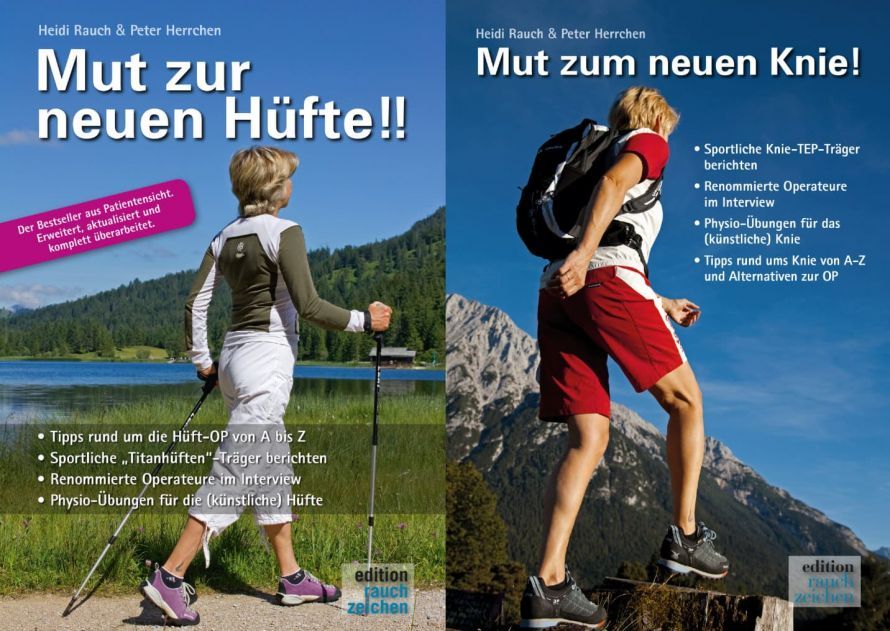
In the two books *“The Courage to Get a New Hip!!”* and “Have the Courage for a New Knee!” 30 patients from various age groups, ranging from 22 to 78, share their stories of successfully undergoing joint surgery and now enjoying their newfound mobility in everyday life and during sports activities such as mountain hiking, road cycling, golf, skiing, soccer, dancing, tennis, running, or horseback riding. Among them is the well-known soccer World Cup champion Klaus Augenthaler. Eight experienced surgeons share their expertise, while a sports and rehabilitation center—which also treats prominent athletes such as Franz Beckenbauer, Boris Becker, and Maria Riesch—contributes physical therapy exercises and tips on proper walking technique. The books also offer comprehensive information on (alternative) therapies and assistive devices, an expanded glossary, useful links, and other valuable content.
The books are available here.
TEPFIT – Fit with Artificial Joints
In March 2015, Peter Herrchen founded the closed Facebook group “TEPFIT – Fit with Artificial Joints (Hip and Knee),” in which (as of August 2024) nearly 8,000 patients, doctors, physical therapists, and other experts exchange information on the topic of “artificial hip and knee replacements.” This group sees a steady monthly growth of 80 to 100 new members.
“In the Facebook group, we receive many questions daily from patients, totaling 30,000 per year. However, to avoid being completely dependent on Facebook and Mark Zuckerberg, I founded the ArthroseKompetenzNetzwerk TEPFIT e.V. association in 2022, along with its associated website. We are not permitted to answer medical questions. So we reach out to doctors who are also in the group, and the medically approved answers are then published on the Facebook page and the association’s website. All of this work has now also led to international connections, so our reach is truly extensive—something that was only possible through the association’s efforts,” says Peter Herrchen, citing a few examples of frequently asked questions: “Most people affected ask questions like ‘How long will I be out of commission?’, ‘When can I drive again?’, ‘When can I start exercising again or fully return to my (physically demanding) job?’ So it’s mostly about possibilities in work, daily life, hobbies, and sports. Basically, I live by the motto ‘Nothing is impossible!’, which is the message I share with everyone affected. Of course, the surgery has to go well, but then you have to take the initiative yourself.”
For many people, an upcoming surgery is a major life event that brings both physical and emotional challenges.
At such times, it’s especially important to be well-informed and prepared. Thorough information about the upcoming procedure can not only reduce fears and uncertainties but also contribute to a better recovery and a successful treatment outcome. By gathering information about the type of surgery, the potential risks and complications, as well as postoperative care and rehabilitation, patients can actively participate in their healing process. This not only strengthens trust in the medical team but also enables patients to make informed decisions and develop realistic expectations.
“Personally, I always make a point of explaining at patient events where to find reliable information on hip replacement surgery and what to look out for when searching online. The first step is to schedule a consultation with a surgeon you trust. Professional societies for joint replacement (https://www.ae-germany.com and https://dgou.de) are also excellent resources. Of course, www.endocert.de—with its database of all certified joint replacement centers—is highly recommended, as is the website www.gesundbund.de, which was launched by the Federal Ministry of Health. At first (five years ago), I wasn’t particularly impressed with the Leading Medicine Guide. That has changed significantly since then, as the portal now features more experts in the field of endoprosthetics, the number of medical articles has increased substantially and their quality has improved, and transparency regarding admission criteria has become a top priority. That’s precisely why we’re having this conversation now! Particularly noteworthy is the detailed description of the certification criteria for endoprosthetics centers (EPZ) and the comparison of the differences between EPZ and EPZmax. “Doctors and clinics that meet these criteria are directly identified in their profiles with the corresponding EndoCert logo,”, says Peter Herrchen, who also reports on the numerous responses to his recommendations: “Many readers of our websites and books write letters of thanks to us, explaining that without our ‘inspirational books’ they would not have been able to return to a high quality of life. This shows that positive motivation is absolutely essential. After all, many medical reference books for patients aren’t truly inspiring, as they often contain too many restrictions. That’s why we’ve published stories from patients who are just as motivated to stay active as my co-author and I are, to share tips and personal experiences straight from the patients themselves, and we’ve combined this with medical advice—fully aware that complications can also arise. That is why joint surgery should always be a last resort. Education and guidance on “self-empowerment” must be given high priority; all conservative treatment options in accordance with the guidelines must be exhausted and combined with open dialogue with the doctor on an equal footing. Prevention efforts, which are unfortunately severely neglected in Germany (accounting for only 1% of total healthcare spending), must also be expanded without fail. “Prevention and health literacy should indeed become school subjects.” With this wish and this appeal, we conclude our conversation.
Thank you very much, Mr. Herrchen, for such a friendly and personal conversation on the topic of joint replacement from the patient’s perspective!
Share this article
Expert Interviews
Read next
- Expert interview
Expert interview with Professor Dr Elmar Herbst, PhD
Oct 15, 2026
Patient-centred and personalised knee surgery
Read more - Expert interview
Cardiogeriatrics: Significance and benefits in the context of hospital reform
Sep 21, 2026
Cardiogeriatrics: Significance and benefits in the context of hospital reform
Read more - Expert interview
Expert Interview with Professor Dr. Amadeus Hornemann, MPH
Sep 18, 2026
Prof. Amadeus Hornemann on Precision Medicine in Gynecology: Modern Surgery, New Techniques, Better Quality of Life
Read more