Expert Interviews
“Joint Replacement Is a Form of Artistry”: An Interview with Dr. Henning Röhl

Claudia Dechamps ·
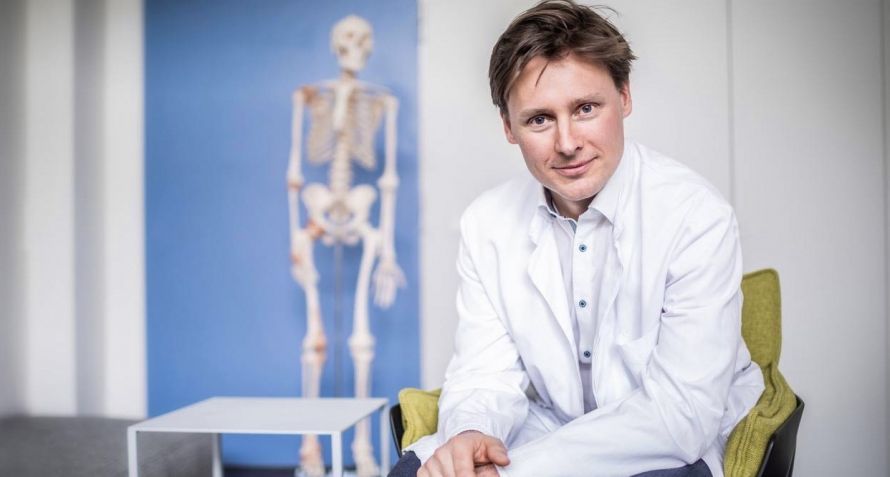
Dr. Henning Röhl, MD, is the Chief of the Department of Orthopedics, Trauma, and Reconstructive Surgery at Diako Mannheim and is highly experienced with artificial joints for the knee, hip, shoulder, and ankle. This specialist in endoprosthetics has a wealth of experience, particularly with so-called replacement and revision surgeries. When it comes to reconstructions or corrections—such as those involving the leg axis—his expertise is frequently sought after even beyond the region. In an interview with the Leading Medicine Guide, Dr. Röhl discusses the possibilities of modern revision endoprosthetics—a highly topical issue that is becoming increasingly important in orthopedics.
Leading Medicine Guide: Dr. Röhl, what exactly is revision arthroplasty?
Dr. Henning Röhl: Revision arthroplasty—it’s essentially the replacement of the replacement. It involves replacing a joint prosthesis. This may be necessary for various reasons. First, due to wear and tear on the prosthesis. The patient may notice, for example, that their knee is swelling or becoming unstable. We document and monitor the condition using X-rays and then make a diagnosis. A second reason for implant replacement can be a prosthesis that has become loose at the bone attachment site; the bone recedes, and the symptoms are similar to those described earlier. A third reason for replacement may be an infection. Fortunately, this does not happen often. The patient then complains of pain. In this case as well, we replace the joint prosthesis with a new implant. In some cases, the mechanical function of the replaced joint is simply not restored to the patient’s satisfaction after the initial surgery; this reason, too, can lead to the need for revision surgery.
Leading Medicine Guide: It’s common medical knowledge that “you should be as old as possible before getting a joint prosthesis.” Precisely because replacing it isn’t so easy.
Dr. Henning Röhl: Neither of those statements is true anymore. That assessment stems from an earlier era, when artificial joints were indeed expected to last only about ten years. Meanwhile, the outcomes achievable with joint replacement are constantly improving, which means our patients with joint wear are getting younger and younger. This places new demands on joint replacement surgery. Today, research has developed material compositions that, in the majority of cases, last a lifetime. For example, innovations may involve specifically doping the plastics in prostheses with vitamin E or other substances, which helps slow the material’s aging process within the body. In addition, our surgical techniques have become increasingly precise. We make small incisions and preserve muscles and tendons. A patient undergoes surgery at 10 a.m., and by 3 p.m., they are already walking and can put their full weight on the prosthesis. And replacement is also taken into account today; modern prostheses are designed—should the need ever arise—to be easily replaced.
Leading Medicine Guide: What materials are the prostheses primarily made of?
Dr. Henning Röhl: That depends on where they’re used. For hip implants, titanium has proven to be very well tolerated for the part that’s connected to the bone. The joint component, on the other hand, is made of ceramic or polyethylene. Body fluids then form a capillary film over the femoral head, allowing the joint to glide as if on a film of fluid in a plain bearing. We use ceramic prostheses especially for younger patients because these materials are extremely advanced. Today’s advanced ceramics have high hardness and are resistant to wear. The risk of ceramic fractures, which is sometimes still mentioned, has virtually disappeared in clinical practice with the ceramics used today.
Leading Medicine Guide: Are the same materials used for knee implants?
Dr. Henning Röhl, M.D.: The knee joint is constructed differently; it has a fundamentally different surface structure. For the knee implant, chromium-cobalt steel is used, or metals with ceramic-coated surfaces are employed. This is due to the different functional principle. The knee is simply the more demanding joint, and its function depends heavily on the fit of the prosthesis—which is influenced by the surgeon and their experience. What we endoprosthetists do is akin to a craft; it’s quite challenging mechanically, and routine and understanding play a major role. When inserting a knee prosthesis, you have to precisely align multiple axes of motion. We test this during the surgery itself to achieve the best possible result.
Leading Medicine Guide: How do you find the right implant for each patient?
Dr. Henning Röhl: My experience naturally plays a major role when consulting with patients. I’m familiar with the advantages and disadvantages of a wide variety of prostheses, and I rely on a prosthesis registry that now tracks nearly all prosthesis models implanted in Germany, along with all modifications and outcomes. A petite 80-year-old woman has different requirements for her implant than a strong, active 50-year-old man. The elderly woman is at greater risk of dislocation—that is, the joint popping out of place; the man needs a prosthesis that is as sturdy and durable as possible. Experience has shown that a sensible balance—based on experience—between innovation and conservatism serves the patient best. After all, every prosthesis model is individually customized. It is essentially a small machine that, once inserted into the body, is designed to function maintenance-free for several decades.
Leading Medicine Guide: It’s fascinating what medicine can do today to restore mobility to both older and younger people. Thanks to the relatively small surgical incisions, patients are mobile again shortly after the procedure. What does rehabilitation look like?
Dr. Henning Röhl: Rehabilitation should begin as soon as possible after surgery. It has been shown that the earlier the first exercises are started, the better the recovery. After joint replacement, it is extremely important for successful rehabilitation to restore good mobility and coordination while simultaneously ensuring proper management of swelling and wound healing. Patients and therapists often place too much emphasis on building strength. Muscle strength is the one aspect that should be put on the back burner during the first ten weeks. Once wound healing is complete and daily activities have resumed, strength usually returns on its own. The first few weeks of rehabilitation are dedicated to maintaining and restoring lost mobility, as well as establishing a coordinated, “smooth” gait.
Leading Medicine Guide: Are all sports possible again with an artificial joint?
Dr. Henning Röhl, M.D.: In principle, yes—though it naturally depends on the level of fitness and athleticism you had beforehand. You can resume a wide variety of sports, especially recreational ones. Some high-impact sports, such as soccer or perhaps skydiving, are less suitable. However, I would generally advise against competitive-level sports after joint replacement.
Leading Medicine Guide: Let’s talk once more about revision surgery—the replacement of the joint prosthesis. You mentioned earlier that wear and loosening can be reasons for a replacement. A third reason is infection. How does that happen? As a patient, one assumes that everything in the operating room is highly sterile.
Dr. Henning Röhl: That’s true to a certain extent; today’s procedures meet very high standards and are completely sterile. But every person carries a lot of bacteria on their body, and so, unfortunately, even after a prosthesis is implanted, bacterial colonization of the prosthesis can still occur. And since the prosthesis isn’t a living organism and can’t defend itself against bacteria without its own immune system, in isolated cases a veritable film of algae forms on the implant. Once this condition has set in, the implant can no longer be preserved and must be replaced.
Leading Medicine Guide: Wouldn’t it be possible to treat the prosthesis accordingly?
Dr. Henning Röhl: Well, one could treat it with certain coatings as a precaution; this is already done in specific cases. At the same time, however, there are competing requirements for the surface of the prostheses. After all, the bone is supposed to fuse with the implant. However, if it is pretreated, this process does not take place as intended, and unfortunately, that is also not in our best interest.
Leading Medicine Guide: How often can a joint implant be replaced?
Dr. Henning Röhl: In principle, we can do this four or five times, or even more often. The limitation usually lies in the available bone mass. A revision prosthesis generally has to be slightly larger than the primary implant, meaning that some bone is lost with each procedure. We must therefore compensate for this loss with the prosthesis. If this can no longer be achieved effectively beyond a certain point, procedures such as bone grafting are used as an alternative or in addition. For this, we use biological or synthetic bone substitutes. Over time, these are remodeled by the body and replaced by the patient’s own bone. These grafts also allow for immediate full weight-bearing. Building up and regenerating bone mass is crucial during revision surgery to establish a low-risk baseline for any future procedures that may be necessary. Even when implanting the first endoprosthesis, one should always establish a good baseline and consider the possibility of a future replacement right from the start. This is achieved, for example, by using the smallest possible prostheses during the initial surgery; the so-called short-shaft hip prosthesis is one such implant.

Leading Medicine Guide: If someone asked you: hip or knee—which presents the greater challenge for you in your work?
Dr. Henning Röhl: Of course, I’m always pleased when I can achieve a good outcome in the operating room—especially with complex cases—using the tools at our disposal. From a technical standpoint, the primary hip replacement is the “simpler” joint. Accordingly, we see a very high rate of patient satisfaction with hip replacements. Of course, I need technical skill and a good planning strategy for all my surgeries. I consider the knee joint to be a greater technical challenge; here, the outcome for the patient is determined even more by the surgeon’s experience and finesse. The greatest challenges are usually prosthetic revisions involving complex reconstruction. I thoroughly enjoy doing all of this.
Leading Medicine Guide: Dr. Röhl, thank you very much for these insights into the current state of the art regarding joint prostheses, their implantation, and replacement.
Share this article
Expert Interviews
Read next
- Expert interview
Expert interview with Professor Dr Elmar Herbst, PhD
Oct 15, 2026
Patient-centred and personalised knee surgery
Read more - Expert interview
Cardiogeriatrics: Significance and benefits in the context of hospital reform
Sep 21, 2026
Cardiogeriatrics: Significance and benefits in the context of hospital reform
Read more - Expert interview
Expert Interview with Professor Dr. Amadeus Hornemann, MPH
Sep 18, 2026
Prof. Amadeus Hornemann on Precision Medicine in Gynecology: Modern Surgery, New Techniques, Better Quality of Life
Read more