Expert Interviews
“Mobility Comes First!” Prof. Fritz Thorey on the Hip and Knee

Alexandra Pfitzmann ·
As a world-renowned specialist in all matters related to the hip and knee, Prof. Dr. med. Fritz Thorey is one of the few specialists who is thoroughly familiar with all areas of orthopedics, trauma surgery, and modern sports medicine. The fact that he has nevertheless focused on these two joints for a long time is a great blessing for everyone who turns to him with hip and knee problems. Whether the issue involves joint preservation or joint replacement—including complex revision arthroplasty—he is regarded as an international authority, performing over 750 surgeries annually. When he was appointed Chief Physician at the International Center for Orthopedics at the ATOS Clinic in Heidelberg am Neckar in 2011—at just 36 years old—it had long been clear: Here comes a true expert to this romantic city on the Neckar!

Suddenly, while jogging or taking a walk, you feel the pain. Your hip isn’t working the way it used to. The pain can develop gradually and intensify slowly, or it can appear immediately and be clearly noticeable. Thanks to our hip joints, we humans are able to stand upright and walk; after all, they bear about 60% of our body weight. Along with the knees, they are the second-largest joints in the human body—and they have to endure quite a lot.
Hip pain isn’t just a matter of age and is one of the most common types of joint pain. Possible causes include wear and tear (osteoarthritis), developmental abnormalities (e.g., hip dysplasia, hip impingement), injuries (accidents), or conditions such as bursitis. A clear diagnosis must be made to determine which treatment will be most effective. Conservative treatment is often possible, but in many cases, it is necessary to support the hip with a hip replacement. Fortunately, modern medicine allows for effective intervention in cases of hip problems. Through pelvic corrections, joint replacement, arthroscopy, and physical therapy, patients can regain a pain-free life with greater mobility. For Prof. Thorey, one factor in particular was decisive in his decision to specialize in hip replacement: he received numerous positive reviews from patients—which motivated the empathetic specialist.
Hip Surgery—A Big Deal?
The topic of hip surgery still gives most people the chills. After all, the hip is a very large joint, so almost everyone tends to think of it as a correspondingly complicated and major surgery. This was usually the case in the past. But today, thanks to new, highly advanced surgical techniques, the procedure is becoming much less daunting.
Prof. Dr. Thorey uses minimally invasive techniques for all hip surgeries. This means that he gains access to the surgical site through small incisions just a few centimeters long: “Access to the hip joint is not gained from the back or the side, but from an oblique angle in front, near the groin. From here, the hip socket or femoral stem can be inserted,” explains Professor Dr. Thorey, adding:
“The advantage is that we operate through natural gaps in the muscles, so they do not need to be cut. In the past, the gluteal muscles were often injured during surgery, which then resulted in a longer rehabilitation period. Thanks to the minimally invasive procedure, nerves and tendons are also spared. As a result, very little blood is lost during the entire procedure—usually less than 200 ml—so we can almost always avoid the need for an autologous blood transfusion before surgery.”
If one hip is affected, will the other soon follow…?
It is indeed the case that in many patients, both hip joints are either similarly damaged at the same time, or only a short period of time passes before the second hip also needs to be replaced. The minimally invasive technique makes it possible to perform a simultaneous, bilateral hip replacement.
“The surgical risks would be significantly higher with conventional approaches. A minimally invasive approach, however, makes this possible without any problems. For patients, this procedure is definitely less taxing than two separate surgeries. Even after bilateral hip replacement, they can get up and walk around with walking aids on the very day of the surgery. Another advantage is that patients do not adopt a compensatory posture due to persistent pain on one side, but are fully restored immediately,” says Prof. Dr. Thorey, encouraging potential patients. He also reports that many of his patients say after the procedure: “Oh, if I’d known that everything would go so smoothly, I would have had it done much sooner.”

Plastic, titanium, or ceramic—which one should you choose?
There are various materials used in hip replacement surgery. Specialist Prof. Dr. Thorey explains:
“Plastic is generally the most affordable option, but it’s not necessarily recommended when it comes to the hip. Ceramic is the most sensible material to use. It’s stable and long-lasting. That means the patient shouldn’t have to expect a revision surgery for the next 20 to 25 years. The less wear and tear that occurs, the better. Personally, I’ve had the best results with ceramic. With it, the patient can enjoy peace of mind for about 25 years.”
Of course, the choice of material is always a question of cost. Not every clinic can afford to use expensive ceramic. And as a patient, you cannot demand the material of your choice even if you pay out of pocket. However, every patient in Germany is always well advised and properly informed, and can, of course, decide for themselves at which clinic treatment should be performed.
“The new type of so-called bearing pair is particularly exciting. A bearing pair creates the connection between the hip socket and the hip stem. This is where the movement of the artificial hip joint takes place. For many decades, a bearing pair consisting of a ceramic head and a plastic (polyethylene) bearing surface has been considered the standard. However, plastic wears down quickly because a much harder material is constantly in contact with it, which in turn leads to loosening of the prosthesis over the long term. Bearing pairs consisting of a ceramic head and a ceramic bearing surface make much more sense. The ceramic-on-ceramic bearing pair exhibits the least amount of wear and is the most compatible,” says Prof. Dr. Thorey enthusiastically.
Ceramic surfaces are significantly harder and smoother and are therefore particularly recommended for younger patients, who are usually much more athletic and active than their older counterparts.
A new cartilage therapy is being used to treat osteoarthritis
Signs of wear and tear are the most common cause of hip joint pain. This condition is known as hip osteoarthritis (coxarthrosis). It is a normal part of the aging process for healthy joint cartilage to break down. The cartilage acts as a cushioning and lubricating layer in the joints. As the cartilage mass decreases, bone eventually rubs directly against bone. And that hurts.
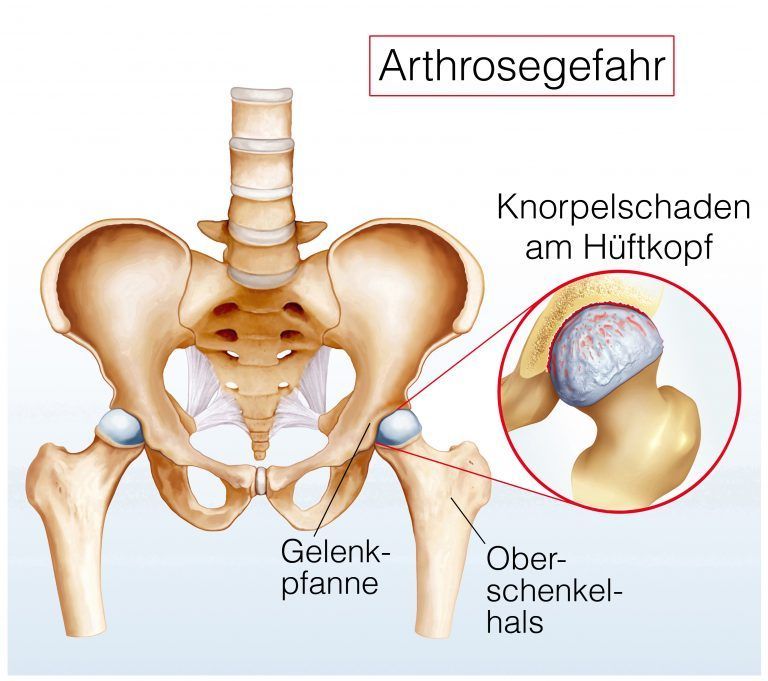
Cartilage damage can also result from accidents or misalignments, including in the joints of the lower extremities, such as the knees and feet—younger people are particularly affected in these cases, so preserving joint function is clearly the primary goal. A new cartilage therapy can work wonders here:
“In cartilage surgery using cartilage cell transplantation (ACT), a cartilage sample measuring just a few millimeters is taken from the patient. There are two companies in Germany to which this sample is sent to cultivate more cartilage. Cultivating the patient’s own tissue then takes approximately three to eight weeks. Using the cartilage cells, which are then returned to us, we can fill in the affected defect during surgery. “You can think of it as filling in potholes in a road to make it smooth again,” explains Prof. Dr. Thorey, who primarily uses this procedure for localized damage to the hip socket. It is difficult to treat femoral heads using this method, but cartilage therapy is often used, particularly for damage to the knee joint. This makes it possible to return to completely normal activity.
Our Knees: Under Heavy Strain Every Day
The knee joints are subjected to heavy strain every day. As a result, it’s not just older people who suffer from knee problems, but also young people—especially athletes—who place particular strain on their knees. “We are convinced of the results of cartilage cell transplantation. Between 2014 and 2018 alone, we successfully treated over 500 patients with this method at our center. In various studies, we observed complete healing of the cartilage damage in more than 85% of cases,” says Prof. Dr. Thorey, highlighting the success.
However, the phrase “knee surgery” sets off alarm bells for many people: After all, it has always been said that these surgeries in particular carry a particularly high risk of infection. “Thanks to advances in surgical techniques, knee surgeries generally pose no greater risk than other surgeries. Moreover, the surgeries are much quicker these days. Anyone who wants to minimize this minimal risk should have knee surgery performed at a specialized clinic rather than necessarily at a hospital where patients with many different conditions are treated,” recommends Prof. Dr. Thorey.
“I have high hopes for the future of medicine in the field of cartilage therapy. Further research findings will offer even more targeted solutions here,” says Prof. Dr. Thorey optimistically. Incidentally, the expert is always delighted by the gratitude of his patients, who are often simply overwhelmed by their regained mobility.

“I recommend that anyone with joint problems—whether in the hip or knee—not put off seeing a specialist. Don’t drag yourself through life in pain for so long! And for prevention, as is so often the case, the magic formula applies: exercise × nutrition. Watch your weight and stay active!” Prof. Dr. Thorey emphasizes in conclusion.
Thank you very much for the interesting conversation, Prof. Thorey!
Are you experiencing problems with your hip or knee joint? Contact Prof. Thorey securely and directly through Leading Medicine Guide!
The International Center for Orthopedics plays a special role in the modern development of high-performance orthopedic medicine: The Heidelberg private clinic is staffed exclusively by specialists who are fully dedicated to the care of the lower extremities. Professor Fritz Thorey, M.D., has been a recognized expert in orthopedics for many years and, in addition to his specialty training in orthopedics, has also completed specialty training in trauma surgery. In addition, Prof. Thorey has completed specialized training in the fields of specialized orthopedic surgery and sports medicine, enabling his center to treat even complex cases involving joint replacement or trauma surgery. Prof. Dr. med. Fritz Thorey is recommended as a proven orthopedic specialist in many medical directories.
Atos – AT229, LMG19 – Image sources: (c) Eugenio Marongiu, (c) Henrie, (c) pikselstock – Adobe Stock.
Share this article
IZO - International Center for Orthopedics
ProfileExpert Interviews
Read next
- Expert interview
Expert interview with Professor Dr Elmar Herbst, PhD
Oct 15, 2026
Patient-centred and personalised knee surgery
Read more - Expert interview
Cardiogeriatrics: Significance and benefits in the context of hospital reform
Sep 21, 2026
Cardiogeriatrics: Significance and benefits in the context of hospital reform
Read more - Expert interview
Expert Interview with Professor Dr. Amadeus Hornemann, MPH
Sep 18, 2026
Prof. Amadeus Hornemann on Precision Medicine in Gynecology: Modern Surgery, New Techniques, Better Quality of Life
Read more