Expert Interviews
Large Incisional Hernias

Alexandra Pfitzmann ·
Hernias occur when tissue or organs protrude through a weak spot in the abdominal wall. They can occur in various locations; the most common types are inguinal, umbilical, and abdominal wall hernias. Incisional hernias, which develop at the sites of previous surgeries, are particularly challenging. Due to altered tissue structures and often larger defects, they require particularly precise surgical planning and expertise to alleviate pain, restore the stability of the abdominal wall, and prevent long-term complications. The editorial team of the Leading Medicine Guide spoke with OA mag.dr. Jurij Gorjanc about this topic.

Incisional hernias differ from conventional hernias in several ways and pose a particular challenge from both an anatomical and a surgical perspective.
“Incisional hernias develop at the site of previous surgical scars—that is, in areas where the abdominal wall has been weakened by surgical procedures. The strength of the abdominal wall scar tissue following abdominal surgery (laparotomy) reaches only 50–70% of the strength of an intact abdominal wall, depending on the extent, region, and time since the surgery. This reduced strength persists even after complete healing and explains the lifelong risk of incisional hernias. They are significantly more difficult to treat because the scarred tissue hinders access, complicates reduction, and often results in larger or multiple defects. Previous surgeries also often result in adhesions within the abdominal cavity, which increases the risk of injury during the procedure. Scar tissue has poorer blood supply, heals more slowly, and is less resilient, leading to a higher incidence of infections, wound healing complications, and recurrences. The use of mesh must also be planned with particular care to ensure that its size, shape, and fixation are optimally suited to the weakened abdominal wall. “Overall, incisional hernias therefore require specialized surgical expertise, precise diagnostics, and individually tailored surgical strategies to achieve long-term stability and good outcomes,” Dr. Gorjanc makes clear at the beginning of our conversation.
The risk of developing an incisional hernia after surgery depends on various patient-related, surgical, and procedure-related factors.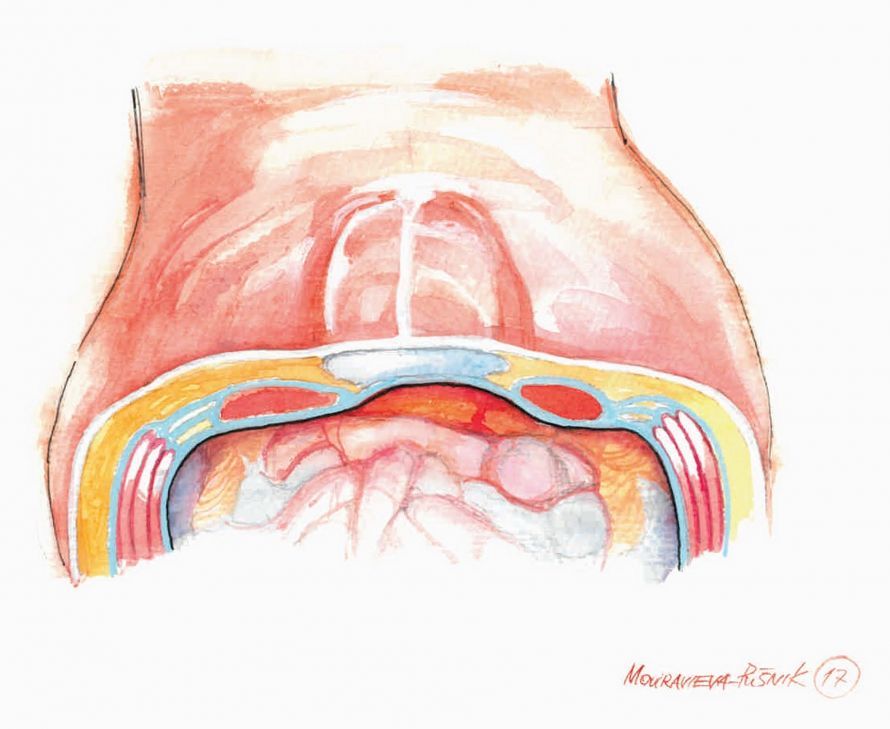
Placement of a synthetic mesh and transfasial fixation with sutures, if necessary._Mouravieva Risnik
“Risk factors are both patient- and surgery-related. On the patient side, obesity, diabetes, smoking, chronic cough, immunosuppression, or poor wound healing play a role. On the surgical side, infections, hematomas, or seromas, tension on the sutures, repeat surgeries, and inadequate suturing technique increase the likelihood of an incisional hernia. Incisional hernias occur more frequently after major laparotomies, which is related to the longer incision. They are therefore less common following laparoscopic procedures. “Essentially, anything that impairs wound healing or puts strain on the abdominal wall increases the risk,” states Dr. Gorjanc.
In summary, an incisional hernia results from a combination of individual patient characteristics, surgical technique, and the postoperative course. Avoiding risk factors through careful surgical planning, optimal suturing techniques, infection prevention, and targeted postoperative care is crucial for significantly reducing the likelihood of an incisional hernia.
The precise diagnosis and planning of incisional hernias require a combination of clinical examination and modern imaging techniques, as these hernias are particularly complex due to scar tissue, adhesions, and, in some cases, irregular defects.
First and foremost, the physical examination is crucial: The surgeon assesses the size, location, and extent of the hernia, checks the stability of the abdominal wall, and determines whether abdominal contents such as the intestine or fatty tissue have prolapsed into the hernial sac. Symptoms such as pain or a feeling of pressure, which may indicate complications like incarceration or strangulation, are also assessed.
Dr. Gorjanc comments: “The preoperative assessment is crucial. The clinical examination is often insufficient, especially in obese patients. CT scans are the gold standard: They reveal the size of the defect, the contents of the hernia, adhesions, and old mesh, and form the basis for surgical planning. A CT scan can often be performed without contrast medium, which significantly simplifies the entire examination. In specific cases, an MRI can be helpful for a more accurate assessment of soft tissue. In addition, there are assessment systems such as the “Carbonell Index” and the calculation of the so-called “Loss of Domain” for very large hernias (when so much abdominal contents are permanently trapped in the hernial sac that they no longer fit back into the abdominal cavity without difficulty), to assess the risk of perioperative complications and determine the indication for measures such as preoperative botulinum toxin injection, intraoperative fascial traction, and other supportive procedures.”
The Carbonell Index is a scoring system used to assess the complexity of incisional hernias. It takes into account factors such as defect size, loss of domain, adhesions, prior surgeries, mesh material, condition of the abdominal wall, and patient risk factors (e.g., BMI, diabetes, smoking). It is used to assess surgical risk, plan the optimal surgical strategy, and determine whether additional measures such as Botox, pneumoperitoneum, or component separation are necessary.
In the treatment of incisional hernias, specialized surgical techniques and modern materials have proven to be particularly effective, as these hernias are especially complex due to scar tissue, defect size, and adhesions.
Open and laparoscopic procedures complement each other in incisional hernia surgery. Open surgery provides direct access, allows for the safe release of adhesions, and is particularly suitable for large or multiple defects. The laparoscopic technique uses small incisions, spares muscles and soft tissues, and often results in less pain and a faster recovery—provided that the anatomical conditions allow for a minimally invasive approach. Modern synthetic meshes are used to stabilize the abdominal wall; their material, size, and strength are selected individually based on the specific defect. Correct fixation is crucial to prevent recurrences. For complex hernias, custom-made or modular meshes are increasingly being used; these adapt precisely to the shape of the defect and improve the functional stability of the abdominal wall.
“The most important foundation is a tension-free, synthetic mesh-supported reconstruction. The open ‘sublay technique’ is the standard approach here. Laparoscopic or robotic procedures are also almost always possible, but are often limited in cases of massive, scar-related hernias following multiple prior surgeries. The specific mesh material is selected based on the risk profile: synthetic meshes in clean surgical fields—which is almost always the case—and biological or hybrid meshes when there is a risk of infection. Sufficient mesh overhang and careful, usually non-traumatic fixation (self-adhesive meshes or adhesive) are crucial. For very large hernias—where the decisive measurement is usually the transverse diameter of the defect, e.g., over 8 cm—a standard sublay technique is no longer sufficient. In such cases, component separation techniques such as the transversus abdominis release (TAR) or preoperative abdominal wall relaxation with Botox or pneumoperitoneum are used. These techniques are designed to allow the abdominal wall to be closed without tension in cases of very large incisional hernias. In TAR, deep muscle layers are surgically released to create greater tissue mobility. Botox temporarily relaxes the lateral abdominal muscles, while a pneumoperitoneum expands the abdominal cavity through gradual insufflation of air—both facilitate the reduction of the hernia contents and the reconstruction of the abdominal wall. “The method involving intraoperative fascial traction is also helpful in bridging large defects,” explains Dr. Gorjanc.
The open Sublay technique is an established procedure for treating abdominal wall and incisional hernias. In this procedure, the synthetic mesh is placed beneath the rectus abdominis muscles but above the peritoneum. This position ensures a stable, tension-free reconstruction, good mesh integration, and low recurrence rates—especially for larger or complex defects.
Incisional hernias pose particular challenges for postoperative healing and the long-term stability of the abdominal wall because the tissue at the surgical site is already altered and weakened. The patient’s active cooperation—particularly early mobilization and avoiding excessive rest—is crucial for the outcome.

Placement of a synthetic mesh and transfasial fixation with sutures, if necessary._Mouravieva Risnik
“Incisional hernias carry an increased risk of infection, seromas, chronic pain, and recurrence. The scar tissue heals more slowly, and the abdominal wall is less stable. Long-term stability depends on good dissection techniques, tension-free methods, well-selected and correctly placed meshes, and optimization of patient factors—such as weight loss, diabetes control, and smoking cessation. After uncomplicated incisional hernia surgery, a rapid return to normal daily activities is recommended; however, heavy lifting and sports should be avoided for about 2–4 weeks. Patient cooperation is crucial for the healing process; resting for too long can even be detrimental, whereas the abdominal wall’s strength is largely restored after about four weeks. Only in cases of very large or complex hernias may a permanent restriction on heavy physical labor be necessary; this decision is made on a case-by-case basis, taking into account the patient’s expectations and individual situation. Preoperative counseling therefore helps to convey realistic expectations regarding very large incisional hernias, explaining to what extent a full recovery can be guaranteed and that postoperative discomfort is possible. “A return to physical activity therefore generally occurs after 2–4 weeks, except in cases of very large defects,” says Dr. Gorjanc.
The surgeon’s experience and the clinic’s specialization are crucial to the success of treatment for complex incisional hernias, as these procedures are significantly more demanding than primary hernia surgeries.
Clinics specializing in hernia and abdominal wall surgery have the necessary equipment, modern materials, intraoperative imaging, and instruments for complex cases. At the same time, this specialization enables an interdisciplinary team with expertise in anesthesia, postoperative monitoring, and rehabilitation—factors that significantly improve the chances of recovery and reduce the risk of complications. Studies and clinical experience show that surgeons with a high volume of surgeries and specialized expertise achieve significantly lower recurrence rates, fewer postoperative complications, and better functional outcomes. For patients, this means not only greater safety but also a faster recovery, less pain, and a stable abdominal wall in the long term.
“Experience is crucial. Complex incisional hernias should ideally be treated at specialized and certified hernia centers. There, complication and recurrence rates are significantly lower. Expertise encompasses not only the surgical technique but also preoperative planning, the choice of method, intraoperative decisions, and postoperative care—often provided by an interdisciplinary team (pain clinic, physical therapy, intensive care unit, etc.). Robotic hernioplasty, as a minimally invasive method, should always be considered an alternative whenever possible,” emphasizes Dr. Gorjanc, and with that, we conclude our conversation.
- Specialist in hernia surgery with a focus on complex abdominal wall and incisional hernias.
- Extensive surgical experience in open, laparoscopic, and
- robotic procedures.
- High professional recognition: FRCS (Royal College of Surgeons) and FEBS AWS (European Hernia Surgery).
- Surgical practice in Klagenfurt with a quality certificate from the German Hernia Society, guaranteeing modern and precise care.
Share this article
Expert Interviews
Read next
- Expert interview
Expert interview with Professor Dr Elmar Herbst, PhD
Oct 15, 2026
Patient-centred and personalised knee surgery
Read more - Expert interview
Cardiogeriatrics: Significance and benefits in the context of hospital reform
Sep 21, 2026
Cardiogeriatrics: Significance and benefits in the context of hospital reform
Read more - Expert interview
Expert Interview with Professor Dr. Amadeus Hornemann, MPH
Sep 18, 2026
Prof. Amadeus Hornemann on Precision Medicine in Gynecology: Modern Surgery, New Techniques, Better Quality of Life
Read more