Expert Interviews
Prof. Pascher: “Only through an interdisciplinary approach can we offer the best possible treatments!”

Claudia Dechamps ·
University Professor Dr. med. Andreas Pascher is one of Europe’s leading surgeons in the field of neuroendocrine tumors—and this experienced visceral surgeon is regarded as an absolute authority on rare tumor diseases of the gastrointestinal tract. In 2018, he was awarded the Von Langenbeck Prize—one of the highest honors bestowed by the German Society for Surgery—for his outstanding scientific achievements in the field of intestinal and multivisceral transplantation. At the University Hospital of Münster, he emphasizes interdisciplinary collaboration and state-of-the-art oncological surgical techniques. The Leading Medicine Guide spoke with this exceptional physician about his vision and the path to achieving these goals.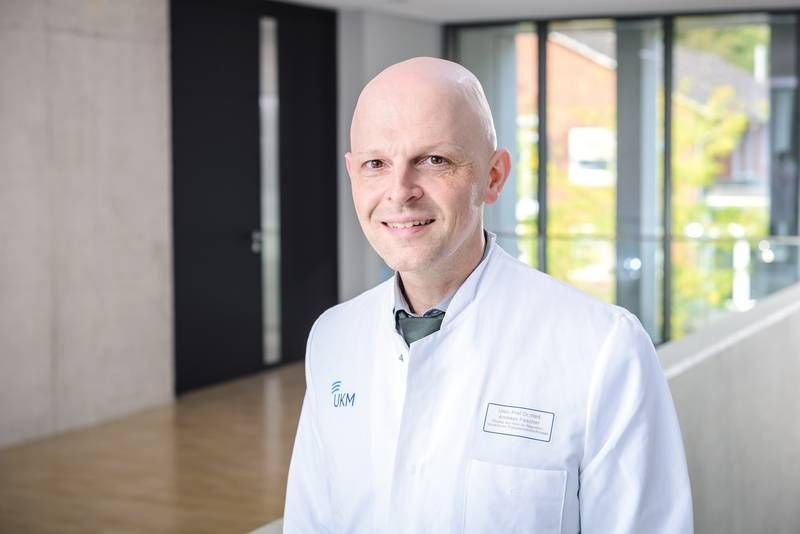
Visceral surgeon Professor Dr. Andreas Pascher is a specialist in liver surgery, pancreatic surgery, gastric, intestinal, and esophageal surgery, as well as oncological and robotic surgery at the University Hospital of Münster. For this highly accomplished physician, who is driven by passion and conviction, interdisciplinary collaboration is of the utmost importance. “This is the only way we can achieve university-level surgery combined with optimal patient care,” says the head of the Department of General, Visceral, and Transplant Surgery at Münster University Hospital. Interdisciplinarity opens up many opportunities. On the one hand, there is an ever-increasing level of specialization in medicine; on the other hand, one must be able to look beyond disciplinary boundaries and work across them. “Only through interdisciplinarity can we offer the best possible and most comprehensive treatments,” emphasizes Prof. Pascher
Stiff hierarchies must change
In visceral medicine in particular, visceral surgery and gastroenterology must be considered together. Through professional exchange, the pieces of the puzzle are put together, so to speak, to develop an individualized and optimal treatment plan. To this experienced physician—whose career has included stints at Charité, Berlin’s University Hospital, and Hannover Medical School—it is clear that interdisciplinary work can only be embedded in a comprehensive process of change. “In hospitals and in medicine, there have traditionally been very steep hierarchies; these structures must change. Today, people work together everywhere in flatter hierarchies. The goal is to strengthen individual responsibility,” explains Prof. Pascher.
Team leadership takes center stage
In day-to-day hospital life, this means that for this leading physician, team leadership takes center stage, and there must be room for dialogue between the various professions. “We must communicate with all stakeholders—not only the physicians from various specialties, but also the nurses, physical therapists, and others. It’s not enough to simply perform highly complex surgical procedures; the follow-up care must also meet the highest standards.” This would require many stakeholders to change their attitudes—a process that is not always easy and requires persuasion. After all, those who have been with the institution for a long time may need to question their own positions in certain areas.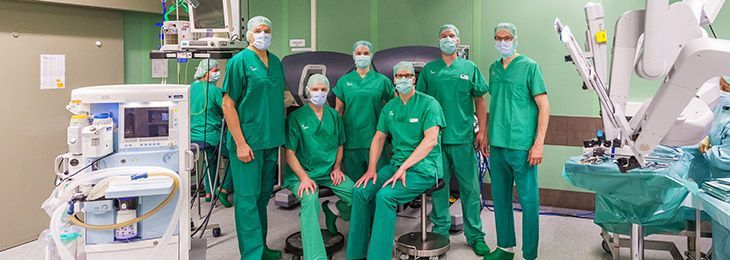
A Willing Ear at Münster University Hospital
But at Münster University Hospital, Prof. Pascher finds a receptive audience for his call for interdisciplinarity. It certainly helps that the hospital’s own nursing school can train the next generation of staff. “This allows us to develop our employees and retain good teams over the long term,” says Prof. Pascher, describing the obvious benefits. Given the acute shortage of skilled workers, this is a key component of the employee strategy that should not be underestimated. “We need visions for our healthcare system,” says Prof. Pascher.
Visions for our healthcare system
He wants to help improve the system. To be able to translate these visions into everyday hospital practice, he also completed an MBA in Health Care Management. He is pleased to observe that the next generation of doctors views interdisciplinarity as a matter of course and intuitively works well and willingly as part of a team. Recognition, greater individual responsibility, and reduced workloads—these are the levers for counteracting the shortage of skilled workers.
In keeping with this approach, the homepage of his Clinic for General, Visceral, and Transplant Surgery at the University Hospital of Münster lists not only the physicians but also the nursing supervisors for the operating room and inpatient units. “During rounds here, it’s no longer the case that the doctor simply gives instructions to the nursing staff; instead, they discuss the best course of action for the patient together. After all, the nurses have their own expertise and wealth of experience, and so do the doctors. Together, this provides the best possible foundation for a good chance of recovery.”
Well-Thought-Out Communication Structures
In the operating room as well, fundamental structures ensure the highest possible level of safety. Prof. Pascher explains this using a simple example: “How do our teams communicate with one another? We practice two-way communication. For example, the surgeon says, ‘I need that instrument, please,’ and the surgical assistant replies, ‘I’m passing the instrument.’ This is how we reduce errors caused by inadequate communication.” Another example of how we minimize risks is the comprehensive training in the surgical field. “We have a highly developed program for minimally invasive and robotic surgery,” explains Prof. Pascher. “Although the focus is on minimally invasive and robotic surgery, we still have to train the teams in all three methods: open, minimally invasive, and robotic surgery.”
Last but not least, certifications from medical professional associations also serve as an important mechanism for monitoring our own quality standards. “By repeatedly seeking certification, we commit to the process of maintaining our own excellence,” explains Prof. Pascher.
Many building blocks for an excellent whole
As the head of the clinic, visceral surgeon Prof. Pascher sees himself, in a sense, as a conductor or coach. “I have to provide guidance, but I also have to be able to participate myself,” he explains with a slight smile. The strong teams at his hospital make day-to-day operations much easier, however. But that doesn’t happen on its own. Prof. Pascher gives an example: “Today, surgery is no longer a purely male-dominated field. But that requires a shift in mindset. Key challenges include: How does this change our leadership culture? How do we bring colleagues back up to speed on the latest technical and surgical standards after parental leave? We address the latter, for example, with the surgical simulator. And how do we structure work hours so that all our employees can balance family life with providing cutting-edge medical care?” Here, too, many small building blocks come together to form an efficient, well-functioning whole. And always across disciplinary boundaries, in an interdisciplinary, collaborative—and successful—manner.
Prof. Pascher, thank you very much for the informative conversation.
You can contact our specialist directly via his profile page in the Leading Medicine Guide.
Share this article
About the medical author
Claudia Dechamps
Editor
Claudia Dechamps – medical author: expert articles, professional insights and medical knowledge in the Leading Medicine Guide.
More about the medical author →Expert Interviews
Read next
- Expert interview
Cardiogeriatrics: Significance and benefits in the context of hospital reform
Sep 21, 2026
Cardiogeriatrics: Significance and benefits in the context of hospital reform
Read more - Expert interview
Expert Interview with Professor Dr. Amadeus Hornemann, MPH
Sep 18, 2026
Prof. Amadeus Hornemann on Precision Medicine in Gynecology: Modern Surgery, New Techniques, Better Quality of Life
Read more - Expert interview
Expert Interview with Professor Dr. Konstantinos Anagnostakos
Sep 15, 2026
Prof. Anagnostakos on Painful Knee Replacements
Read more