Expert Interviews
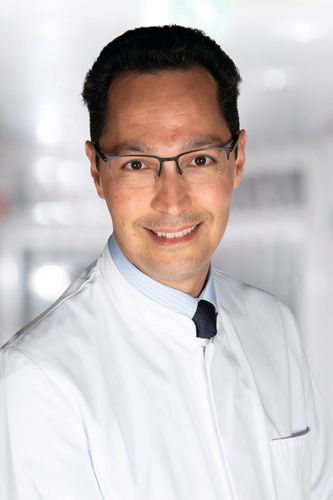
Prof. Dr. med. Frank Breuckmann and Our Most Important Organ: “A Matter of the Heart!”

Alexandra Pfitzmann ·
The heart has always been considered a particularly vulnerable organ; after all, it is the engine of our body. We feel our heartbeat, which is a sign that we are alive. That is why it is so frightening when the heart becomes diseased. Cardiovascular diseases have become increasingly prevalent over the course of the 20th century—by the turn of the millennium, they accounted for nearly fifty percent of deaths in industrialized countries and about a quarter in developing countries. Heart and circulatory problems are classified as so-called “lifestyle diseases,” since Western lifestyles in particular—characterized by a high-fat diet, nicotine use, and often a lack of exercise—contribute to these conditions. The spectrum of these diseases is broad, ranging from high blood pressure and arrhythmias to heart failure, stroke, and heart attack.
The editorial team of the Leading Medicine Guide spoke with Professor Frank Breuckmann, M.D., a specialist in cardiology, internal medicine, and intensive care and emergency medicine, and Chief Physician of the Department of Internal Medicine at Klinik Kitzinger Land near Würzburg, about this field. Prof. Breuckmann enjoys an international reputation and possesses a high level of expertise, particularly in the treatment of heart attacks and strokes.

Leading Medicine Guide: Narrowing of the coronary arteries can lead to a lack of oxygen in the heart and trigger a heart attack. What treatment options can you and your team offer in such cases?
Prof. Dr. med. Frank Breuckmann: Narrowing of the coronary arteries, known as stenoses, can be treated in a variety of ways. The first step is to determine the extent to which the affected artery is narrowed. Depending on the patient’s symptoms, this can be determined through direct cardiac catheterization or—especially if there is no heart attack or acute circulatory disturbance—through non-invasive diagnostic procedures. For non-invasive procedures, our clinic uses virtual cardiac catheterization via computed tomography, as well as various ultrasound examinations.
What is a cardiac catheterization?
After administering local anesthesia, a thin plastic tube (catheter) is inserted into the patient—either through the arm or the groin—under X-ray guidance and advanced to the heart or the aorta near the heart. Once in place, images using contrast dye can be obtained, and pressure measurements and imaging can be performed. During the cardiac catheterization, various parts of the heart can be examined. In most cases, the examination is limited to visualizing the coronary arteries and thus assessing blood flow to the heart muscle. Depending on the reason for the examination, the ventricles, atria, and other involved vessels may also be examined, which can sometimes be important, for example, in cases of heart valve disease.
If a significant narrowing is identified at the end of the diagnostic evaluation—that is, a narrowing that poses a risk to the heart’s blood supply—we offer all standard treatment options via cardiac catheterization. This includes simple balloon angioplasty, angioplasty using special drug-eluting balloons, and the placement of stents. The stents implanted today are virtually without exception drug-eluting, which ensures long-term patency. In rare cases, a surgical procedure, such as bypass surgery, may be recommended.
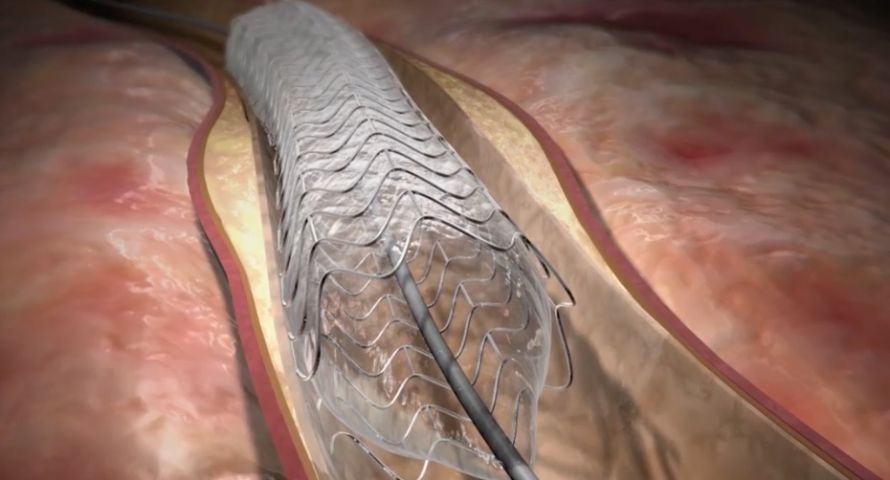
But don’t worry: Dilation, stent placement, or surgery aren’t always actually necessary. Depending on their severity, some narrowings can be treated solely with medication and a healthy lifestyle, with ongoing monitoring of the condition.
Leading Medicine Guide: Please explain the use of stents. How does stent implantation work, and what are the associated risks?
Prof. Dr. med. Frank Breuckmann: A vascular support—also known as a stent in medical terminology—is a small wire mesh that is inserted into a blood vessel “from the outside,” so to speak, without surgery, to keep it open in the long term. The procedure takes place in an operating room-like setting known as a cardiac catheterization lab. After local anesthesia, a thin access point, similar to an IV line, is inserted into an artery in the arm or groin. Through this access point, extremely thin wires and catheters can be advanced through the blood vessels to the heart. The catheters are then used to visualize the coronary arteries using contrast dye. The physician closely monitors the entire procedure under X-ray guidance via their monitors. The procedure is generally painless.
If a narrowing requiring treatment is found, a folded stent can be inserted into the affected coronary artery via one of these special tubes—the guide catheter—and expanded using pressure from a balloon. The deposits are pushed aside by the stent, clearing the path once again. This may cause a brief sensation of pressure in the chest, but it subsides quickly. Sometimes it is necessary to insert several such stents during a single procedure.
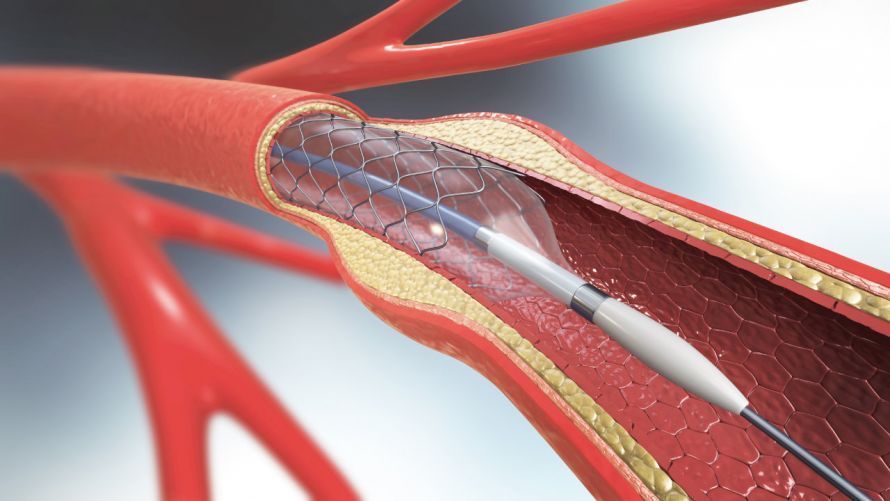
Even though stent implantation can cause complications in rare cases, you do not need to worry too much about risks during the procedure. Stent implantation usually proceeds without incident. Despite the routine nature of the procedure and the use of specialized techniques, we know that the risk increases with age, the presence of underlying medical conditions, and the severity of the patient’s condition. Therefore, the risk is assessed individually for each patient and weighed against alternative treatments.
Leading Medicine Guide: Please explain the dangers of arterial hypertension. Why does high blood pressure develop, and what makes it so dangerous?
Prof. Dr. med. Frank Breuckmann: Arterial hypertension is one of the most important treatable risk factors for the cardiovascular system. The problem with arterial hypertension—that is, high blood pressure—is that it doesn’t cause pain. As a result, high blood pressure can persist for years and cause long-term damage without the patient even realizing it. According to WHO estimates, half of all strokes and heart attacks are a direct result of high blood pressure. If high blood pressure is detected early, it can usually be managed effectively.
Nearly nine out of ten patients suffer from what is known as essential or primary hypertension. This is caused by increased vascular resistance or increased vascular stiffness. Contributing factors can include, for example, advanced age, an unhealthy diet, being overweight, lack of exercise, stress, or genetics. Only in about ten to fifteen percent of patients are other medical conditions the underlying cause—such as disorders of the kidneys, adrenal glands, or thyroid. These specific conditions would each require specialized treatment.
An essential and fundamental component of any treatment—and, incidentally, of prevention as well—is a healthy lifestyle, particularly one that includes regular, moderate physical activity, a healthy diet, and emotional well-being. Medication is only necessary when high blood pressure is more severe, when relevant comorbidities are present, or when general measures lead to only limited improvement. As a rule, this is now implemented from the very beginning using two blood-pressure-lowering medications. Patients can greatly support the management of their condition and the adjustment of their medication by regularly monitoring their blood pressure themselves and keeping a blood pressure diary.
If achieving the right medication regimen proves particularly difficult, specially trained physicians—known as hypertensiologists, who meet the criteria of the German Hypertension League—are available, as is the case here at the Kitzinger Land Clinic.
Leading Medicine Guide: Your clinic in the Kitzinger Land region has a so-called “stroke unit” specifically designed for stroke patients. What distinguishes such a stroke unit?
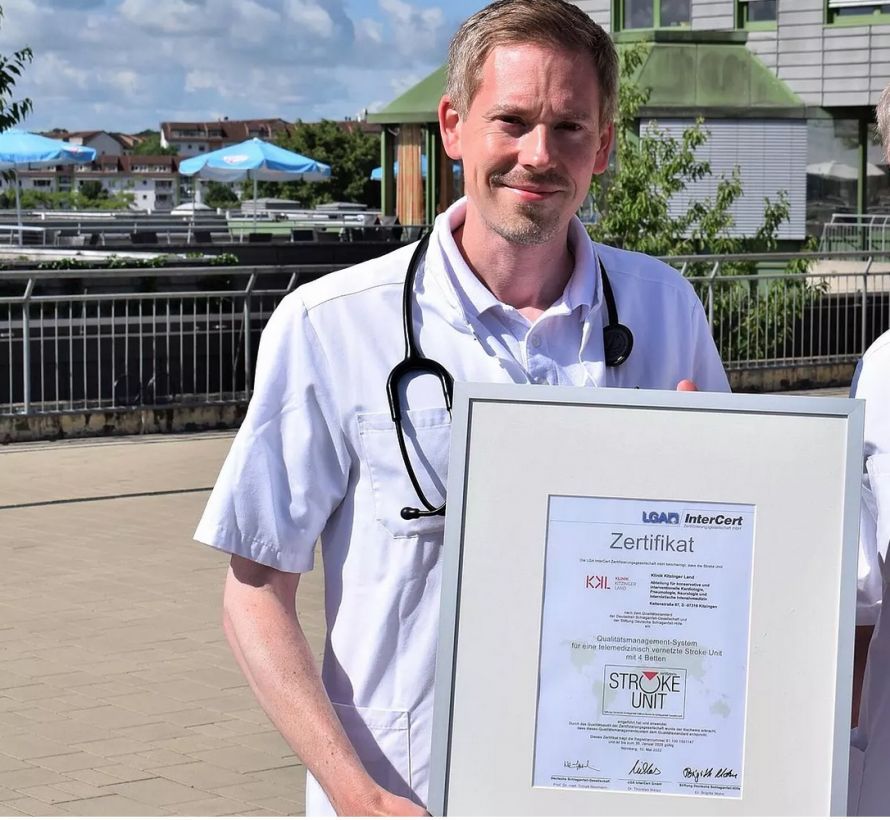
Prof. Dr. med. Frank Breuckmann: Stroke treatment requires specialized and interdisciplinary collaboration among experts. The stroke unit is a specialized monitoring unit where stroke patients are cared for and treated by a qualified team of specialized physicians and nurses, physical therapists, speech therapists, occupational therapists, and social workers. The Kitzinger Land Clinic has had such a stroke unit since 2012. It is integrated into the intensive care unit, has four beds reserved specifically for stroke patients, and was recently recertified by the professional neurological society. To ensure optimal care for our stroke patients, our clinic is also a certified member of the Stroke Network with Telemedicine in Northern Bavaria (STENO). This network brings together three supraregional stroke treatment centers and eighteen general and specialized care hospitals in Middle, Upper, and Lower Franconia, as well as in parts of the Upper Palatinate and southern Thuringia. The acute care hospitals, including our clinic, utilize the telemedicine connection to the three centers providing the highest level of care.
A stroke occurs when there is a sudden disruption of blood flow to the brain. The affected part of the brain receives insufficient oxygen, causing damage to the tissue. Since the damage to nerve cells—similar to that of heart muscle cells during a heart attack—progresses rapidly, it is important to act at the first signs of a stroke. The first four to five hours after a stroke are considered critical.
Pioneering Achievement: Certification of “Chest Pain Units”
Prof. Dr. med. Frank Breuckmann was directly involved as the lead author in a true milestone in innovative cardiology: As a specialist in acute chest pain, he was among the authors of the first position paper by the German Society of Cardiology that promoted the certification of “Chest Pain Units.” To ensure that these “chest pain units” could establish themselves as emergency facilities for the initial care of patients with unexplained chest pain, Prof. Breuckmann was committed to this cause from the very beginning—with success. Today, there are many such facilities where acute or newly onset chest pain is evaluated quickly and effectively. With the forward-looking care structure of the “Chest Pain Units,” an important step was taken under the leadership of this renowned specialist toward take both the diagnosis and treatment of acute heart attacks to a new level—even in cases of atypical chest pain—and significantly improve the chances of survival for those affected.
As Prof. Breuckmann recently clarified: “Especially in cases of chest pain that may indicate a heart attack or similarly serious conditions, prompt medical treatment is vital and a matter of life and death.” Much has changed since he began in 2008, first working to build up local programs and eventually dedicating himself to establishing “Chest Pain Units”: When Prof. Breuckmann led the West German Heart Center in Essen to become the first certified “Chest Pain Unit,” he could not have imagined that just a few years later, over 300 such “chest pain units” would be available throughout Germany for initial care, including, of course, a clearly defined goal at the Kitzinger Land Clinic. Prof. Breuckmann continues to follow these developments, as he remains one of the most experienced experts in this field and is actively involved in optimizing care for heart attacks—and is in high demand as a consultant throughout Europe and the U.S.
Leading Medicine Guide: In addition to cardiology, you also have a strong focus on pulmonology. Please explain the connection between the heart and the lungs.
Prof. Dr. med. Frank Breuckmann: In addition to neurology—with its focus on critical stroke care—and internal medicine intensive care for the treatment of critically ill patients, pulmonology is an integral part of our cardiology-focused department. The heart and lungs form a functional unit. The right side of the heart carries oxygen-poor blood to the lungs, where it is oxygenated and then pumped through the left side of the heart into the body and to the organs. Diseases of both the heart and the lungs can cause the primary symptom of shortness of breath—whether at rest or during exertion. In such cases, it is important to have the appropriate expertise in both areas. Heart failure, for example, can lead to fluid buildup in the lungs; the lung tissue becomes compressed, causing shortness of breath. On the other hand, lung diseases themselves can lead to increased pressure in the so-called pulmonary circulation and to heart failure. The treatment approaches here vary greatly—it is therefore important not to focus solely on the heart in cardiology.
Professor Dr. Breuckmann, thank you very much for this interview!
Anyone who would like to learn more about Prof. Dr. med. Frank Breuckmann should definitely visit his profile page in the Leading Medicine Guide. You can also easily contact him there.
Share this article
About the medical author
Alexandra Pfitzmann
Editor
Alexandra Pfitzmann – medical author: expert knowledge, professional articles and medical insights in the Leading Medicine Guide.
More about the medical author →Expert Interviews
Read next
- Expert interview
Cardiogeriatrics: Significance and benefits in the context of hospital reform
Sep 21, 2026
Cardiogeriatrics: Significance and benefits in the context of hospital reform
Read more - Expert interview
Expert Interview with Professor Dr. Amadeus Hornemann, MPH
Sep 18, 2026
Prof. Amadeus Hornemann on Precision Medicine in Gynecology: Modern Surgery, New Techniques, Better Quality of Life
Read more - Expert interview
Expert Interview with Professor Dr. Konstantinos Anagnostakos
Sep 15, 2026
Prof. Anagnostakos on Painful Knee Replacements
Read more