Expert Interviews
Prostate Diagnostics and the Resulting Image-Guided Surgical Techniques - Expert Interview with Professor Marko Brock, M.D.

Sabine Schneider ·
Professor Marko Brock, M.D., is a leading specialist in the field of urology and robot-assisted surgery and heads the Department of Urology and Minimally Invasive/Robotic Surgery at Prosper Hospital in Recklinghausen. With his many years of experience and expertise, he has earned an outstanding reputation in the treatment of urological conditions. Prof. Dr. Brock is particularly well-known for his use of the Da Vinci surgical system, which enables procedures to be performed with exceptional precision and minimal trauma.
His areas of clinical focus include the treatment of prostate cancer, bladder and kidney tumors, and benign prostatic hyperplasia. Of particular note is his expertise in robot-assisted prostatectomy and in the treatment of complex urological conditions where minimally invasive techniques play a crucial role. With more than 390 robot-assisted procedures in 2023—including over 230 radical prostatectomies—Prof. Dr. Brock impressively demonstrates his high level of expertise and experience in this field. In addition to his surgical work, Prof. Dr. Brock is deeply involved in medical research, particularly in the diagnostic imaging of prostate cancer.
As a member of numerous urological professional societies, he is also actively committed to the exchange of knowledge and the advancement of urological medicine. Prof. Dr. Brock is valued not only for his medical excellence but also for the personal and compassionate care he provides to his patients. Through his combination of state-of-the-art technology, scientific expertise, and a compassionate approach, he ensures optimal care for each individual patient.
The editorial team of the Leading Medicine Guide had the opportunity to speak with Prof. Dr. Brock specifically on the topic of prostate diagnostics.

Prostate diagnostics have made significant advances in recent years, particularly through the use of modern imaging techniques such as magnetic resonance imaging (MRI) and fusion imaging. These technologies enable more precise and earlier detection of prostate cancer and provide a basis for personalized treatment methods. Image-guided surgical techniques are used particularly in the field of surgical therapy; these techniques make it possible to precisely locate tumors and perform minimally invasive procedures with the highest precision. This not only optimizes tumor removal but also helps preserve the surrounding healthy tissue.
In recent years, prostate diagnostics have advanced significantly through the use of advanced imaging techniques, enabling a substantial improvement in diagnosis and more precise treatment planning.
“The concept of fusion imaging is particularly exciting in this context. I have a long-standing connection to this field, as I have been working with MRI imaging for prostate cancer for over ten years. In the beginning—that is, before MRI was widely available and established throughout Germany—we relied heavily on ultrasound techniques—such as contrast-enhanced ultrasound, conventional B-mode ultrasound, or elastography, in which mechanical waves are directed into the tissue. At that time, attempts were made to visualize prostate cancer from various perspectives, but this approach ultimately led to the adoption of MRI. Today, MRI has a firm place in the diagnosis of prostate cancer and prostate health in general. With the recent revision of the German S3 guideline, MRI has gained even greater importance: Traditional digital rectal examination is increasingly taking a back seat in screening. Instead, MRI is now recommended directly in cases of an abnormal PSA level or a rapid rise in PSA—which confirms the existing diagnostic approach. Ultrasound and contrast agents are limited in their diagnostic value in this context. Even though there have been recent developments in the field of high-resolution ultrasound, in which certain areas of the prostate do not appear to be inferior to MRI, the ultrasound method remains limited overall—both in terms of sensitivity and specificity. In contrast, MRI is technically standardized. Multiparametric MRI combines various sequences such as diffusion imaging, T2 imaging, and contrast-enhanced techniques. This standardization makes it the preferred method for visualizing prostate cancer,” explains Prof. Dr. Brock at the beginning of our conversation, adding:
“Elastography hardly plays a role anymore. Since MRI has become available at this level of quality, it is rarely used in clinical practice. The procedure is simply too imprecise, too subjective, and prone to error. Many of the abnormalities visible there ultimately do not correspond to cancer. Therefore, the use of elastography for prostate diagnostics is strongly discouraged—even though it is still used in some practices or clinics. From a technical standpoint, this is hardly justifiable, especially since the S3 guideline clearly advises against using elastography for the diagnosis of prostate cancer. If at all, it could be used as a supplementary tool for determining size—but it is unsuitable for predicting cancer.” 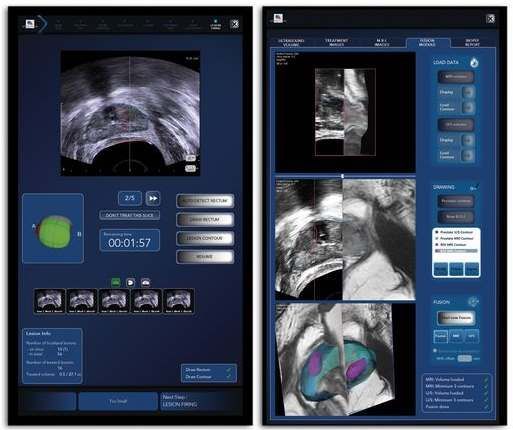
One of the greatest strengths of fusion imaging is its ability to prevent misdiagnoses. With conventional biopsies, in which samples are usually taken blindly from multiple sites in the prostate, tumors may be overlooked or samples may be taken from less affected areas. With image-guided fusion biopsy, however, samples are taken directly from the suspicious areas, leading to a higher success rate and a more accurate diagnosis.
Before surgery is even considered, detailed imaging is performed first—in this case, an MRI of the prostate. It is important to note that the MRI itself does not provide a diagnosis.
“The diagnosis of prostate cancer is always made histologically, that is, through a microscopic examination of tissue. Imaging, however, provides a crucial indication of whether cancer is suspected and whether a biopsy—that is, a tissue sample—is therefore necessary. This is precisely where the great advantage of MRI becomes apparent. In patients who have not yet undergone a biopsy, MRI can achieve a sensitivity that is five to ten percent higher. This means that the probability of actually detecting a tumor increases. At the same time, MRI allows for a more precise characterization of the tumor. There may be multiple foci within the prostate—but the key is to identify the one with the highest potential for metastasis. Only so-called clinically relevant carcinomas actually require treatment. This is precisely where MRI’s strength lies. Therefore, if there is an elevated PSA level or another cause for suspicion, an MRI is performed first. This is followed—if necessary—by a targeted fusion biopsy, in which the MRI images are combined with live ultrasound imaging. If the tumor is histologically confirmed and precisely localized, a sort of “tumor map” is created, which serves as the basis for planning treatment. This MRI-based planning provides crucial information, particularly for scheduled surgery: for example, the exact location of the tumor in relation to the bladder neck, the sphincter, the urethra, or the rectum. This allows for significantly more precise surgical planning. “This information also makes it easier to decide whether and to what extent nerve-sparing surgery is possible,” explains Prof. Dr. Brock.
Image-guided surgical methods and robot-assisted techniques offer numerous advantages over traditional surgical procedures in the treatment of prostate cancer.
One of the greatest strengths of these modern approaches is their significantly improved precision. By combining imaging techniques such as MRI and ultrasound, surgeons can visualize the exact location of the tumor in real time, enabling targeted and minimally invasive removal of the tumor. This results in reduced tissue loss, as healthy areas of the organ can be spared. Compared to traditional procedures, in which the surgeon may have to rely on blurry or less detailed imaging information, image-guided surgery allows for more precise planning and execution of procedures.
“Robotics plays a central role in our surgeries, especially in prostate surgeries. The preoperative diagnostics are crucial for surgical planning. For example, we determine whether lymph node removal is necessary in cases of moderately aggressive prostate cancer based on the tumor’s location and size on the MRI, as well as the risk of metastasis, which we calculate using nomograms. This approach helps us avoid unnecessary lymph node removal and thereby reduce complications such as lymphedema or thrombosis. We now perform all prostate surgeries exclusively with robotic assistance using the DaVinci system, carrying out approximately 300 procedures for prostate cancer each year alone. In addition, we perform around 40 radical cystectomies with abdominal reconstruction, as well as approximately 100 surgeries for kidney tumors, including partial removals. We first introduced the DaVinci system in 2008, at that time using an older generation of the system. Today, we have the latest four-arm system from Intuitive, and we have two units in use. Patients are hardly bothered by the use of robotics anymore, as this technology has now become standard and is no longer a unique selling point. We are particularly well-positioned thanks to the excellent quality-of-life data that we systematically collect. As a certified German cancer center and urological oncology center, we are evaluated based on quality parameters. These include, among other things, tumor-free status, recurrence rates, and, above all, patients’ quality of life—such as the incidence of urinary incontinence or erectile dysfunction. “In these areas, we have consistently ranked among the top centers compared to over 130 centers in Germany, Austria, and Switzerland for several years, and have even held the top spot for the past two years,” states Prof. Dr. Brock. 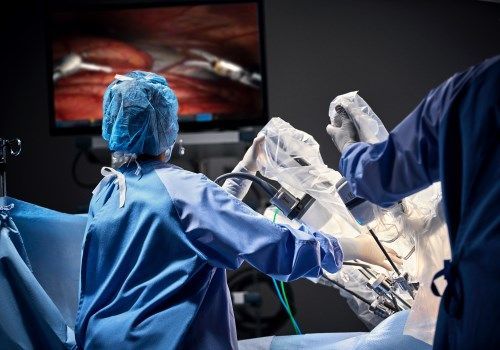
The introduction of image-guided surgery has significantly improved the healing process and postoperative recovery for patients with prostate cancer. These modern technologies—in particular the combination of high-resolution imaging techniques such as magnetic resonance imaging (MRI) and ultrasound, as well as the use of robot-assisted surgery—offer surgeons more precise visualization and planning of the procedure. This leads to a number of benefits that positively influence the healing process and recovery after surgery.
“The tumor-specific prognosis for prostate cancer—that is, whether a tumor will recur or metastasize—depends largely on the aggressiveness of the tumor and the timing of the diagnosis. Nowadays, surgery is generally performed starting at Stage 2, and early diagnosis combined with modern imaging—which determines the tumor size even before surgery—enables nearly 100% tumor-free outcomes. Tumors that are detected later and may already have metastasized to lymph nodes or invaded neighboring organs, on the other hand, carry a high risk of recurrence despite surgery. Therefore, it is essential to tailor both diagnosis and treatment to be patient-centered and individualized. The individual need for reassurance among patients and their families plays an important role in this context. While younger patients usually want to undergo a biopsy to be sure, older patients often make a conscious decision against further testing and prefer to live with a certain degree of risk. Treatment is also tailored accordingly to the patient’s personal risk and individual needs, for example through more frequent follow-up care or additional adjuvant therapies in cases of higher relapse risk,” explains Prof. Dr. Brock, adding an important note:
“If a finding is merely monitored, follow-up is conducted strictly according to guidelines. Patients are usually enrolled in an observational study such as the PRIAS study (Prostate Cancer Research International: Active Surveillance), which is reviewed annually on an international basis. Currently, about 70 patients are enrolled in the study. Follow-up examinations are conducted in collaboration with primary care physicians, with PSA levels measured every three months. A repeat MRI is generally recommended after one and three years, based on established criteria, or sooner if the PSA level changes significantly. Unfortunately, many men are largely unaware of these options and the current state of the evidence, as there is a great deal of misinformation on the internet. Therefore, it is advisable to consult a qualified physician.”
The typical patient with prostate cancer is in his mid-60s, although screening is recommended starting at age 45 or 50, as the risk increases significantly during this period. There is a clear need for public education in this area, as men are less likely than women to undergo screening.
Prof. Dr. Brock recommends: “Screening is particularly important, however, because tumors can be treated or monitored more effectively in the early stages. A major problem is that statutory health insurance does not cover the cost of prostate MRI scans. PSA tests are also not covered by insurance but are classified as IGeL services, which patients must pay for themselves. The MRI, which is recommended by the guidelines to refine the diagnosis, costs patients several hundred euros. This financial burden means that many patients are not treated in accordance with the guidelines, which represents a significant disadvantage compared to other types of cancer, such as breast cancer in women, for which mammograms are covered by insurance. This issue is rarely addressed at the political level, even though prostate cancer is the most common cancer in men. Studies demonstrating the benefits of MRI and fusion biopsy are sometimes ignored because expert reports—such as those from the IQWiG (Institute for Quality and Efficiency in Health Care)—reach different conclusions without the involvement of urologists. For clinicians, this creates a conflict: They want to provide patients with guideline-based care, but cannot always order the recommended tests because they are not covered, which limits the quality of diagnosis.”
Prostate cancer is considered one of the most treatable types of cancer when detected early!
Prof. Dr. Brock explains: “In the past, surgery or radiation therapy was often performed immediately upon diagnosis, which was associated with significant side effects such as incontinence and erectile dysfunction. Today we know that many early-stage tumors can initially be monitored, and only about 40 percent of patients will require treatment later on if the tumor becomes more aggressive. Many men’s fear of incontinence or erectile dysfunction following a diagnosis is therefore often unfounded. Modern, nerve-sparing surgical techniques result in complete continence without the need for incontinence pads in over 90 percent of cases for patients without additional risk factors such as diabetes or obesity. Factors such as pre-existing incontinence or prior radiation therapy can worsen outcomes, but the surgery itself is not always the cause of such symptoms. “That is why individualized, patient-centered treatment planning is crucial to maintaining the best possible quality of life and to performing surgery only on patients for whom the benefits clearly outweigh the risks.”
Healthcare policy in Germany is undergoing a comprehensive transformation, shaped primarily by the current hospital reform. This reform aims to improve care by centralizing complex procedures at specialized hospitals with the appropriate experience.
Studies show that a higher caseload improves the quality of care for complex surgeries. At the same time, the practical implementation of the reform poses a challenge in many regions, for example due to a lack of information and short lead times. Furthermore, financial aspects—such as the adjustment of reimbursement systems—and the long-overdue digitization of the healthcare system are important issues that are crucial for ensuring high-quality patient care in the long term.
“I generally welcome the current hospital reform, which centralizes procedures at hospitals with specific levels of experience. Studies show that, particularly in the case of complex cancer surgeries, quality improves when these procedures are performed more frequently. However, I find the manner in which the reform is being implemented—especially here in North Rhine-Westphalia—problematic; there was too little information and lead time, which makes practical implementation difficult. It would also be desirable to make quality measurable and to reward higher quality with higher reimbursement, for example through a quality-oriented DRG (Diagnosis-Related Group). In urology, specifically regarding prostate cancer, efforts are currently underway to implement this, but we are still a long way from achieving it. Another major issue is the revision of the fee schedule for physicians, which affects private billing. We have serious concerns here because revenue from private insurance cross-subsidizes the healthcare system. If the fee schedule becomes more restrictive and we are only allowed to bill for standard procedures, we face the risk of significant revenue losses. This, in turn, jeopardizes cross-subsidies, such as prostate MRI scans for patients with public health insurance, which are often not covered at present,” says Prof. Dr. Brock, adding:
“Hospitals are already struggling to survive and must constantly invest in new technology to remain competitive. Good cost-effectiveness and digitalization are essential in this regard. Unfortunately, digitization is still lagging behind in many hospitals. For example, there is still no widespread implementation of electronic physician reports or integration with electronic health records. While digitization is being driven forward in medical practices, hospitals are often stuck with outdated systems. Data protection regulations also make it difficult to simply send test results via email, and fax machines are still in use—a technology that, in my view, has long been obsolete. Policymakers need to invest more here and accelerate implementation, because the financial burden is a major hurdle for hospitals.”
Finally, a clear appeal to all men!
“More screenings, less Dr. Google. Screenings are recommended starting at age 45 or 50 and usually take place once a year. If the PSA level is low at the start, the intervals can be extended to up to three years. The digital rectal exam is becoming less important in this context, but it’s still performed, for example, to estimate prostate size. Thanks to modern technology, screenings can now be conveniently conducted via blood draw and video call—which makes participation even easier and more practical for patients,” advises Prof. Dr. Brock, and with that, we conclude our conversation.
Thank you very much, Professor Dr. Brock, for this important information on prostate diagnostics!
Share this article
Expert Interviews
Read next
- Expert interview
Expert interview with Professor Dr Elmar Herbst, PhD
Oct 15, 2026
Patient-centred and personalised knee surgery
Read more - Expert interview
Cardiogeriatrics: Significance and benefits in the context of hospital reform
Sep 21, 2026
Cardiogeriatrics: Significance and benefits in the context of hospital reform
Read more - Expert interview
Expert Interview with Professor Dr. Amadeus Hornemann, MPH
Sep 18, 2026
Prof. Amadeus Hornemann on Precision Medicine in Gynecology: Modern Surgery, New Techniques, Better Quality of Life
Read more