Expert Interviews
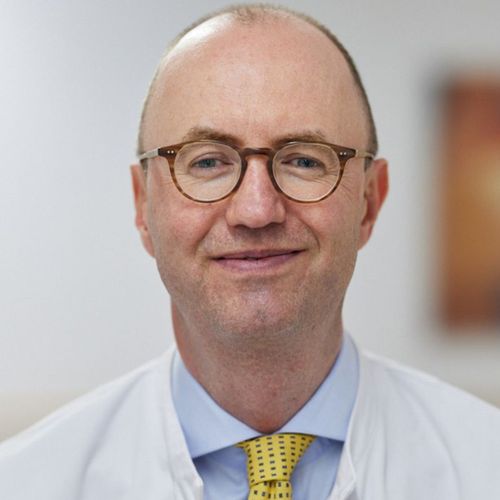
Prof. Schräder on the Modernization Drive in Endoprosthetics

Alexandra Pfitzmann ·
Joint replacement surgery is currently undergoing a significant wave of modernization: robotics, digital navigation, customized implants, and immersive technologies such as VR are transforming surgical precision and raising the quality of care to a new level. At the same time, the number of cases is rising, which further increases the need for efficient, standardized, and yet patient-specific treatment pathways.
Modern joint replacement is thus no longer merely implant surgery, but a highly digitized, data-driven process that opens up new possibilities for physicians to achieve optimal results. The editorial team of the Leading Medicine Guide learned more about this in a conversation with Professor Dr. Peter Schräder.

Robotic assistance systems are fundamentally transforming joint replacement surgery because they enable a level of precision that is virtually unattainable with purely manual techniques. In complex hip and knee procedures, they assist the surgeon in precisely aligning implants with the patient’s individual anatomy, accurately restoring the leg axis, and optimally adjusting soft tissue balance.
“Robot-assisted knee arthroplasty has noticeably increased the precision of procedures because it combines exact planning with equally exact execution. Navigation allows the joint to be aligned to within a tenth of a degree, while the robot translates this plan into reality with millimeter precision. This allows the axes, mobility, and stability of the knee joint to be adjusted with significantly greater precision than with purely conventional methods. Since the introduction of these systems, it has become evident that patients are more satisfied, regain mobility more quickly, and achieve better radiological outcomes.
Robotics is only one part of a larger overall process, but it contributes significantly to the quality of the results. Several robotic systems are now available simultaneously—a capability offered by only a few hospitals in Germany. This has led to significantly more knee replacements being performed than hip replacements, and many patients specifically seek out facilities that offer robot-assisted procedures.
The technology’s advantages are particularly evident in cases of complex deformities or revision surgeries, as it enables more precise reconstruction and thus increases patient satisfaction. The initially longer operating times are no longer an issue today. “Once the team has developed a routine and adapted the workflow, robot-assisted procedures take no longer than conventional surgeries. Case volumes can therefore increase without delaying procedures, and incision-to-suture times are now identical,” explains Prof. Dr. Schräder at the beginning of our conversation.
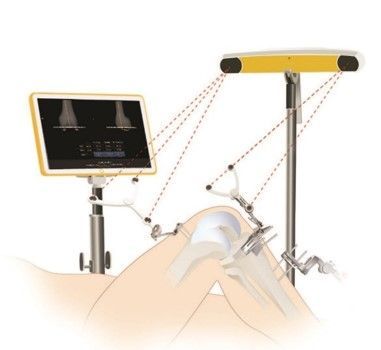
The introduction of robotics at OrthoCentrum Jugenheim led to a clearly structured and well-coordinated learning and implementation phase. First, a small core team was established, consisting of two experienced surgeons as well as a dedicated surgical assistant and surgical nurse. This team familiarized itself thoroughly with the system, optimized workflows, and ensured that all steps became routine and reproducible. Only once this core team was confident and well-coordinated were additional colleagues gradually brought on board.
Prof. Dr. Schräder explains: “New team members go through a structured training program: two days in the training lab with theory and practical exercises on anatomical specimens, with separate sessions for medical and nursing staff. This is followed by supervised surgeries on actual patients, during which an experienced surgeon is always present. The high volume of procedures results in a steep learning curve, enabling independent work after two to three months.
The clinic meets the criteria for a maximum-care endoprosthetics center, which means that all surgeons must already meet high case volumes, participate in regular continuing education, and adhere to defined quality standards. As a result, there is already a high level of routine in place even before new technologies are introduced, which further accelerates the onboarding process. Parallel to internal development, structural changes are also taking place in the regional environment.
Due to politically driven centralization, clinics are increasingly specializing, and complex procedures are more frequently referred to centers with high levels of expertise. Collaborations are emerging in which specialized facilities take on complex revision surgeries or challenging knee arthroplasty, while other clinics are deliberately no longer offering these services,” he adds:
“As a result, our catchment area has expanded significantly. Patients travel from across Germany because they specifically seek out specialized centers and consciously choose facilities that offer high case volumes, certifications, and modern technologies such as robot-assisted systems. The rising case volumes and positive feedback from the certification bodies show that this approach is successful and is clearly appreciated by patients.”
Customized implants—particularly patient-specific hip prostheses—offer significant advantages over standard implants because they replicate a patient’s individual anatomy, biomechanics, and load-bearing conditions much more accurately.
“The length of hospital stay has been further reduced through the use of robotics, as several factors work together to enable a faster recovery. Patients typically stay in the hospital for about five days, which is already significantly shorter than in the past. Even shorter stays would be theoretically possible, but outpatient infrastructure in Germany is not yet universally equipped to support this.
Early discharge can only be reliably achieved if physical therapy, follow-up care, and home support are seamlessly organized—something that has historically been less established in this country than in nations such as Denmark or the United States. A key factor in the shorter length of stay is a modern treatment approach that begins on the very day of surgery. Patients no longer receive drains, which makes it easier for them to move around. Movement therapy begins right in the recovery room with a motorized splint that automatically moves the knee through its full range of motion. Shortly thereafter, patients are taken to the ward and take their first steps.
This early mobilization not only promotes recovery but also strengthens the sense of independence that is particularly important to many. Those who can move confidently again quickly are less dependent on assistance and find their hospital stay significantly more pleasant. “The combination of robot-assisted precision, optimized pain management, and consistent early mobilization means that patients recover faster and can return to their daily lives sooner,” explains Prof. Dr. Schräder.
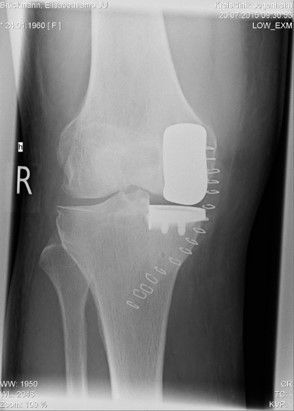
In the long term, the implants benefit from optimized load distribution. When the prosthesis precisely follows the individual anatomy, there is less localized overloading, which reduces the risk of wear and loosening. The reduced bone resection also facilitates subsequent revision surgeries, which play an important role for younger patients.
Intraoperatively, virtual reality (VR) primarily aids with orientation. By linking with navigation systems or robotic assistance platforms, planned incision lines, axes, or implant positions can be visualized as holographic overlays. This facilitates the implementation of preoperative planning and helps identify deviations early on.
“Preoperative measures and modern digital tools play a crucial role in improving the outcome of joint surgery. Virtual reality is playing an increasingly important role, particularly in the operating room. It enables plans viewed on a tablet to be transformed into an immersive 3D experience, allowing for a more realistic assessment of anatomical structures, implant positions, and movement patterns.
The first practical applications are just around the corner, and the technology will further enhance the precision of both planning and surgical execution in the future. For the medical team, VR also offers the opportunity to simulate procedures in advance and transfer plans directly to the surgical robot—a step that significantly refines technical preparation. For patients, however, success begins long before the actual procedure.
Digital educational tools, such as personalized videos that can be accessed at any time via a QR code, make the information easier to understand and allow for more targeted clarification of questions. Many patients view this content together with their family members, which deepens their preparation and shortens the educational phase at the hospital.
This is complemented by nutritional measures: special oral solutions ensure that patients enter surgery with a better energy reserve. The old principle of long fasting periods is also outdated—eating early after the procedure supports recovery and promotes mobility,” explains Prof. Dr. Schräder, emphasizing:
“VR technologies also serve as a tool for professional continuing education. Surgeons can virtually practice surgical procedures, simulate complex cases, and assess the planned prosthesis position in 3D beforehand. This form of preparation will continue to grow in importance in the future, without, however, replacing the surgeon. Rather, it creates a synergy between human experience and technical support that makes surgeries more precise, faster, and less invasive.”
Junior surgeons can practice procedures in a realistic setting without putting patients at risk. They experience typical complication scenarios, practice hand-eye coordination, and develop a feel for anatomical structures before stepping into the operating room. At the same time, experienced surgeons benefit because VR allows them to simulate rare or particularly challenging cases in advance and test new techniques risk-free.
Virtual reality goggles (VR goggles) enable surgeons to immersively visualize and experience three-dimensional anatomical structures. They project patient-specific data—such as CT or MRI images—into a virtual environment where joints, implant positions, or surgical steps can be viewed and simulated in a realistic manner. This improves spatial orientation, supports preoperative planning, and provides an effective training tool for complex procedures.
Experience to date shows that robot-assisted knee arthroplasty not only facilitates early mobilization but also has a positive impact on factors that may later be decisive for the longevity of a prosthesis.
Prof. Dr. Schräder comments: “We are already observing that patients experience less pain after a robot-assisted procedure, regain mobility more quickly, and have better X-ray images immediately after surgery. These early results are important because they form the basis for how well an implant functions in the first few years—and it is precisely these first few years that are considered particularly indicative of long-term outcomes.
Whether robotics actually extends the overall lifespan of a prosthesis cannot yet be definitively proven, simply because not enough time has passed. Statements about durability are always retrospective, and the technology has not been in widespread use long enough to provide 15- or 20-year data. What can be done, however, is to examine the survival rates from the first few years and extrapolate from them.
The data available so far give reason to hope that the more precise alignment and improved soft-tissue balance achieved through robotics could yield long-term benefits. Of particular importance here are patient-relevant outcomes: freedom from pain, mobility, and the ability to quickly return to daily life. These factors are already showing significant improvements. Whether this will ultimately result in a measurably longer implant lifespan will only be possible to assess with certainty in the coming years.”
High-profile success stories, such as that of skier Lindsey Vonn—who continued to train and compete at the highest level despite having a partial joint replacement—are significantly changing perceptions of modern joint replacement surgery. They demonstrate that artificial joint replacement is no longer automatically associated with functional limitations or the end of athletic ambitions.
“The durability of modern knee replacements has changed significantly thanks to technical advances and robot-assisted procedures. Today, many people with a prosthesis can achieve far more than in the past—including demanding athletic activities. The prominent example of skier Lindsey Vonn shows just how capable a well-implanted knee prosthesis can be, but such cases must always be considered in the context of individual circumstances.
Elite athletes possess exceptional muscular control, a different level of training, and a unique mental mindset. These factors enable them to handle stresses that are not readily achievable for the average patient. A sled prosthesis generally provides good conditions for athletic activity because the cruciate ligaments are preserved, allowing the knee to move more naturally. When implanted precisely—for example, with robotic assistance—it can even be suitable for dynamic sports.
Even with a total knee replacement, many activities are possible, including skiing; however, returning to such movement patterns is more complex and requires more training. Modern implants now allow for knee flexion of up to 140 degrees, which offers significantly more range of motion for sports than older models, which were limited to about 120 degrees. At the same time, patients’ expectations are changing. Media coverage often creates the impression that every prosthesis must automatically enable peak performance.
However, individual factors such as muscle strength, coordination, age, pre-existing conditions, and personal goals play a decisive role. The technology opens up new possibilities, but it does not replace the physical prerequisites necessary for extreme physical demands. However, this development clearly shows that the limits of what is possible with a prosthesis are shifting—and patients’ expectations are growing along with them,” explains Prof. Dr. Schräder, adding:
“Instead, it is becoming evident that modern implants—combined with precise surgical techniques, customized components, and optimized rehabilitation concepts—enable a level of performance that would have been unthinkable just a few years ago. Such cases have an impact far beyond the individual patient.
They strengthen patients’ confidence in the durability and resilience of modern prostheses and significantly raise expectations regarding functional outcomes. People who would previously have expected significant limitations on their activities are now specifically asking for solutions that enable them to return to sports, work, and daily life at a high level. At the same time, they motivate surgeons to continue pushing the boundaries of reconstruction and to employ technologies that restore joint function as close to physiological as possible.
For joint replacement surgery, this means that the demand for precision, customization, and postoperative mobility is increasing. Patients expect not only freedom from pain, but also a joint that feels natural, is stable, and can withstand high levels of stress. Success stories like Lindsey Vonn’s make it clear that this is achievable—and in doing so, they set new standards for what modern joint replacement can achieve.”
American ski racer Lindsey Vonn is considered one of the most impressive examples of just how effective modern joint replacement surgery can be today. After several severe knee injuries, she received a partial knee replacement (slide prosthesis), which replaced the damaged section of the joint and restored stable, resilient joint function. Despite this procedure, Vonn returned to the slopes and continued to win World Cup races in alpine skiing, including in disciplines such as downhill and super-G. Her successes demonstrate that even in elite sports, an artificial joint replacement does not necessarily mean the end of a career—provided that surgical technique, implant selection, and rehabilitation are optimally coordinated. However, Lindsey Vonn’s career came to an end after a severe fall during the Olympic downhill race in Cortina d’Ampezzo in February 2026. She lost control shortly after the start, fell hard, and suffered a broken leg.
Custom-made prostheses are used at the clinic only in select cases. Most hip and knee implants are standard prostheses, which are entirely sufficient for the vast majority of patients and deliver excellent results.
“A custom-made solution is necessary only when there are anatomical peculiarities. This applies, for example, to very short people for whom even the smallest available implant sizes do not fit, or to patients with significantly altered hip structures following childhood conditions such as dysplasia or multiple dislocations.
In such cases, the bone shape no longer corresponds to typical anatomical conditions, meaning a standard prosthesis could not be securely anchored. For these specific situations, a custom prosthesis is designed and manufactured. This first requires precise measurements using specialized MRI scans.
Based on this data, the implant is custom-made, a process that takes about two to three months. Only then is the surgery performed using the custom-fitted prosthesis. It is important to clarify that these custom-made prostheses are only used when they are truly medically necessary—not as a general option for every patient,” emphasizes Prof. Dr. Schräder, and with that, we conclude our conversation.
Thank you very much, Professor Dr. Schräder, for this interesting insight into hip and knee joint replacement!
- A specialist with a broad range of expertise in orthopedics, trauma surgery, joint replacement, pediatric orthopedics, sports traumatology, rheumatology, and cartilage surgery.
- Recognized expert in hip and knee joint replacement and complex revision surgeries.
- A wave of modernization in joint replacement: a 20% increase in case numbers, three robotic systems, VR technology in the OR, customized hip replacements, a second location, and high-profile success stories (including Lindsey Vonn).
- Chief Physician & Medical Director of Orthopedics/Traumatology in Jugenheim – Establishment of a state-of-the-art, fully specialized clinic.
- Personalized, stepwise treatment with a focus on joint preservation, minimally invasive techniques, and conservative options prior to surgery.
- High surgical quality: approximately 800 primary joint replacement surgeries per year, very low infection rate (0.2 %), use of state-of-the-art navigation systems.
- University-level standards and strong networking for continuous innovation and quality assurance.
- Pediatric orthopedics with a high degree of empathy
Share this article
Expert Interviews
Read next
- Expert interview
Expert interview with Professor Dr Elmar Herbst, PhD
Oct 15, 2026
Patient-centred and personalised knee surgery
Read more - Expert interview
Cardiogeriatrics: Significance and benefits in the context of hospital reform
Sep 21, 2026
Cardiogeriatrics: Significance and benefits in the context of hospital reform
Read more - Expert interview
Expert Interview with Professor Dr. Amadeus Hornemann, MPH
Sep 18, 2026
Prof. Amadeus Hornemann on Precision Medicine in Gynecology: Modern Surgery, New Techniques, Better Quality of Life
Read more