Expert Interviews
Developments in Modern Hip and Knee Replacement Surgery

Alexandra Pfitzmann ·
About five million people in Germany suffer from osteoarthritis of the hip or knee joints—a condition that can cause pain, limited mobility, and a significant loss of quality of life. When conservative treatments are no longer sufficient, modern hip and knee replacement surgery offers a highly effective way to regain mobility and freedom from pain. Today, advanced implants, minimally invasive techniques, and precise surgical procedures enable customized solutions that allow patients to actively participate in daily life once again.
The editorial team spoke with Professor Dr. Fritz Thorey, a world-renowned expert in hip and knee surgery, to learn more about the latest developments in the treatment of knee and hip conditions.

Making an informed decision between a partial-knee replacement and a total knee replacement today requires a much more nuanced analysis than it did just a few years ago. The focus is always on how far the osteoarthritis has progressed and which structures of the knee joint are affected.
“The decision between a partial and a total knee replacement essentially depends on how severely and in which areas the joint is damaged. A partial prosthesis is only an option if the wear is clearly limited to a single compartment—that is, if only the inner or outer side is affected, or if the area behind the kneecap is isolated.
As soon as at least two joint compartments are affected—for example, the inner and outer sides simultaneously—a partial knee replacement becomes ineffective because it would only address part of the problem, and pain in the other area would persist. In such cases, a total knee replacement is necessary to functionally stabilize the entire joint and reliably eliminate the symptoms.
Imaging plays a central role in this process. High-quality X-rays and, if necessary, an MRI scan show precisely which structures are damaged and how far the wear and tear has progressed. Based on this information, it can be determined whether a partial prosthesis is still appropriate or whether a total prosthesis is the better solution. This information is then incorporated into the three-dimensional surgical planning, which helps to accurately assess the anatomical conditions and select the optimal implant.
For the patient, this decision-making process is usually very streamlined. Many patients bring X-rays or an MRI scan with them to the initial consultation. During the examination, the symptoms are assessed, the images are evaluated in parallel, and the team discusses which type of prosthesis makes the most medical sense. “This way, within a single appointment, a clear picture emerges of which treatment offers the best prospect of freedom from pain and stable function,” Prof. Dr. Thorey makes clear at the beginning of our conversation.
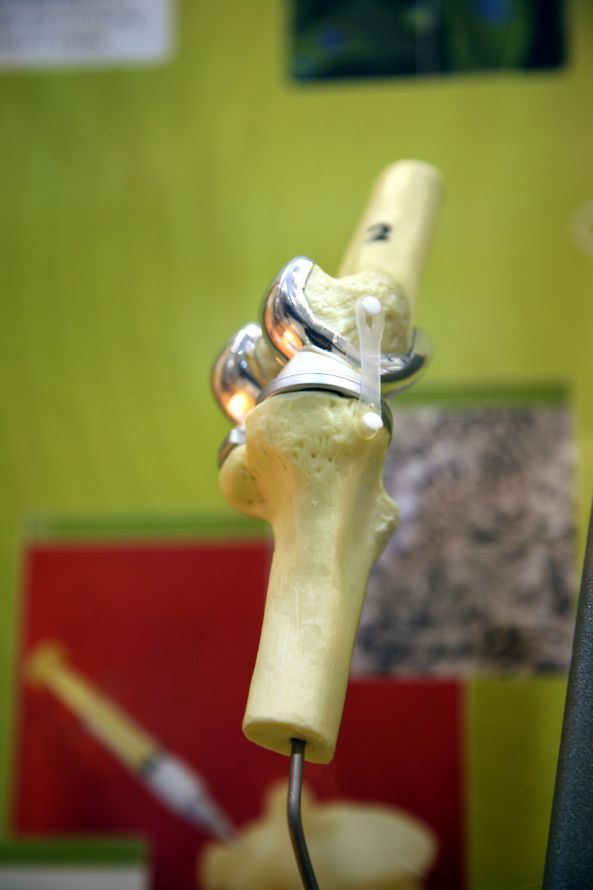
Patient-specific implants and surgical guides (PSI) are playing an increasingly important role in cases of complex axial deviations or unusual anatomical conditions because they enable a more precise, individually tailored treatment than is often possible with standardized instruments.
“Anatomical peculiarities can significantly influence the decision between a partial and a total prosthesis, because they determine how well a joint can be reconstructed in the first place. For example, if a knee is severely tilted into a bowleg or knock-knee position—that is, if there is a pronounced malalignment—a partial prosthesis quickly reaches its limits. It can only replace a single segment of the joint but does not correct major axial deviations.
In such cases, a total knee replacement offers a significantly better option for correcting the leg axis and restoring stable alignment to the joint. The situation is similar with old fractures or malunions in the knee joint area. If the bone structure has changed or previous injuries have led to irregularities, the original joint mechanics usually cannot be reliably restored with a partial prosthesis.
A total knee replacement, on the other hand, makes it possible to compensate for defects and redistribute the load-bearing conditions. Such anatomical characteristics are therefore a key factor in the decision-making process, as they determine whether a minimally invasive procedure is sufficient or whether a more comprehensive replacement is necessary to achieve long-term freedom from pain, stability, and function. The starting point is a detailed CT- or MRI-based 3D analysis of the knee joint, which visualizes not only the articular surfaces but also rotational relationships, axial deviations, bone defects, and ligament structures.
Based on this, patient-specific templates or even fully customized implants are designed to precisely match the individual anatomy. PSI offers a decisive advantage, particularly in cases of severe varus or valgus deformities, pronounced torsional anomalies, or complex prior surgeries: They enable precise planning of the resection surfaces and implant position before the first incision is made. The templates guide the surgeon intraoperatively exactly along the previously defined incision lines, thereby reducing the risk of incorrect angles or uneven resections.
In cases of anatomical peculiarities—such as unusual condylar shapes, asymmetries, or bony deformities—a standardized implant may reach its limits. A patient-specific implant, on the other hand, replicates the individual joint geometry and ensures more harmonious force distribution, better ligament tension, and a more natural range of motion,” explains Prof. Dr. Thorey.
Robot-assisted procedures such as MAKO systems or modern navigation platforms increase precision in knee arthroplasty to a level that is virtually unattainable with freehand techniques. They combine preoperative 3D planning with intraoperative real-time data analysis, thereby enabling the planned implant position to be implemented with millimeter precision.
Prof. Dr. Thorey comments: “Whether a robot is used in the operating room depends heavily on the individual condition of the knee joint. The MAKO system is used particularly frequently for partial knee replacements because it allows for extremely precise planning and placement of the implant. Precise placement is especially critical for partial knee replacements, as even small deviations can affect durability and function.
The robot can also offer advantages for total knee replacements, especially in cases of significant misalignment or a history of previous surgeries. In such cases, robotic assistance enables a significantly more precise correction of the axes than even a very experienced surgeon could achieve manually.
In a “normal” knee without any particular anatomical challenges, however, the differences between a skilled surgeon and the robot are minimal. For this reason, robotic technology is not used across the board for every procedure. Another reason for this case-by-case decision lies in the system’s compatibility with a specific—and sometimes older—implant model.
For patients with a straight leg axis and no complex medical history, a more modern implant is often the better choice, which is why robotic surgery is deliberately avoided in such cases. At the same time, it is openly acknowledged that robotic surgery requires additional steps, such as attaching sensors to the tibia and femur, which naturally carries an increased risk of infection,” and he adds regarding the durability of the prostheses:
“It is not yet possible to say with certainty whether robotic surgery improves the long-term durability of prostheses, as this would require data spanning several decades. Initial results, however, suggest that partial prostheses in particular benefit from the more precise positioning. The implants appear to be almost perfectly aligned on X-rays, which fuels the hope that this precision will later translate into a longer lifespan.
First, a precise 3D model of the knee joint is created using CT or MRI data, revealing all individual anatomical features, axial deviations, and cartilage damage. Based on this, the surgeon can simulate the optimal size, position, and alignment of the prosthesis even before the procedure. During surgery, sensors or robot-assisted arms capture the actual joint geometry, ligament tension, and the knee’s range of motion. The system continuously compares this information with the preoperative plan and immediately flags any deviations. This allows the surgeon to precisely control bone resection and position the prosthesis so that it functions optimally from a biomechanical standpoint.
“The robot does not perform any steps on its own, but acts as a high-precision assistive tool that prevents misalignments and limits the accuracy of the cuts.”
Robotic assistance only works reliably if the surgeon actively guides it and the planning is thoroughly prepared. The robot does not replace surgical decision-making; rather, it implements what has been previously determined.
Prof. Dr. Thorey emphasizes: “After planning, it indicates exactly where the cuts must be made and limits the working area so that you cannot ‘cut off-target.’ As soon as the instrument moves outside the defined area, the saw stops automatically—that is one of the major safety advantages.
Nevertheless, the human surgeon remains the central authority. The robot does not think independently but operates exclusively within the parameters specified for it. Before the procedure, the implant size, exact positioning, and orientation are determined in collaboration with the technical team. During the operation, anatomical landmarks on the bone are recorded so that the system knows where the joint is located in space and the plan can be precisely transferred to the actual anatomy.
However, the actual execution remains in the hands of the surgeon. He guides the instrument, monitors every step, and can manually stop the procedure at any time. The robot ensures precision and safety, but it neither replaces experience nor surgical judgment—it enhances them.”
New implant materials and optimized bearing pairs have significantly advanced knee arthroplasty in recent years because they directly address the three key requirements of a modern prosthesis: functionality, stability, and durability. Advances in materials technology now enable implants that function more naturally from a biomechanical perspective, generate less wear, and remain anchored more stably in the bone over the long term.

“Custom-made knee implants are primarily used when the anatomy deviates so significantly from the norm that a standard prosthesis can no longer fit reliably or be positioned correctly. This applies in particular to pronounced malalignments or situations in which the bone has been significantly altered by previous injuries or surgeries. In such cases, custom-made implants or tailor-made cutting blocks enable precise planning and exact execution in the operating room, because the specific characteristics of the bone can be fully taken into account in advance.
The material itself is generally not selected on an individual basis. While there are implants with special hypoallergenic coatings—such as ceramic surfaces like Oxinium—these are used only in rare cases where a proven allergy actually exists. Allergies to implant materials are extremely rare in the body—significantly rarer than contact allergies on the skin. A reaction to costume jewelry or nickel therefore says little about how the body will react to an implant. “True implant allergies are extremely rare, so coated or custom-made implants are necessary only in exceptional cases,” explains Prof. Dr. Thorey.
Modern knee prostheses benefit above all from materials that are significantly more wear-resistant. Highly cross-linked polyethylene (sometimes fortified with vitamin E) generates far fewer particles and exhibits significantly less wear than the polyethylene used in previous generations. In addition, ceramic-coated or oxidized metal surfaces provide particularly smooth, corrosion-resistant sliding surfaces that reduce friction and minimize the risk of metal ions or incompatibilities. Together, these modern bearing pairings result in more harmonious force transmission, a more even distribution of load on the prosthesis, and thus greater stability and a more natural feeling of movement—a noticeable advantage, especially for active patients.
Innovative joint-preserving therapies aim to preserve natural joint function for as long as possible and delay the need for a total joint replacement—sometimes even avoiding it altogether. Especially for younger, active patients or those with early- to moderate-stage cartilage damage, modern biological procedures now offer possibilities that were unthinkable just a few years ago.

Cartilage cell transplantation plays a central role. In this procedure, the patient’s own cartilage cells are harvested, cultured in the laboratory, and later implanted into the defect. This method is particularly suitable for localized cartilage defects and can generate structures very similar to hyaline cartilage. Modern matrix-assisted techniques (M-ACT) facilitate healing and shorten rehabilitation time.
Prof. Dr. Thorey explains: “When patients report before surgery that they have already undergone cartilage cell therapy, we first carefully assess whether a prosthesis is truly necessary or if the joint can be treated in another way. Especially in cases of localized cartilage damage—that is, clearly defined defects that resemble a single ‘pothole’ rather than affecting the entire joint—there are very good alternatives. These include procedures such as cartilage cell transplantation or techniques in which the damaged area is scraped away and then filled with a collagen matrix.
Such procedures can specifically repair the defect without immediately requiring an implant. It is crucial to make a clear diagnosis and not to attempt to treat damage that is already too advanced. Especially in younger people, whose remaining joint cartilage is still intact, major surgeries can often be avoided in this way. How long this effect lasts depends heavily on the cause of the damage. If it is an isolated defect caused by sports or trauma, it is quite possible that a prosthesis will never be necessary later on, as long as the remaining cartilage stays healthy.”
Digital technologies have fundamentally transformed postoperative rehabilitation following knee and hip surgeries because they enable much more precise, individually tailored management of the healing process.
“Digital training programs certainly play a role in rehabilitation, even if the term ‘AI’ often promises more than it actually delivers. Many of these systems essentially work with pre-programmed algorithms: You enter a patient’s individual conditions—such as exercise capacity, pre-existing conditions, or current fitness level—and this generates a personalized exercise program.
This is helpful because it allows for very targeted guidance on what a patient is already allowed to do and what should still be avoided. For patients undergoing conservative treatment, there are also platforms that allow them to take complete training and exercise programs home with them. Wearables such as smartwatches can be integrated as a supplement, but they play a rather minor role in the orthopedic field.
They primarily provide activity data, such as step count, which can certainly be useful for assessing progress or exercise limits. However, the real strength of these devices lies in the field of cardiology, for example with heart rate or ECG functions. “Nevertheless, they can make everyday life easier because some of the measurements are now medically useful and can help shorten treatment paths or avoid unnecessary appointments,” recommends Prof. Dr. Thorey.
The greater precision of robot-assisted surgeries does indeed help many patients get back on their feet more quickly and leave the hospital sooner.
“In practice, the length of stay is usually between three and five days, depending on how fit a person is and how well they can be mobilized after the procedure. Younger, athletic people are often ready to go home safely after just three days, while older patients understandably need a little more time.
A look at the U.S. reveals a completely different system, where even major orthopedic procedures are frequently performed on an outpatient basis. While this is medically feasible, it is often problematic from the patient’s perspective. Many American patients report that they are sent home on the evening of their surgery with severe pain and postoperative bleeding, and must manage on their own without adequate support.
This is precisely why many of them prefer to have their surgery in Germany. In this country, there is also a lack of comprehensive home-based post-operative care provided by nursing staff, which is what would make such a model safe in the first place. A hospital stay of less than three days would therefore be more of a burden than a benefit for many people. Knee replacements simply cause pain in the first one to two days, which requires close monitoring. It would also be more difficult to organize the administration of pain medication or thrombosis prevention at home.
In addition, in countries like the U.S., patients are often provided with additional products and assistive devices whose usefulness is questionable and which tend to stem from the healthcare system there. Compared to earlier times, when patients stayed in the hospital for three weeks after knee replacement surgery and were barely allowed to get out of bed during the first week, today’s hospital stay of three to five days is already an enormous step forward.
“During this time, most patients achieve stable mobility, can care for themselves, and can be safely discharged home,” states the specialist in hip and knee surgery.
Technological developments in orthopedics will continue, but not in the form of a sudden upheaval, rather as a continuous, step-by-step process. Artificial intelligence will primarily play a supporting role—not so much as an autonomous system, but as a tool that improves diagnostics and surgical precision.
Prof. Dr. Thorey notes: “In orthopedics, the surgeon remains indispensable because access to the joint and the surgical procedure still require human experience and manual skills. However, AI can help to better interpret imaging data, refine surgical planning, and control surgical procedures with even greater precision. How quickly these technologies spread depends heavily on the economic conditions.
Robotic systems are expensive, and many hospitals are currently unable or unwilling to make the investment, especially since the higher costs are not covered by flat-rate payments per case. As long as these structural problems persist, the introduction of new systems will proceed rather hesitantly. At the same time, pressure is mounting from patients who are increasingly well-informed about robotics and are specifically seeking out hospitals that offer such procedures.
But in a healthcare system with increasingly scarce capacity, this very trend is leading to further increases in wait times at the more innovative hospitals, while other hospitals are closing or investing less.”
The processes at the Athos Clinic in Heidelberg have already been optimized to such an extent that, compared to many other facilities, they are considered exceptionally efficient. The processes have been refined over the years, ensuring that care is provided at a very high level, and there are now only a few areas left where short-term improvements could be made.
“Of course, medicine is constantly evolving, and in a few years new innovations will emerge that can then be meaningfully integrated. At the moment, however, the most important technical and organizational innovations have already been implemented, so patients benefit from a very modern, well-established structure,” says Prof. Dr. Thorey, emphasizing at the end of our conversation:
“At our hospital, we perform approximately 2,500 hip and knee replacements per year—a figure that encompasses the entire facility and demonstrates the high level of specialization and routine in the field of joint replacement.
These case numbers reflect the fact that patients travel not only from the region but from all over Germany and even internationally because they specifically seek out centers that perform such procedures on a daily basis and have a corresponding level of experience.”
Thank you very much, Professor Dr. Thorey, for this important update on robotics in hip and knee arthroplasty!
- Medical Director of the ATOS Clinic Heidelberg; internationally renowned specialist in hip and knee surgery, joint replacement, sports orthopedics, and sports traumatology.
- Globally recognized expert performing approximately 750 complex surgeries per year; recipient of numerous awards and research prizes.
- A leader in modern hip and knee arthroplasty: short-stem and standard prostheses, revision surgeries, AMIS/MIS techniques, customized implants, and robot-assisted MAKOplasty (Mako SmartRobotics™).
- Specializes in hip and knee arthroscopy, cartilage surgery, cartilage cell transplantation, and axial corrections.
- Continuously develops and refines muscle-sparing, minimally invasive procedures for maximum mobility and athletic performance—even in cases of advanced osteoarthritis.
- An active researcher with regular publications in international journals; a pioneer in innovations in implant technology, bearing surfaces, and joint-preserving procedures.
- Director of the internationally renowned IZO—International Center for Orthopedics at the ATOS Clinic in Heidelberg, which attracts patients from all over the world.
Share this article
Expert Interviews
Read next
- Expert interview
Expert interview with Professor Dr Elmar Herbst, PhD
Oct 15, 2026
Patient-centred and personalised knee surgery
Read more - Expert interview
Cardiogeriatrics: Significance and benefits in the context of hospital reform
Sep 21, 2026
Cardiogeriatrics: Significance and benefits in the context of hospital reform
Read more - Expert interview
Expert Interview with Professor Dr. Amadeus Hornemann, MPH
Sep 18, 2026
Prof. Amadeus Hornemann on Precision Medicine in Gynecology: Modern Surgery, New Techniques, Better Quality of Life
Read more