Expert Interviews
TAPE: Transarterial Embolization for Joint Diseases of the Hip, Knee, Hands, and Feet

Alexandra Pfitzmann ·
Transarterial periarticular embolization (TAPE) is a minimally invasive, image-guided procedure for treating painful joint conditions. It is used in particular for conditions affecting the hips, knees, hands, and feet and aims to reduce inflammation-related pain through targeted vascular embolization. The goal of this method is to specifically reduce pathological hyperperfusion and inflammation in the joint area, thereby alleviating pain and improving mobility. The editorial team of the Leading Medicine Guide was able to learn more about this topic in a conversation with Professor Dr. Dr. med. Thomas J. Vogl.

TAPE therapy (transarterial periarticular embolization) is used in particular for chronic joint diseases caused by degenerative changes or inflammatory processes.
“TAPE stands for transarterial periarticular embolization. Sometimes it’s simply referred to as TAE, or transarterial embolization, but TAPE actually describes the procedure more precisely. What’s fascinating about it is that you can help people by selectively occluding blood vessels. Normally, such arterial procedures are used to stop bleeding or treat tumors. Here, however, medications are delivered directly into the joint via the blood vessels. By occluding specific vessels, the proliferating synovial membrane—the synovium—as well as existing inflammatory conditions are cut off from the blood supply. This then leads to an improvement in symptoms. The procedure is not suitable for acute inflammation or tumor-related conditions, but rather for chronic joint damage: cartilage defects, old ligament injuries, or general irritation within the joint. It is precisely these inflammatory conditions that are interrupted by embolization because blood flow is reduced. “Many patients are then able to move better again, become more mobile overall, and experience a significant improvement in their quality of life,” explains Prof. Dr. Dr. Vogl at the beginning of our conversation, adding:
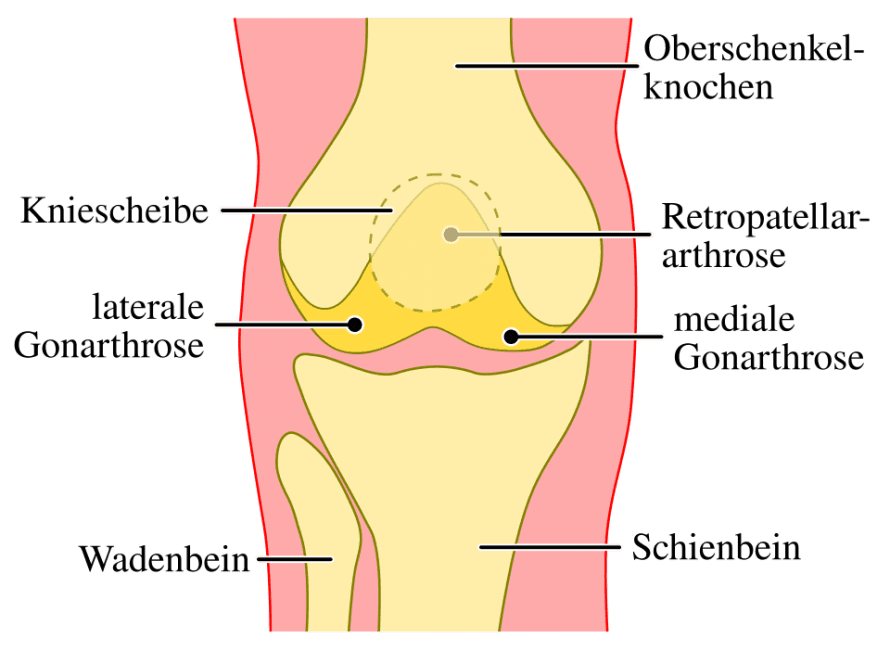
“Typically, patients come to us whose joints have been steadily deteriorating over a long period of time but who do not yet want joint replacement. For example: a 60-year-old patient with severe knee osteoarthritis. If the procedure allows him to walk well for one or two more years, the need for a prosthesis can be delayed. This is important because if you receive an artificial knee at age 60, it’s often worn out by age 70—and replacing a prosthesis is always significantly riskier at an older age. That is exactly what we are trying to avoid. The procedure is most commonly used on the knee; globally, that is the primary area of application. The hip joints follow next. Less commonly, the procedure is used to treat elbows with severe osteoarthritis, as well as wrists or feet—but essentially anywhere where soft-tissue reactions occur. This can be easily controlled because areas with strong blood flow absorb a lot of contrast agent, and these “cloudy” areas can be specifically reduced using the microspheres. There are two variants here: permanent particles, which are slowly broken down over many years, and newer, temporary particles that dissolve completely within three to six months through natural processes in the blood. Many patients find this very appealing. The effect is essentially the same, though with the temporary particles, it is not yet known whether the effect remains just as stable in the long term, since they have not been in use long enough. And it’s important to note: The procedure does not heal the joint. The cartilage remains damaged. But the pain subsides, quality of life improves, and you can use your own joint for longer.”
TAPE is often used when conservative treatments such as physical therapy, pain medication, or intra-articular injections are no longer sufficiently effective, but surgery is not yet necessary or desired. The method is particularly beneficial for patients seeking a joint-preserving alternative, as the procedure leaves the joint itself unchanged and is performed using a minimally invasive technique.
“Typically, the patient contacts us beforehand, either through their orthopedic surgeon or directly. First, we clarify in a phone conversation whether the procedure is generally a viable option. When the patient then comes in for a personal consultation, we take three-dimensional images, usually an MRI that includes vascular imaging. This allows us to check whether the blood vessels are patent and whether the procedure is technically feasible at all. Next, we need to determine the insurance coverage—that is, which health insurance provider is responsible. Depending on the insurance plan, it may be necessary to obtain approval. We assist patients throughout this process. Some health insurance providers require a detailed justification or hypothesis regarding the costs before they give their approval. This must be assessed on a case-by-case basis. After the examination, we discuss everything with the patient again, go over the benefits and risks, and decide together whether to proceed with the procedure. This can take place either on the same day or at a later appointment. The procedure itself takes about an hour and is generally painless. Afterward, we monitor the patient for another four hours. If everything is normal, the patient can leave the clinic the same day,” says Prof. Dr. Dr. Vogl.
Conservative therapies such as painkillers, anti-inflammatory medications, or injections usually only provide symptomatic relief without directly addressing the cause of the pain, whereas surgical procedures are significantly more invasive, require longer recovery times, and may be associated with higher risks. TAPE, on the other hand, targets the affected vessels specifically, is gentle on the tissue, preserves the joint, and can be used both as a standalone therapy and in conjunction with other treatments. Through this direct, minimally invasive treatment, pain can often be effectively reduced and joint function improved without the need for surgery.
TAPE is not suitable for patients with severely damaged joints, such as those with advanced osteoarthritis or massive cartilage loss, since the pain in these cases is primarily caused by structural damage. Infected or acutely inflamed joints, as well as systemic infections, also preclude the procedure. Additionally, blood clotting and vascular conditions must be suitable—severe clotting disorders, uncontrolled anticoagulation, or certain vascular diseases increase the risk. In cases of severe obesity or unfavorable anatomy, access to the blood vessels may be difficult. In general, TAPE is not a substitute for surgery when a prosthesis or another procedure is clearly necessary, such as in cases of instability, severely impaired function, or large defects.
The TAPE procedure is well-structured for patients, minimally invasive, and can usually be performed on an outpatient basis. Prior to the procedure, thorough preparation is required, including a detailed medical history, physical examination, and imaging studies such as ultrasound, MRI, or CT to accurately assess the affected joint and vascular structure. In addition, potential risks—such as blood clotting disorders or comorbidities—are assessed, and the patient is informed about the procedure, possible side effects, and post-treatment care. Adjustments to blood-thinning medications are often necessary.
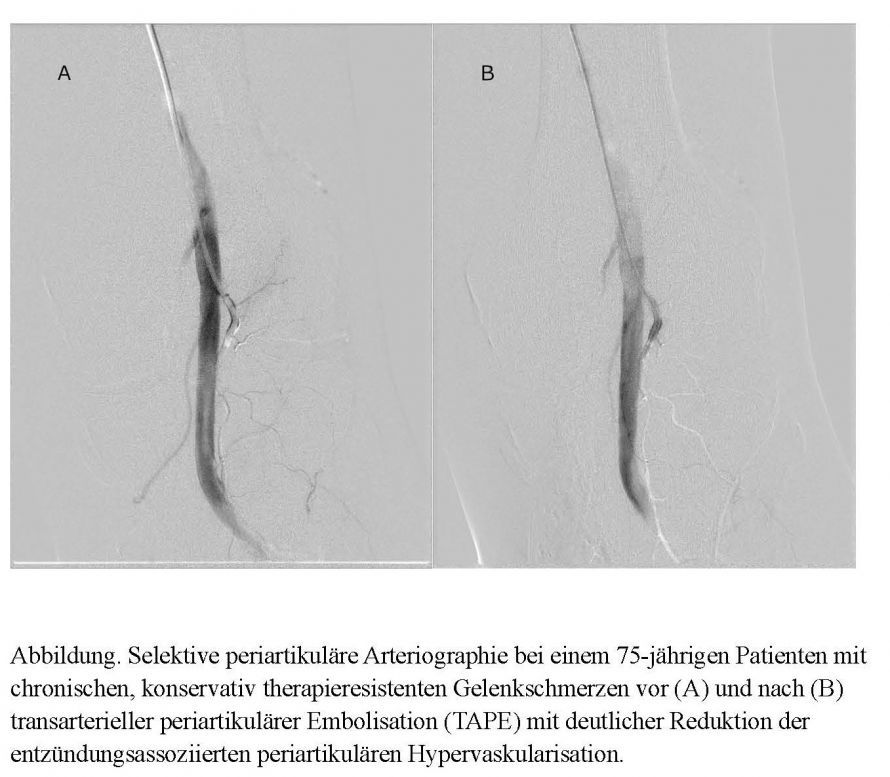
On the day of treatment, the patient first receives local anesthesia. A thin catheter is then inserted through an artery in the groin or arm and advanced under X-ray guidance to the small vessels surrounding the affected joint. There, the vessels causing inflammation are selectively occluded using tiny particles. The patient remains awake during the procedure or receives light sedation; general anesthesia is not required. After the catheter is removed and a brief monitoring period, the patient can usually go home the same day.
Prof. Dr. Dr. Vogl comments: “During the procedure itself, up-to-date blood test results are needed, and a very small catheter is inserted and guided precisely to the correct location. The procedure usually takes between half an hour and an hour because working on the very small vessels requires extreme precision. With the appropriate experience, however, this is quite feasible. In general, the method is intended for patients whose quality of life is severely impaired by osteoarthritis but who are not yet ready or suitable for a total joint replacement—whether because they are too young, do not yet want it, or the damage has not yet progressed that far. This procedure fills that exact gap. After all, even with a prosthesis, there’s no guarantee that you’ll be completely symptom-free afterward. Many would take the same approach at this stage: first try to see if embolization can restore your quality of life. A prosthesis can always be implanted later—it’s not going anywhere, and these days, they’re performed everywhere. “The method itself was developed in a context similar to that of prostate or uterine fibroid embolization,” he explains at the end of our conversation, describing what happens afterward:
“A little rest won’t hurt, and physical activity should be reduced at first. We’ve never experienced any serious complications in several hundred patients. At most, there might be some minor bleeding at the puncture site in the groin, but fortunately, no serious problems have occurred so far. As for the effect, most patients report that the first signs of improvement begin after three to four weeks. The maximum effect is reached after about three months, and the benefit usually lasts one to two years—depending on the patient’s range of motion and how well they cooperate. If the symptoms worsen again, the procedure can generally be repeated. It shouldn’t be done indefinitely, but two to three times is certainly possible. This is a very attractive option, especially for younger patients who are experiencing knee problems early on and want to delay knee replacement for as long as possible.”
Thank you very much, Professor Dr. Dr. Vogl, for this interesting insight into the promising TAPE treatment!
- Specialist in radiation therapy/radio-oncology, neuroradiology, and interventional radiology in Frankfurt am Main and recognized as one of Europe’s leading experts in interventional radiology.
- Performs advanced procedures such as transarterial regional chemoperfusion, tumor ablation techniques, and embolizations.
- An innovator in medical technology, known for developing an angiography robot to improve tumor diagnosis.
- Focuses on minimally invasive treatments, including the use of state-of-the-art 3D camera technology and AI.
- Committed to patient-centered care, quality assurance, and interdisciplinary collaboration.
- Official partner of the DFB, specializing in medical care for professional athletes.
- Has published numerous standard works, received several scientific awards, and is a member of various international professional associations.
Share this article
Expert Interviews
Read next
- Expert interview
Expert interview with Professor Dr Elmar Herbst, PhD
Oct 15, 2026
Patient-centred and personalised knee surgery
Read more - Expert interview
Cardiogeriatrics: Significance and benefits in the context of hospital reform
Sep 21, 2026
Cardiogeriatrics: Significance and benefits in the context of hospital reform
Read more - Expert interview
Expert Interview with Professor Dr. Amadeus Hornemann, MPH
Sep 18, 2026
Prof. Amadeus Hornemann on Precision Medicine in Gynecology: Modern Surgery, New Techniques, Better Quality of Life
Read more