Expert Interviews
Certification as a Maximal Care Arthroplasty Center, Robotics in Arthroplasty: Expert Interview with Prof. Schräder

Alexandra Pfitzmann ·
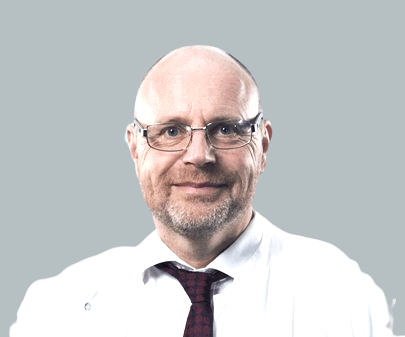
Prof. Dr. Peter Schräder, Chief Physician and Medical Director of the Department of Orthopedics and Traumatology at OrthoCentrum Jugenheim (OCJ), is an outstanding specialist whose expertise is highly regarded far beyond the region. With a broad range of specialties—from orthopedics and trauma surgery to pediatric orthopedics, rheumatology, and sports orthopedics—he covers all areas of modern orthopedics. His expertise in knee and hip joint replacement, as well as in joint-preserving cartilage surgery, is particularly noteworthy.
His clinic in Seeheim-Jugenheim, idyllically situated in the Darmstadt-Dieburg district, enjoys an excellent reputation as a specialty clinic for mobility. Here, patients of all ages receive individualized and holistic care. Prof. Dr. Schräder places the utmost importance on finding the best possible treatment for every condition of the musculoskeletal system—whether conservative or surgical. Thanks to state-of-the-art equipment and innovative treatment methods, such as minimally invasive procedures and high-precision navigation systems, his patients’ mobility is restored as quickly as possible.
Prof. Dr. Schräder devotes particular attention to pediatric orthopedics. His sensitivity and empathy, combined with his expertise, create a trusting environment—especially for young patients—in which individualized treatment plans are developed. Whether dealing with growth disorders, congenital malformations, or injuries, the focus is always on ensuring the best possible quality of life for the children—always in close consultation with their parents.
In adult medicine, Prof. Dr. Schräder sets the standard, particularly in the implantation of artificial joints. With approximately 1,200 hip and knee replacements performed annually—including revision surgeries—the clinic ranks among the leading centers in this field. The use of high-quality implants and tissue-preserving techniques ensures outstanding treatment outcomes. Innovative approaches, such as computer-assisted navigation, guarantee optimal alignment of the prostheses, which improves functionality and significantly extends the lifespan of the implants.
Prof. Dr. Schräder also demonstrates his versatility in rheumatology and sports traumatology. Using targeted, often non-surgical therapies, he alleviates symptoms and ensures that surgery can frequently be avoided. Should surgery nevertheless be necessary—for example, in cases of severe cartilage damage or complex ligament reconstructions—he employs minimally invasive and state-of-the-art procedures to minimize the burden on patients as much as possible.
The editorial team of the Leading Medicine Guide spoke with Prof. Dr. Schräder to learn more about “Robotics in Endoprosthetics.”
In joint replacement—that is, the replacement of joints with artificial implants—robot-assisted procedures are becoming increasingly important. These systems enable unprecedented precision in the planning and execution of surgeries, which significantly improves both the positioning of prostheses and postoperative functionality and longevity. At the same time, they open up new possibilities for taking individual anatomical conditions into account and further developing minimally invasive procedures.
“We’ve been working with the Cori robot from Smith + Nephew—a so-called handheld robot—for over two years, and we chose this model because it offers a good balance between the surgeon’s experience and the maximum benefits of robotics. Ultimately, robots are always tied to the respective joint replacement manufacturer. So you can’t use a prosthesis from Company B with a robot from Company A. We’ve been using that company’s navigation system for over 20 years, and the robotic system complements it. Since we’re extremely familiar with the navigation system, the learning curve for the robotic system was very short, as we were already very familiar with the software and the necessary planning. All that was needed were minor adjustments and changes to the hardware, which are made on a sterile-wrapped iPad on the operating table. Operating the robot—which is essentially a milling machine—naturally requires practice; it takes about 20–50 surgeries to become fully proficient. There’s little room for major errors here, and in the beginning, two experienced surgeons are at the table who also have extensive experience with the navigation system. This allows everything to be carried out smoothly, quickly, and safely. “At first, the surgery took about 10–15 minutes longer than usual, but we were able to adapt very quickly, so that the duration of the surgery is now identical with and without robotic assistance,” said Prof. Dr. Schräder regarding the introduction of robotic surgery in Jugenheim.
A key advantage of robot-assisted systems is the reduction of intraoperative tissue trauma. Robotic assistance enables smaller, more precise incisions, which puts less strain on the surrounding tissue and muscles. As a result, healing is promoted, postoperative pain is reduced, and patients can return to rehabilitation more quickly. Robot-assisted systems also offer the ability to make intraoperative adjustments in real time during the procedure, which reduces the need for repeated corrections or adjustments that may be required with conventional techniques. Prof. Dr. Schräder explains: “Robotics combines the precision of axial alignment—which is crucial for function and longevity and is enabled by navigation—with precise incision guidance and the exact implementation of the preoperative plan. And this preoperative planning is the greatest advantage of robotics, since you can run through the entire operation once beforehand—whether that means the size or position of the implants, the thickness, etc.—and can explore the various options on the sterile iPad, compare them with one another, and decide on the optimal one.”
Robot-assisted procedures in endoprosthetics offer significant advantages when it comes to enhancing the longevity and functionality of endoprostheses. These technological advances enable more precise implantation and optimized fitting of the prostheses, which improves both the immediate functionality and the long-term durability of the implants. “We’re already seeing initial trends regarding the effects of robotics on function and improved mobility due to reduced pain. Durability cannot yet be measured, as this requires a 10- to 20-year follow-up period, which is simply not feasible at this point in time. The hard facts on this simply do not exist yet. We can only conclude that the precise implantation of the prosthesis has a decisive effect on longevity, and robotics ensures this. In other words, the hypothesis is plausible, but it simply hasn’t been proven yet,” notes Prof. Dr. Schräder.
Preoperative planning plays a crucial role in joint replacement surgery, as it forms the basis for the entire surgical procedure and ensures that the prosthesis is optimally tailored to the patient’s individual anatomical conditions.
“In principle, custom-made prostheses exist. We don’t do that, and the fact is that very few clinics with excellent results and high case volumes do so. This option exists, and it also seems plausible—yet this procedure has not gained widespread acceptance. After all, in the end, customization isn’t all that relevant. A prosthesis doesn’t have to be 100% accurate to a tenth of a millimeter. Positioning is what matters! Because that defines the axis and stability. And that’s exactly what robotics and navigation handle,” Prof. Dr. Schräder clarifies, explaining everything that is done with the patient before surgery once the decision to use a prosthesis has been made:
“First, a full-leg standing X-ray is taken, digitized, and marked with reference spheres. This involves measuring the entire leg axis from the hip joint to the ankle using an X-ray. Based on this X-ray, I can simulate and plan the surgery in advance. I can try out different implant sizes and positions until I find the optimal position for the best outcome. In the operating room, locators are attached to the upper and lower leg on the open knee so that the computer can precisely determine the leg’s position—whether it is flexed or extended, whether it is bowlegged or knock-kneed, etc. This visualization is dynamic, allowing me to see how the leg changes under different forces. Using a special scanning device, I can map the shape of the knee joint, which generates a visual representation. The computer then calculates a recommendation for how the implant can be inserted, and I compare this with my own plan so that I can draw on my experience to intervene and make a decision. This is where the great advantage of robotics becomes apparent: the computer analyzes the decision and predicts its positive or negative consequences. This results in a very effective decision-making process. The prosthesis is then implanted, and the incision is closed. We follow the fast-track approach, meaning the patient regains mobility very quickly. Even in the recovery room, the patient is allowed to eat and drink again and is fitted with a mobilization splint right there. The patient can already bear full weight on their leg on the very day of surgery. However, the patient remains hospitalized for as long as necessary. Our goal is to help patients regain their independence as quickly as possible!”
The use of robotics in joint replacement surgery is expected to undergo even more profound development in the coming years.
“The use of artificial intelligence and more advanced robotics will certainly increase in the next phase of development, especially with regard to the digitization of internal networking, including preoperative planning and intraoperative implementation. Quality assurance is also partly organized through AI, as the implementation of the desired quality standards can be well documented. We’re certainly still in the early stages here, but it’s important for us to actively help shape the entire process. The enthusiasm for the latest technical developments is understandable, but we must ensure that we can still intervene to steer the process. Connectivity will certainly continue to advance. Patients, too, are becoming increasingly digital: they are given smartwatches and tasks to prepare for surgery. We now also perform digital gait analyses to assess axial relationships and movement patterns. Looking ahead, there will certainly be collaborations here with manufacturers of robotics, navigation systems, and endoprostheses—as well as with insurance companies and payers,” explains Prof. Dr. Schräder.
Certification as a maximum-care joint replacement center contributes significantly to improving patient care and optimizing surgical outcomes by ensuring the highest quality standards and specialized expertise. Hospitals that receive this certification must demonstrate that they possess extensive experience and specialized expertise in performing complex joint replacement surgeries.
“Certification is carried out by a company commissioned by the German Society for Orthopedics and Trauma Surgery that specializes in joint replacement and involves a comprehensive set of criteria. This includes the number of physicians employed at the center and their respective qualifications, and a minimum number of joint replacement surgeries per year must also be met. Process quality is also taken into account—the process of admitting patients is reviewed, as well as procedures such as X-rays, the administration of anesthesia, and so on. Finally, a quality assessment is conducted, which is crucial for evaluating the quality of outcomes. Here, the auditors closely examine the percentage of complications and the percentage of prostheses that are implanted correctly. These audits take place annually and include follow-up examinations, as well as surveys of referring physicians, patients, and satisfaction levels—all in all, a comprehensive set of requirements that must be met. Preparation for this process takes about a year. A large amount of documentation must be submitted, and a team of auditors—comprising experts in the fields of endoprosthetics and quality assurance—visits the facility for an on-site inspection. Certification as a Maximal Care Endoprosthetics Center represents the highest level of care we have received. Only a few clinics hold this certification: seven in Hesse and about 150 throughout Germany. “Given that there are about 2,000 hospitals in Germany, of which about 1,000 offer endoprosthetics, 500 of which are certified, and only 150 are considered maximum-care endoprosthetics centers, the exclusivity of this certification becomes clear,” explains Prof. Dr. Schräder.
“We’ve been performing joint replacement surgery in Jugenheim for 30 years and recently celebrated our anniversary. While preparing for this anniversary, the idea arose to pursue certification. It was clear to us from the outset that we would meet all the requirements. But bringing all processes up to a level ready for certification is a completely different challenge. After all, all processes must be reviewed again, and the entire team must be motivated. My deputy and I were the driving force behind this effort. We spoke with our senior physicians and ultimately assigned the respective responsibilities. This was followed by numerous joint meetings and close teamwork. Together, we reflected on whether our approach was sensible and effective. Suddenly, ideas for optimizing and adapting processes began to emerge from a wide variety of disciplines. Ultimately, patients at a maximum-care center are highly likely to receive the best possible treatment outcome. This is due to the close interdisciplinary collaboration and the high level of expertise of the designated lead and senior surgeons, who ensure maximum safety and a minimal complication rate. For many patients, this means accepting a longer commute when in doubt in order to receive the best possible treatment option. “A key health policy goal is for maximum care centers to cooperate closely with other endoprosthetics centers and private practitioners and to form a network,” said Prof. Dr. Schräder at the conclusion of our conversation.
Thank you very much, Professor Dr. Schräder, for this insightful perspective!
Share this article
Expert Interviews
Read next
- Expert interview
Expert interview with Professor Dr Elmar Herbst, PhD
Oct 15, 2026
Patient-centred and personalised knee surgery
Read more - Expert interview
Cardiogeriatrics: Significance and benefits in the context of hospital reform
Sep 21, 2026
Cardiogeriatrics: Significance and benefits in the context of hospital reform
Read more - Expert interview
Expert Interview with Professor Dr. Amadeus Hornemann, MPH
Sep 18, 2026
Prof. Amadeus Hornemann on Precision Medicine in Gynecology: Modern Surgery, New Techniques, Better Quality of Life
Read more