Expert Interviews
Precision in Knee Surgery: Robotics Sets New Standards

Alexandra Pfitzmann ·
The evolution from computer-navigated knee surgery to precise robotics marks a decisive advance in joint replacement surgery. While navigation technology already ensured more reliable axis guidance and reproducible results, modern robotics now enables even more customized and precise implant positioning in real time. This technological advancement is particularly significant, as approximately 20 million people in Germany are affected by knee osteoarthritis—a condition that often leads to severe pain and limited mobility and frequently necessitates joint replacement.

“A lot has changed in knee surgery in recent years—particularly with the transition from purely manual implantation, through computer-navigated surgery, to modern robotics. The robot is not a system that operates independently, but rather a precise tool that assists the surgeon. It enables new concepts in knee arthroplasty to be implemented with the highest precision: Implants are aligned to the nearest degree and millimeter so that they fit the patient’s individual anatomy perfectly.
The goal is an overall better functional outcome and higher patient satisfaction. Robotics thus represents a further advancement that goes beyond both manual techniques and traditional computer-assisted navigation. While navigation already helped improve spatial orientation, robotics allows for an even more precise execution of the planned incisions and implant positions.
Despite these technical advances, control remains entirely with the surgeon—the robot does not perform surgery independently but rather assists the surgeon’s hand. How these systems will evolve remains to be seen. In some countries, such as those in Asia, prototypes are reportedly already in existence that can perform surgical steps autonomously.
Planning, too, could be influenced more heavily by artificial intelligence in the future, for example by making suggestions or guiding the surgeon through the process. However, it is not yet clear how far this development will go or what role humans will play in the operating room in the long term,” Dr. Stiebler explains at the beginning of our conversation.
The clinical benefits arise primarily from the fact that robotics not only “cuts more precisely” but also understands the biomechanics of the knee while the surgeon is working. Real-time data on axial alignment, ligament tension, and stability transform the procedure from a purely anatomical reconstruction into a functional optimization of the joint—and that is exactly what patients notice later in their daily lives.
“Computer navigation has long been an advanced technique in knee arthroplasty, but it has never been widely adopted. To this day, most knee replacements are implanted manually—using instruments that are aligned with the bone without the ability to reproduce settings with degree- or millimeter-level precision. Good results are possible with this approach, especially when following traditional concepts in knee arthroplasty. However, modern concepts demand significantly greater precision: they take into account different anatomical phenotypes of the knee joint and their individual joint lines.
This anatomical diversity is difficult to replicate exactly by hand. Computer navigation was a first step toward improving alignment. Robotics, however, goes far beyond that. It makes it possible to precisely adapt implants to the patient’s individual anatomy and to implement modern concepts with the highest precision. With the help of the robot, the surgeon collects all relevant data—leg axis, ligament tension, range of motion—in real time during surgery and uses this data to create a digital model of the knee joint. Based on this, the size and position of the implants can be digitally planned and then implemented with millimeter precision.
Additional invasive imaging such as CT or MRI is not necessary for this. Despite these technical capabilities, the robot remains an assistive system. It does not operate independently but supports the surgeon in precisely implementing the planned alignment. It remains to be seen how far the development of autonomous systems will go. In some countries, prototypes already exist that perform surgical steps autonomously. Artificial intelligence could also play a greater role in planning and make recommendations in the future. However, it is still unclear how these technologies will evolve and what impact they will have on surgical practice in the long term,” explains Dr. Stiebler, adding:
“In robot-assisted knee arthroplasty, the planned implant position can first be digitally simulated. The system shows in real time how different angles affect the leg axis, mobility, and stability of the knee joint. This initially produces an optimized digital result, which the surgeon then translates into the reality of the operation. This is precisely where the key difference lies compared to earlier computer-assisted navigation. With that system, similar plans could be created, but the actual cuts were performed entirely by hand. The surgeon had to mount resection blocks precisely on the bone—a time-consuming process in which even small deviations during attachment or sawing could lead to a loss of precision. Although navigation assisted with alignment, accuracy depended heavily on the surgeon’s manual dexterity and experience.
Robotics closes this gap. Once the digital plan is in place, the surgeon continues to guide the saw, but the robotic arm controls the exact plane in which the cut may be made. Resection blocks are no longer needed, and the system prevents deviations from the planned cut path. This achieves reproducible, millimeter-level precision. Studies—including cadaver studies conducted by the manufacturer—show that the system’s resection accuracy is significantly higher than that of manual techniques. In addition, evidence from studies and prosthesis registries suggests that navigated knee prostheses last longer and are implanted with greater precision than those inserted manually. It can therefore be concluded that robot-assisted systems further enhance this advantage.”
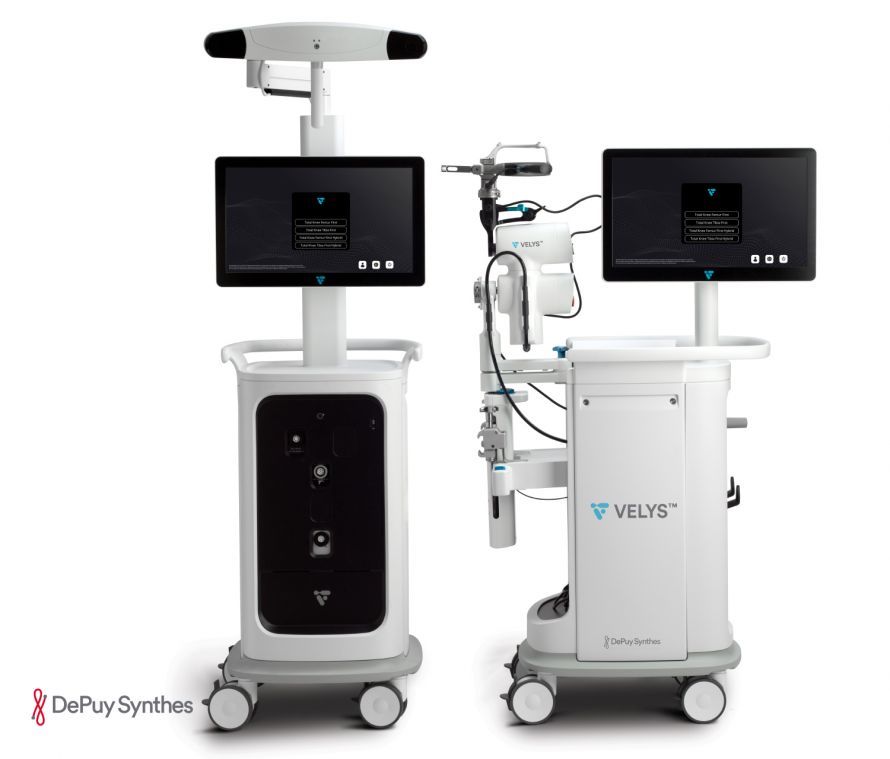
Photo of Velys with caption: Robot-assisted knee arthroplasty with the VELYS™ system for maximum precision and customized implant positioning.
Robotics improves outcomes especially in cases where the anatomy is complex—and it challenges the surgeon to select, from among many precise data points, the configuration that will provide the patient with the best long-term function.
The robot not only helps the surgeon align the implants precisely but also shows in real time during the planning phase how different angles affect the mobility and stability of the knee joint. This allows the best possible outcome to be achieved digitally first. Only once this plan is finalized is it implemented surgically. This is precisely where the key difference lies compared to earlier computer-assisted navigation.
Dr. Stiebler explains: “With the previous navigation system, similar plans could be created, but the incisions were made entirely by hand. The surgeon had to mount resection blocks precisely onto the bone—a time-consuming process in which even small deviations during attachment or sawing could lead to a loss of precision. Some surgeons found this technique challenging because it required very precise, almost ‘video-game-like’ handling. Despite monitoring the cuts, a certain margin of error remained.
With the robot, this source of uncertainty is eliminated. Although the surgeon continues to guide the saw, the robotic arm controls the exact plane in which the cut may be made. This virtually eliminates deviations from the planned cut path. This precision is reproducible and has been demonstrated in cadaver studies, which show significantly higher accuracy compared to the manual technique. Even though direct comparative data between navigation and robotics is lacking, it is considered established that knee replacements performed using navigation are implanted more precisely and last longer than those performed manually—an advantage that robotics is expected to further enhance.” He then describes the process for the patient:
“Once the diagnosis has been made and it is determined that an implant is necessary, the patient is usually given a surgery date within about six weeks. About a week before the procedure, the preparatory examinations take place: a consultation with the anesthesiologist, instruction on assistive devices, and the organization of rehabilitation measures. On the day of surgery, the patient is admitted to the hospital and undergoes surgery. The actual surgery takes about one to one and a half hours—even though the team is still in the process of getting accustomed to the robot.
Mobilization begins on the day of surgery: the patient is expected to get out of bed and take their first steps on the same day, if possible. The patient is discharged no later than the fifth day after the procedure and transitions from home to rehabilitation. The first clinical follow-up takes place after three months, with additional appointments scheduled after one year and then after five years. The clinic’s social services department handles the organization of rehabilitation.”
Robotics significantly alters the surgical learning curve and the surgical team’s decision-making process more than conventional implantation. While in conventional implantation the surgeon’s experience and anatomical landmarks largely determine implant alignment, robotics provides additional real-time data on the leg axis, joint stability, and ligament tension.
The surgical team must immediately interpret these biomechanical relationships and incorporate them into their surgical decision-making. While this makes the procedure more challenging, it also makes it more precise and reproducible.
“The transition to robot-assisted knee surgery follows a clear learning curve. Before the team even begins working on patients, they must first complete theoretical and practical training provided by the manufacturer. This includes training on how the system works, its logic, and safety mechanisms.
This is followed by a hands-on course in which surgeries are performed on artificial knees. Only after this intensive training phase do the surgeons receive a certificate authorizing them to use the system. What they have learned is further reinforced at the hospital. The first procedures are always performed under the supervision of an experienced system specialist from the company, who supports both the surgical team and the surgeons.
“It’s not just the surgeon who must be proficient in using the system—the entire surgical team must also be familiar with its setup, operation, and procedures. There are dedicated training sessions for this, in which all participants are trained step by step,” says Dr. Stiebler.
Robotic knee surgeries enable extremely precise alignment of the prosthesis—down to the exact degree and millimeter. This improves joint mechanics, prevents improper loading, and ensures a more natural feeling of movement through more harmonious ligament tension. Patients benefit early on: Studies show less pain, faster mobilization, and better early functional outcomes. These include:
- KOOS – Knee Injury and Osteoarthritis Outcome Score: assesses pain, activities of daily living, ability to participate in sports, and quality of life.
- WOMAC – Western Ontario and McMaster Universities Osteoarthritis Index: measures pain, stiffness, and function in daily life.
Initial registry data suggest that robotically implanted knees—especially in complex cases—are more stable and require revision less frequently. Robotics thus combines reproducible precision with individual adaptation to the patient’s anatomy—an advantage for early recovery and the long-term durability of the prosthesis.
A joint replacement center integrates modern robotics not simply as an additional device, but as an end-to-end process that transforms planning, the surgical procedure, team communication, and quality assurance. The crucial step is to establish robotics not as a “technical add-on,” but as a new clinical standard that involves everyone—from the surgical team to the postoperative care team.
“In the future, robotics will play a role not only in primary care but also in revision surgery. Even though the team has only recently begun working with it and no revision has been performed yet, it is foreseeable that the robot will find a permanent place here. It is already evident that it offers clear advantages in complex initial cases. A recent case illustrates this: The patient has a defect on the inner side of the tibial head that might not be adequately addressed with a standard prosthesis. In such situations, a decision must be made intraoperatively as to whether the defect can be compensated for by a deliberately chosen, slightly deviating orientation of the tibial component, or whether a step must be resected and a metal augmentation inserted to provide stable underlayment for the component.
While such fine-tuning is possible manually, it is significantly more difficult. Certain angles—such as a planned deviation of up to five degrees—can hardly be set precisely without technical assistance because spatial orientation is limited. The robot, on the other hand, enables implementation with degree-level accuracy and guides the saw precisely in the desired plane. This significantly increases precision,” emphasizes Dr. Stiebler, adding:
“In principle, there are hardly any situations in which one would deliberately forgo the use of robotics. Should the system ever be unavailable, the procedure can, of course, also be performed manually. But under normal circumstances, nearly every patient benefits from the greater accuracy of the robot-assisted approach. An exception is made for customized implants, which are manufactured specifically for individual patients. These continue to be implanted manually, as they use personalized resection blocks and are not compatible with the robot.”
In Schwalmstadt, approximately 200 to 300 knee replacements are performed each year. The VELYS™ robot has only been in use since April 14 and is therefore still very new to everyday clinical practice. For the team, this is naturally an exciting phase, even if the transition isn’t as significant as it is for hospitals that previously performed surgeries exclusively by hand.
 Photo: Velys surgery with caption: Surgery using the Velys robot
Systems like VELYS™ operate within a virtual safety corridor: The saw is only allowed to cut within the plane that was previously defined digitally. Deviations are virtually impossible. This allows the leg axis, rotation, and cut depths to be maintained within the submillimeter and subdegree ranges—a level of precision that is virtually unattainable with manual or purely navigated techniques. VELYS™ is not an autonomous robot, but rather an assistance system: the surgeon retains control at all times. During surgery, the system creates a patient-specific 3D model, continuously measures axial alignment and ligament tension, and simulates various implant positions before any cuts are made. This ensures that the biomechanically optimal option is selected. Another advantage: VELYS™ does not require CT or MRI planning in advance. The model is generated directly in the operating room, without additional radiation exposure and without time-consuming preparation.
Concluding our conversation, Dr. Stiebler comments: “Thanks to my many years of experience with computer navigation, much of it was already familiar to me—the mindset, the planning steps, the digital alignment. What’s new, above all, is working with the robotic arm and the associated procedures, which require a certain amount of adjustment and a willingness to learn. For teams without navigation experience, this technological leap would be significantly greater, because the entire surgical logic changes. Looking to the future, artificial intelligence also plays a role. It could support intraoperative planning, standardize decisions, and make suggestions to the surgeon without relieving him of responsibility.
In the long term, the question arises as to how far this development will go. Systems such as the Da Vinci robot already exist today, allowing surgeries to be controlled—in theory—over long distances—for example, a patient in Germany and a surgeon in New York. Technically, this is already possible, even though stable connections and safety considerations play a major role. This is not yet an issue for current knee robots, but development is advancing rapidly. It is difficult to predict today which possibilities will become reality in ten years.”
- Chief of Orthopedics and Trauma Surgery, Director of the Endoprosthetics Center, and Specialist at Asklepios Klinikum Schwalmstadt.
- Robot-assisted knee arthroplasty using the VELYS™ system for maximum precision and customized implant positioning.
- Minimally invasive hip surgery using the AMIS technique for rapid, muscle-sparing rehabilitation.
- Wide range of prostheses: partial and total joint replacements, axis-guided systems, custom-made implants.
- Extensive expertise in shoulder replacements, including reverse and short-shaft systems.
- Experienced revision surgeon for complex revision surgeries.
- Certified quality with hundreds of implantations performed annually and strictly tested standards.
- Academically engaged instructor
Share this article
Expert Interviews
Read next
- Expert interview
Expert interview with Professor Dr Elmar Herbst, PhD
Oct 15, 2026
Patient-centred and personalised knee surgery
Read more - Expert interview
Cardiogeriatrics: Significance and benefits in the context of hospital reform
Sep 21, 2026
Cardiogeriatrics: Significance and benefits in the context of hospital reform
Read more - Expert interview
Expert Interview with Professor Dr. Amadeus Hornemann, MPH
Sep 18, 2026
Prof. Amadeus Hornemann on Precision Medicine in Gynecology: Modern Surgery, New Techniques, Better Quality of Life
Read more