Expert Interviews
Robot-assisted knee replacement—over 500 procedures, including sliding and revision prostheses

Alexandra Pfitzmann ·
Robot-assisted knee replacement is becoming increasingly important because knee osteoarthritis is a widespread condition in Germany. According to current data, over 7% of the adult population is affected by knee osteoarthritis—that’s several million people who suffer from pain, limited mobility, and a significant loss of quality of life. Since the condition usually worsens over time, many patients will eventually require a knee replacement. Modern robot-assisted procedures enable particularly precise, individually tailored implantation and help improve the function and durability of the knee prosthesis. The editorial team of the Leading Medicine Guide spoke with Stylianos Toumasis from the Nardini Clinic in Landstuhl about this topic.

Robot-assisted knee replacement represents one of the most advanced developments in orthopedic surgery and takes the precision of implantation to a new level. While with conventional methods the alignment of the prosthesis depends heavily on the surgeon’s experience, anatomical estimates, and mechanical aids, robotics enables a highly personalized and data-driven planning process. At the start of the surgery, the patient’s knee is digitally measured to create a precise 3D model that maps the actual anatomy in real time. Based on this, the system generates a personalized surgical plan that determines the optimal size, position, and alignment of the prosthesis. The surgeon can adjust and refine this plan before the robot-assisted incision ensures millimeter-level precision.
“We have been using robot-assisted knee replacement for two years, having previously used a navigation-assisted technique. Over the past two years, we have performed more than 500 implantations—including primary knee replacements, sliding knee replacements, and revision knee replacements. We are convinced that this technology offers clear advantages that directly benefit patients. This is because robotics allows prostheses to be implanted with significantly greater accuracy and precision. If a prosthesis fits exactly, this in turn increases its durability and generally reduces postoperative pain. As a result, patients only need to stay in the hospital for a short time and can return home sooner. Another important advantage is that robotics allows for the creation of a personalized surgical plan. The prosthesis is adapted to the individual’s anatomy and specific characteristics rather than being implanted according to rigid standards. Robotics helps to implement this customization precisely, ensuring that the best possible results are achieved in the end,” Stylianos Toumasis makes clear at the beginning of our conversation.
Individual anatomical measurement using a robotics-assisted system fundamentally changes the planning and execution of knee replacement surgery because, for the first time, it provides a precise, patient-specific image of the knee joint in real time.
While conventional procedures rely heavily on experience, average anatomical values, or mechanical alignments, digital measurement enables an exact analysis of the actual joint geometry, ligament tension, leg axis, and cartilage condition.
“In robot-assisted knee arthroplasty, the anatomical measurement is performed directly during the operation. With the so-called Cori System, a robotic technology from Smith & Nephew, no CT scan is required beforehand. Instead, a virtual, three-dimensional model of the knee joint is created during the procedure. The surface of the knee is scanned point by point using special sensors and markers. This provides the surgeon with an exact representation of the individual anatomy—including all angles and specific features of the respective joint—even while the surgery is in progress. The major advantage is that everything happens in real time. This is not data collected months in advance, but a current, immediate representation of the knee exactly as it is at the time of surgery. Within a few minutes, a complete 3D model is available, supplemented by information about the ligament status of the joint. The ligaments, in particular, play a central role. Their tension and interaction cannot be reliably assessed by either CT or MRI—only the surgeon can do so directly on the exposed joint. This so-called ligament balancing is crucial for a successful knee replacement: The collateral ligaments must be stable, and depending on the type of prosthesis, the posterior cruciate ligament may also be required. This is where the surgeon’s experience comes into play, as they assess ligament tension and incorporate this information into the robot-assisted planning. “The robotic system then helps position the prosthesis so that it optimally fits the patient’s individual anatomy and ligament alignment,” explains Mr. Toumasis.
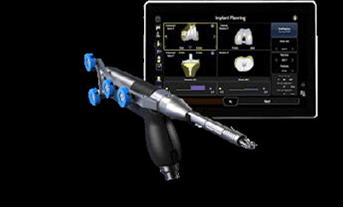
Robot-assisted knee replacement is particularly suitable for patients for whom precise, individually tailored implantation is crucial for the functional outcome. People with complex anatomical conditions—such as pronounced axial deviations like bowlegs or knock-knees, severe cartilage damage, or pre-existing misalignments resulting from previous injuries—benefit particularly from this approach.
Robotics also offers clear advantages for younger, more active patients who have high expectations regarding the prosthesis’s mobility, stability, and durability, as precise alignment improves the implant’s longevity. Patients with existing partial or total knee replacements who are scheduled for revision surgery also benefit, as robotic technology significantly simplifies planning and execution in these challenging situations.
Stylianos Toumasis comments: “At our clinic, we perform robotic surgery on virtually all patients who require a primary knee prosthesis or a sliding prosthesis—including many revision surgeries. Only in very rare cases—involving extremely complex bone defects—does robotic surgery reach its limits. Otherwise, we consistently leverage the advantages of this technology because it enables particularly precise implantation. The benefits are particularly evident when it comes to complications. A major problem in recent years has been pain and dissatisfaction following knee replacement surgery. Studies show that about one in five patients is not truly satisfied after surgery. The reasons for this are varied—the patella, ligament tension, and minor deviations in alignment. With robotics, we can better control many of these factors because we can adapt the prosthesis much more precisely to the individual’s anatomy. We respect the natural shape of the knee and position the implant so that it fits this anatomy optimally. Another important factor is the risk of loosening. When a prosthesis is precisely positioned, the risk of loosening is significantly lower. Naturally, long-term results spanning 20 years are not yet available, as robotics has only been widely used for the past five to six years. But one thing is certain: the more precisely the prosthesis is implanted, the longer it lasts. Studies also show that patients regain mobility faster and more effectively after a precisely implanted prosthesis. The overall results are better because the joint functions more harmoniously from the start, and there is less irritation or improper loading.”
Robot-assisted knee surgery is so effective at reducing the risk of complications such as malalignment, loosening, or limited mobility primarily because it enables an unprecedented level of precision in the planning and execution of the surgery.
Sliding prostheses (partial prostheses) and revision prostheses are among the most challenging procedures in knee arthroplasty because they require particularly precise planning and a high degree of surgical experience. The challenges vary, but they have one thing in common: the anatomy is more complex, less predictable, and requires a customized strategy.
“A partial knee replacement uses different implants than a total knee replacement, and it is only suitable for patients whose osteoarthritis is truly limited to a single segment of the joint. In addition, the collateral and cruciate ligaments must be intact. Robotics allows these procedures to be performed with great precision, leading to excellent outcomes. In the field of revision arthroplasty—that is, when an old prosthesis must be removed and replaced with a new one—robotics is also becoming increasingly important. The software is now also used for such revision procedures. However, these surgeries are more complex and require a great deal of experience, because revision surgeries are generally less common, and the anatomy is often significantly altered after the removal of a loosened or infected prosthesis. This poses additional challenges for robotic technology. For this reason, while it is used in revision surgeries, it is not used for all patients. The technology reaches its limits when dealing with large bone defects. As far as the learning curve is concerned, a great deal of experience is required despite all the technical support. Those who have already worked with navigation-assisted procedures will find their way around more quickly, but robotics also requires practice, dry runs, continuing education, and a deep understanding of the system. After all, despite all the technology, one thing remains clear: Robotics does not replace the surgeon. It does not perform any steps independently. The surgeon decides which plan to follow, what adjustments are necessary, and how the prosthesis will ultimately be implanted. “The responsibility always lies with the surgeon,” emphasizes Stylianos Toumasis.
Robotics can significantly increase the precision of knee replacement surgery, but the surgeon’s experience remains crucial to the outcome. Robotic systems provide data, measure ligament tension, display axis alignments, and prevent technical deviations—but they do not replace surgical judgment.
Robot-assisted knee replacement has a noticeably positive impact on both early rehabilitation and long-term patient satisfaction because it makes the surgery more precise, less invasive, and better biomechanically optimized.
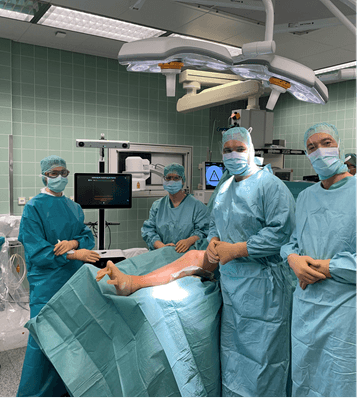
“After surgery—whether a total knee replacement, partial knee replacement, or revision surgery—rehabilitation proceeds even faster with robotic assistance than it did in the past, because patients experience less pain, which is also related to the minimally invasive technique. While hospital stays used to last two weeks, they are now usually less than a week. At our joint replacement center, we perform approximately 250 knee surgeries per year—total knee replacements, partial knee replacements, and revision surgeries. Almost all of them are performed using the robotic system. Two lead surgeons perform these procedures, as such surgeries require a great deal of experience and a high level of expertise. That is why the majority of these procedures are performed by experienced surgeons. Robotics for partial knee replacements has now become standard in many hospitals. In revision surgeries, however, the use of robotics is still relatively rare. “But we also use the technology wherever it makes sense and is feasible,” says Stylianos Toumasis, adding at the end of our conversation:
“At Nardini Clinic, as a maximum-care endoprosthetics center, we work to the highest quality standards—whether for knee and hip replacements or shoulder arthroplasty. The patient is always our top priority. Our goal is to achieve the best possible results using modern technologies and minimally invasive methods. Many hospitals in Germany are now interested in this technology and are also trying to implement robotics-assisted procedures. In orthopedics, there is a growing recognition that robotics—when used correctly—leads to greater patient satisfaction. Through continuing education and collaboration with colleagues, the use of robotics continues to expand, enabling us to achieve even better results in the long term.”
Thank you very much, Dr. Toumasis, for your insightful explanation on the topic of “robot-assisted knee replacement”!
- Chief of Orthopedics and Trauma Surgery & Director of EPZmax, Nardini Clinic Landstuhl; Board-Certified Specialist in Orthopedics and Trauma Surgery with specializations in advanced orthopedic surgery, sports medicine, manual medicine, and physical therapy; Master of Science in Health Care Management
- Areas of expertise: Hip replacement (minimally invasive: AMIS/ALMIS), hip replacement revision, knee replacement (partial/total), robot-assisted (CORI), knee replacement revision, shoulder replacement, arthroscopy, sports traumatology, trauma, foot, and hand surgery
- 15 years of experience with computer-assisted and robot-assisted surgery
- High case volume: >550 hip and ~250 knee replacements per year
- EndoCert-certified center for maximum care
Share this article
Expert Interviews
Read next
- Expert interview
Expert interview with Professor Dr Elmar Herbst, PhD
Oct 15, 2026
Patient-centred and personalised knee surgery
Read more - Expert interview
Cardiogeriatrics: Significance and benefits in the context of hospital reform
Sep 21, 2026
Cardiogeriatrics: Significance and benefits in the context of hospital reform
Read more - Expert interview
Expert Interview with Professor Dr. Amadeus Hornemann, MPH
Sep 18, 2026
Prof. Amadeus Hornemann on Precision Medicine in Gynecology: Modern Surgery, New Techniques, Better Quality of Life
Read more