Expert Interviews
Strategic revision surgery for prosthetic loosening: Minimally invasive whenever possible; early mobilization is crucial. Bilateral total hip replacement via AMIS approach in a single session

Alexandra Pfitzmann ·
When a prosthesis becomes loose or inflamed, every day counts. Modern revision surgeries therefore rely on clear strategies, minimally invasive techniques, and precise planning—so that patients can regain mobility more quickly.

“Prosthesis loosening can have various causes, with aseptic loosening being the most common. Over the years, this results in normal wear and tear of individual components—such as the polyethylene or metal parts. After about two decades, a prosthesis can therefore become loose without any infection being present. Less commonly, septic loosening is the underlying cause—that is, an infection in the area around the prosthesis. This requires a completely different treatment strategy than the aseptic form.
Another cause is periprosthetic fractures—that is, fractures around the prosthesis following a fall—which also lead to loosening and necessitate a revision surgery. An acute infection can also occur within the first four weeks after surgery. These early infections affect about two to three percent of patients. In such cases, swift action is crucial: The prosthesis must be surgically relieved of pressure, the soft tissues and joint space are thoroughly irrigated and debrided, and mobile components that are not firmly anchored in the bone are replaced. This is accompanied by antibiotic therapy.
“This approach differs significantly from the treatment of chronic or so-called low-grade infections, which often present less obviously but must be treated just as thoroughly,” explains Stylianos Toumasis at the beginning of our conversation.
An early, clearly structured treatment strategy fundamentally changes the course of prosthetic loosening or infections because it guides the entire therapeutic process—from diagnosis to rehabilitation—in a targeted manner.
“When a prosthesis has reached the end of its service life after about 20 years, replacement is often unavoidable. The first crucial step is a thorough diagnostic evaluation to definitively rule out the presence of an infection. This is done via joint aspiration or—if necessary—an arthroscopic biopsy. This is followed by imaging diagnostics: In addition to X-rays, CT, MRI, or MARS MRI are used to precisely assess soft tissues, prosthesis positioning, and potential bone damage.
Only once all the information is available is a decision made as to whether a one-stage or two-stage replacement is appropriate—depending on the extent of the bone defects or the suspicion of a low-grade infection. The amount of existing scar tissue also plays a role. “The goal is to perform surgery that is as minimally invasive as possible in order to spare muscles and tendons, reduce pain, and minimize the risk of dislocations, infections, or functional impairments,” explains Toumasis, adding:
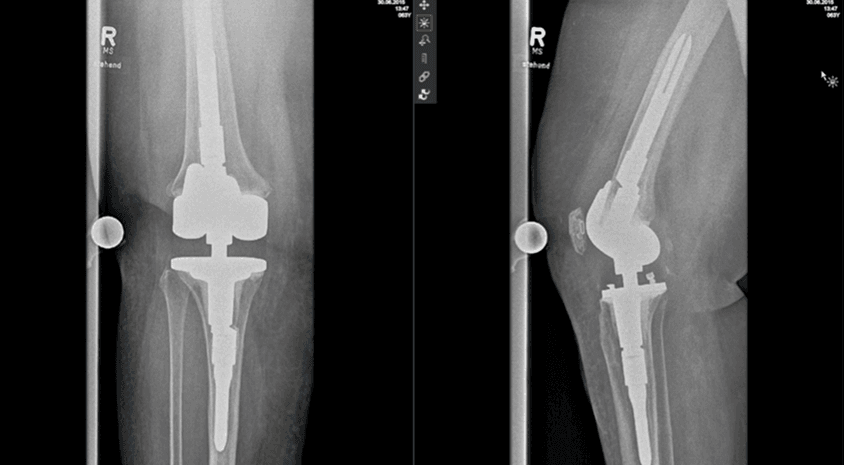
“A two-stage replacement is primarily necessary when there is a long-standing low-grade infection with significant defects. In this case, the old prosthesis is removed and a spacer is inserted—a placeholder made of antibiotic-impregnated bone cement that maintains joint stability. In some situations, the joint is even left completely without an implant for a time. After three to six weeks—depending on the pathogen and the condition of the bone and soft tissues—reimplantation can then take place.
For patients, this results in varying degrees of limitation depending on the joint. The situation is more complex for the hip and knee than for the shoulder. With a spacer, at least limited mobility remains possible: standing, taking a few steps, and some joint function are achievable. Without a spacer, however, mobility is virtually impossible, so that patients usually remain in a wheelchair and must even be hospitalized for the entire period—accompanied by consistent antibiotic therapy. During the period between the removal and reimplantation of a prosthesis, muscle atrophy cannot be completely prevented, but it can be significantly mitigated.
Targeted isometric exercises are performed even during the inpatient stay—that is, movements that do not involve weight-bearing and stabilize the muscles given the current situation. However, much more is not possible during this phase because the joint cannot yet bear weight, and full range of motion can only be achieved after reimplantation. This is precisely why the period between prosthesis removal and reimplantation is kept as short as possible. Instead of waiting several weeks or even months, the goal is usually to keep the interval to just two to three weeks. If no complicated bacterial infections are detected, an attempt is also made to perform the replacement in a single-stage procedure to keep the period of limited mobility as short as possible. This approach significantly reduces muscle atrophy, loss of function, and the need for lengthy rehabilitation.”
Shoulder prostheses play a significantly smaller role in everyday clinical practice than hip or knee prostheses, but when they become necessary, the causes usually lie in complex injuries or long-standing tendon damage.
“More common than classic shoulder osteoarthritis are complex or multifragmentary fractures in which reconstruction is no longer possible and a prosthesis becomes necessary. Another typical cause for a shoulder prosthesis is so-called defect arthropathy, which develops when a rotator cuff tear persists for years, causing the joint to lose its function. In such cases, a prosthesis can restore mobility, even though these procedures are significantly less common overall than hip or knee surgeries.
In knee arthroplasty, hand-guided robotic technology—known as CORI robotics—is routinely used; it is employed for every implantation of total or partial prostheses and also offers significant advantages in revision surgeries. Revision surgeries, in particular, are more challenging than primary surgeries, and robotic assistance provides additional information during the procedure and ensures more precise placement of the prosthesis than a purely freehand method. In hip surgery, however, the advantages of robot-assisted implantation are currently less pronounced. The crucial information can already be reliably obtained intraoperatively via X-rays.
Although robotic assistance is possible, the technical effort involved is disproportionate to the clear added value. “High-quality hip replacements can be performed even without robotics,” states Toumasis.
Whether a one-stage or two-stage revision is appropriate for an infected prosthesis depends on several medical factors. The type of pathogen, the extent of the infection, the condition of the bone and soft tissues, and the patient’s overall health are decisive. Pathogens that are easily treatable and locally confined infections tend to favor a single-stage replacement. In cases of multidrug-resistant pathogens, extensive tissue damage, or larger bone defects, a two-stage procedure is safer because it allows for complete debridement. Surgical conditions—such as the ability to completely remove infected tissue and insert suitable revision implants—are also factored into the decision. Ultimately, all findings combine to form an overall picture that indicates which procedure offers the most stable and lowest-risk solution in the long term.
The AMIS method offers several clear advantages over conventional approaches in revision surgeries because it structures the procedure in a way that minimizes damage to muscles and soft tissues, thereby significantly accelerating rehabilitation. The key difference is that AMIS operates through a natural interval between the muscles without cutting through fibers or detaching tendons.
“The AMIS method also plays an important role in revision surgeries, provided the surgical complexity allows for it. Thanks to many years of experience in primary hip arthroplasty, both the necessary instruments and the expertise are available to perform revisions via this minimally invasive approach. The method is particularly suitable when only the cup or stem needs to be replaced in isolation and no additional bony procedures, such as osteotomies, are required. If the effort involved is reasonable, the procedure is consistently performed via the anterior, muscle-sparing approach.
AMIS stands for Anterior Minimally Invasive Surgery and describes an anterior approach that utilizes a natural muscle gap between the sartorius and tensor fasciae latae muscles. A special extension table allows for optimal visualization of the hip joint. Thanks to a procedure that has been standardized over the years, excellent results have been achieved. For patients, this means less blood loss, a significantly lower risk of dislocation, less pain after surgery, and a noticeably shorter rehabilitation period. Since no muscles or tendons are detached during this procedure, full weight-bearing capacity is restored immediately after surgery.
Even in cases of bilateral osteoarthritis, both hip joints can be treated in a single operation—under general anesthesia, with an inpatient stay of about one week, and the ability to bear full weight as early as the first day. The clinic has been using this method regularly for bilateral procedures since last year, particularly for younger, working patients who cannot undergo two consecutive extended rehabilitation periods. “The results are exceptionally good,” says Stylianos Toumasis regarding the AMIS method, adding:
“However, such a surgery requires a high level of expertise. It’s not just the surgeon’s experience that’s crucial, but the collaboration of an entire, well-coordinated team: surgical assistants, operating room nurses, anesthesiologists, ward staff, and physical therapists. Over 5,000 AMIS implantations in the past two decades have led to a high level of routine. It is therefore important for patients to know that they are in a certified, comprehensive-care joint replacement center where these procedures are performed regularly and with a high degree of professionalism.”
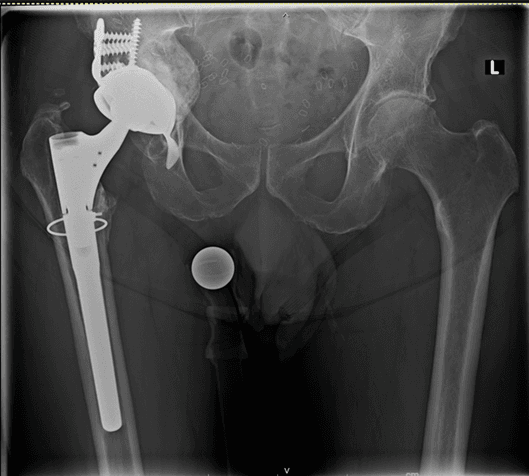
Modern planning tools and digital measurement systems enable a level of surgical precision that would be virtually impossible to achieve with purely manual techniques. They lay the foundation for ensuring that even complex revision surgeries can be performed in a reproducible, safe, and long-term stable manner—thereby achieving significantly better functional outcomes for patients.
“Compared to the past, technical support in joint replacement has advanced enormously. In addition to traditional X-rays, digital planning tools and specialized software are now available to prepare procedures with precision. Even before the operation, the surgeon knows—to near-millimeter precision—the required implant size, the exact osteotomy height, and the optimal positioning of the components. Particularly in hip and knee arthroplasty, robot-assisted procedures are also used, offering additional safety and accuracy during surgery.
These digital tools do not replace the surgeon, but they enable significantly more precise implantation and thus contribute significantly to the durability of the prosthesis. This is because many cases of loosening result from suboptimal positioning. If a prosthesis is not positioned exactly, the risk of premature loosening increases considerably. “Modern technology therefore helps reduce sources of error and achieve stable, long-term results,” explains Stylianos Toumasis.
At Nardini Klinikum, approximately 800 endoprostheses are implanted annually—about 500 hip prostheses and 250 to 300 knee prostheses, including revision surgeries. Hip prostheses are implanted almost exclusively using the AMIS method, and this approach is also used for revision surgeries whenever feasible. Knee prostheses are always implanted with robotic assistance. The high volume of cases, the specialization, and the consistent use of modern technology ensure that intraoperative decisions can be made quickly, safely, and at the highest level.
In conclusion to our conversation, Stylianos Toumasis emphasizes: “Even with perfect planning, situations can arise during surgery in which the original strategy must be adjusted. Despite digital tools, precise preoperative planning, and modern imaging, it sometimes only becomes apparent intraoperatively that certain conditions are not as expected—such as significantly poorer bone quality, unusual anatomy, or the fact that cementless fixation cannot be safely performed.
In such moments, experience, routine, and a well-coordinated team that can react immediately are essential. A certified maximum-care arthroplasty center therefore always has all necessary options on hand: alternative implants, cemented components, screw fixations, or special instruments. If the original plan cannot be implemented, the team immediately switches to Plan B without wasting any time. This flexibility is crucial for ensuring the stability of the prosthesis and preventing complications.”
Thank you very much, Dr. Toumasis, for this important information on revision arthroplasty!
- Chief of the Department of Orthopedics and Trauma Surgery at the Nardiniklinikum Landstuhl
- Board-certified specialist in orthopedics and trauma surgery with a broad range of additional expertise
- Specialist in hip, knee, and shoulder joint replacement
- Expert in minimally invasive hip surgery and complex prosthesis replacements
- A leader in robot-assisted knee replacement (CORI)
- Experienced in arthroscopic and sports trauma surgery
- Surgical expertise ranging from trauma surgery to foot and hand surgery
- Master of Science in Health Care Management for quality-oriented care
- Focus on modern treatment of hip and knee osteoarthritis
Share this article
Expert Interviews
Read next
- Expert interview
Expert interview with Professor Dr Elmar Herbst, PhD
Oct 15, 2026
Patient-centred and personalised knee surgery
Read more - Expert interview
Cardiogeriatrics: Significance and benefits in the context of hospital reform
Sep 21, 2026
Cardiogeriatrics: Significance and benefits in the context of hospital reform
Read more - Expert interview
Expert Interview with Professor Dr. Amadeus Hornemann, MPH
Sep 18, 2026
Prof. Amadeus Hornemann on Precision Medicine in Gynecology: Modern Surgery, New Techniques, Better Quality of Life
Read more