News
When the Patella Goes Off Track – Modern Treatment of Trochlear Dysplasia

Sabine Schneider ·
Trochlear dysplasia is a malformation of the trochlea in the knee joint and one of the most common causes of patellar instability. Normally, the patella glides smoothly along the groove in the femur when the knee is bent and straightened. However, if this groove is too shallow or asymmetrical, the patella can easily slip outward—a condition known as patellar dislocation. Those affected often experience a feeling of instability, pain in the front of the knee, and a crunching or grinding sensation during movement.
The condition primarily affects young, athletically active people and can be either congenital or result from injuries. It is often not noticed until after repeated dislocations. Untreated trochlear dysplasia leads to long-term cartilage damage and chronic patellofemoral instability.
Causes and Diagnosis
The cause lies in a malformation of the bony groove on the femur. Genetic predisposition plays a role, as do mechanical factors, such as increased tension in the patellar tendon or a misalignment of the leg. Due to the flat or asymmetrical trochlea, the kneecap loses its grip during movement and slips laterally out of the gliding groove.
Diagnosis involves a clinical examination and imaging techniques such as MRI or CT. These allow for a precise assessment of the degree of trochlear deformity and whether there are associated injuries to the medial patellofemoral ligament (MPFL) or the cartilage. Classification is based on the Dejour classification (Types A–D), which describes the severity of trochlear dysplasia.
Treatment Options
Treatment depends on the extent of the malformation and the symptoms. In mild cases, a conservative approach—including targeted physical therapy, muscle strengthening, and stabilization of the knee joint—is often sufficient. The goal is to restore the muscular balance between the medial and lateral structures and to improve patellar tracking.
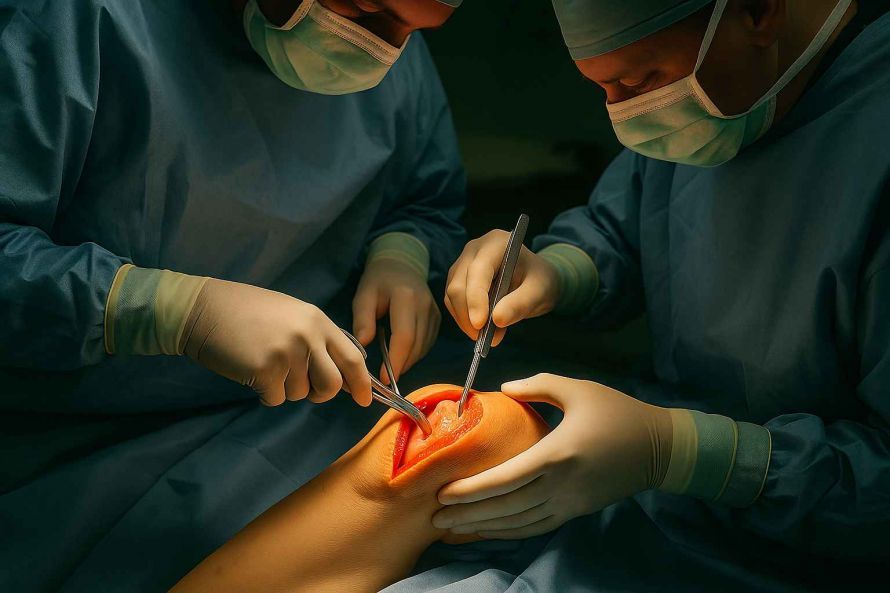
In cases of recurrent dislocations or more severe malformations, surgical correction—known as trochleoplasty—is necessary. During this procedure, the orthopedic surgeon reshapes the trochlea and deepens the gliding groove so that the patella is guided stably once again. The procedure is typically performed using a minimally invasive technique to minimize stress on the surrounding tissue.
Trochleoplasty—Restoring Joint Stability
Trochleoplasty is now considered an established procedure for treating severe trochlear dysplasia. Depending on the individual’s anatomy, various techniques are available, such as the “modified Dejour trochleoplasty” or the “trochleoplasty with a flexible osteochondral flap.”
The surgery is often combined with reconstruction of the medial patellofemoral ligament (MPFL). This ligament stabilizes the patella on the inner side and prevents lateral displacement. The combined procedure (“combined trochleoplasty and medial patellofemoral ligament reconstruction”) is considered the gold standard for recurrent patellar dislocations associated with severe trochlear dysplasia.
Studies in specialized journals such as *Knee Surg Sports Traumatol Arthrosc* and *J Bone Joint Surg* demonstrate a significant improvement in stability and function following such surgery. Patients report high satisfaction and a significant reduction in pain and episodes of instability.
Postoperative Care and Prognosis
After surgery, the knee is immobilized with a splint for several weeks. Following this, physical therapy begins with passive and, later, active movements. The goal is to maintain range of motion without overloading the reconstructed structures. Full weight-bearing is usually possible after three to four months.
In the long term, trochleoplasty leads to a significant stabilization of the knee joint. The risk of recurrent dislocations decreases considerably, and patients regain confidence in their joint. Studies show that over 90 percent of patients are symptom-free or show significant improvement after the procedure.
Significance for Orthopedics and Trauma Surgery
The treatment of trochlear dysplasia is a complex but well-established subspecialty of orthopedics and trauma surgery. It requires experience in knee surgery and a deep understanding of the individual anatomy of the patellofemoral joint. Thanks to a combination of modern imaging, precise surgical techniques, and structured follow-up care, excellent functional outcomes can be achieved today.
Early diagnosis is crucial to preventing permanent damage to cartilage and bone. Anyone suffering from recurrent dislocations, instability, or pain in the front of the knee should therefore consider a specialized orthopedic evaluation.
Share this article
Verified expertise
Recommended specialists
4 specialists
4 results





News
Read next
- News
Scabies: A contagious skin disease that is easily treatable
Oct 26, 2026
Severe itching and minor skin changes should be taken seriously
Read more - News
Heat Rash: What's Behind the Itchy Blisters
Oct 23, 2026
Heat Rash: Heat and Sweat Can Disrupt the Skin's Balance
Read more - News
Enlarged Prostate – When Medication Is Sufficient and When Surgery Is Recommended
Oct 21, 2026
Why Many Men Ignore Urinary Problems for Too Long
Read more