
Trochlear dysplasia is a malformation of the bony glide surface of the kneecap (patella). If the gliding surface (trochlea) is too flat or asymmetrical, the risk of recurrent patellar dislocations (the kneecap popping out of place) is significantly increased. Accurate diagnosis using MRI and classification according to Dejour are crucial for determining the severity of trochlear dysplasia. In cases of severe trochlear malformation, surgery can be performed to reconstruct the patellar trochlea, thereby providing the patella with proper guidance. Trochleoplasty, which is often performed in combination with medial patellofemoral ligament replacement (MPFL reconstruction), can restore the patella’s guidance and stability and significantly reduce the risk of recurrent dislocations.
Definition and Anatomical Basics
The trochlea forms the upper portion of the gliding track in which the patella is guided during flexion and extension of the knee joint. In trochlear dysplasia, this gliding track is too shallow or asymmetrical, causing the patella to lose its stable guidance. As a result, the patella no longer remains centered during flexion, leading to abnormal stress on the patellar gliding track, which causes pain and a feeling of instability. The lack of bony guidance for the patella also contributes to the occurrence of patellar dislocations, in which the patella pops outward out of its gliding track.
Anatomically, the trochlea is formed by bony and cartilaginous structures, which enable low-friction gliding. If the shape is altered, contact between the patella and the trochlea becomes irregular, which over time contributes to the development of cartilage damage behind the patella and in the area of the trochlea.
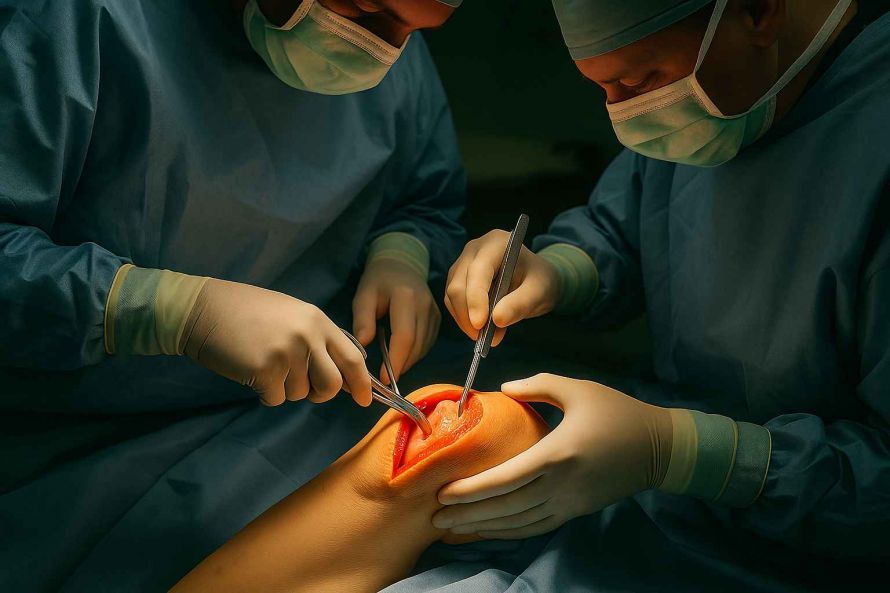
Surgical treatment of trochlear dysplasia: Two specialists perform a trochleoplasty on the knee joint.
Causes and Risk Factors
The causes of trochlear dysplasia are congenital developmental abnormalities. Genetic predispositions explain why trochlear dysplasia tends to run in families. Furthermore, trochlear dysplasia is always bilateral, though the severity may vary between sides.
It is not uncommon for affected patients to also have other congenital abnormalities that can serve as additional risk factors for patellar dislocations and must be taken into account when treating trochlear dysplasia. These include, among other things, a high-set patella (patella alta) as well as torsional deformities of the thigh and/or lower leg. Recurrent patellar dislocations can cause damage to the articular cartilage and lead to an increase in symptoms of instability.
Diagnosis and Classification According to Dejour
The diagnosis of trochlear dysplasia is made through an MRI examination. According to the Dejour classification, four types (A through D) are distinguished based on the severity of the deformity. While Type A shows mild flattening, Type D is characterized by a severely altered and asymmetrical trochlea with a sharp edge. This classification helps assess the need for surgical treatment.
As previously mentioned, trochlear dysplasia is often associated with other congenital risk factors and abnormalities that exacerbate the clinical presentation. Therefore, a comprehensive clinical and imaging evaluation is necessary, covering all factors that may contribute to patellofemoral instability. Accordingly, a careful clinical examination of gait and the function of the adjacent joints is just as necessary as an assessment of the stability of the patellar glide. Depending on the clinical findings, additional imaging studies—such as leg axis or torsion measurements—may be required to account for the need to address other risk factors in the treatment of trochlear dysplasia.
Treatment Options
Treatment for trochlear dysplasia depends on the severity and symptoms. Mild forms are treated conservatively, for example through targeted muscle training, physical therapy, and exercises to align the leg axis or stabilize the patella. Such coordinated functional training can improve patellar tracking and alleviate symptoms in mild cases of trochlear dysplasia or patellofemoral instability. Orthopedic aids or braces can further support the patella’s gliding motion.
In cases of severe deformity and recurrent dislocations, surgical treatment is recommended. Trochleoplasty procedures, in which the bony guide surface for the patella is reconstructed, are particularly important for restoring stable patellar tracking and load-bearing capacity, since an inadequately formed bony gliding surface has a significant negative biomechanical impact on instability. Trochleoplasty is often performed in combination with ligament reconstruction and other bony procedures.
Surgical Procedures (Trochleoplasty & MPFL Reconstruction)
In a trochleoplasty, the bony trochlear groove is remodeled during surgery so that the patella can once again be stably guided within the newly shaped groove.
To do this, during the operation, the cartilage of the trochlea is detached from the rest of the femur along with a thin layer of bone (bone-cartilage lamella). This allows bone to be removed from the underlying bone and a new bony groove, adapted to the anatomy, to be created. The detached bone-cartilage lamella is then fitted into the newly formed guide groove and secured with absorbable sutures or pins. The newly created trochlea provides improved bony guidance for the patella, thereby significantly reducing the risk of recurrent dislocation.
Since trochleoplasty is frequently performed for patellofemoral instability and in patients with recurrent patellar dislocations, this procedure is typically combined with ligament reconstruction (MPFL reconstruction). In addition to restoring the bony guidance of the patellar glide surface, this also stabilizes the ligamentous apparatus.
The surgery requires surgical expertise to ensure that the groove is reshaped to properly accommodate the patella. The procedure can be performed either open or arthroscopically and takes one to two hours, depending on any additional procedures that may be necessary. A hospital stay of 1–2 days is expected following the surgery.
Follow-up Care and Rehabilitation
Postoperatively, gradual mobilization takes place under the guidance of a physical therapist.
Crutches are primarily used to relieve pressure on the knee joint, prevent swelling, and reduce pain. In addition to physical therapy and lymphatic drainage, daily self-exercises are particularly helpful in rebuilding mobility and load-bearing capacity after surgery, allowing patients to gradually resume everyday activities after about 6 weeks. This is followed by a rehabilitation program focused on building muscle, strength, and coordination. Regular exercise bike training, rowing machine workouts, and independent training at the gym help you recover as quickly as possible after surgery. Depending on the procedure, the healing of the bone and cartilage structures, and progress in building muscle mass, strength, and coordination, sports activities can be resumed after 6–12 months. Regular follow-up examinations monitor the healing process and help prevent complications.
Prognosis and Research Findings
The prognosis following trochleoplasty is very good when the procedure is performed for the correct indication.
Various high-impact clinical studies, such as those by Dejour et al. or Nelitz M., have demonstrated that trochleoplasty leads to a significant improvement in symptoms and instability. In addition, biomechanical studies have shown that remodeling the trochlear groove not only centers the patellar tracking but also improves the distribution of cartilage load. It can be assumed that this also reduces the risk of cartilage damage. Long-term studies have shown that patients with severe trochlear dysplasia and patellar instability, in particular, benefit sustainably from trochleoplasty combined with MPFL reconstruction. Based on the favorable clinical outcomes and the positive results of published studies, trochleoplasty is recommended by international professional societies and experts as an effective treatment method for patellofemoral instability.
Frequently Asked Questions About Trochlear Dysplasia
How is trochlear dysplasia diagnosed?
In addition to a comprehensive clinical examination, imaging techniques are essential for assessing and classifying the severity of trochlear dysplasia. MRI scans, in particular, allow for the evaluation of the trochlea’s shape and the detection of asymmetries. The severity of trochlear dysplasia is classified according to Dejour (Types A–D) and is particularly relevant for determining the need for surgery.
When is surgery necessary?
The need for trochleoplasty depends, on the one hand, on the patient’s symptoms and, on the other hand, on the severity of the instability. Since severe trochlear dysplasia, in particular, is a significant contributor to patellofemoral symptoms, the possibility of trochleoplasty should always be considered when treating patellofemoral instability.
However, since various other congenital risk factors—in addition to trochlear dysplasia—can also contribute to patellofemoral symptoms, a careful analysis of all factors is always required for treatment planning. These include, among others, leg axis misalignments, torsional abnormalities, and, for example, a high-riding patella. Taking into account the patient’s symptoms, clinical findings, and imaging results, an individualized treatment plan can then be developed for each patient.
How is trochleoplasty performed?
In trochleoplasty, the missing bony glide surface of the patella is surgically remodeled so that the patella can be stably guided within a newly formed glide surface. To do this, the bone-cartilage lamella of the trochlea is detached from the rest of the femur. This allows for the creation of an anatomical bony groove into which the previously detached bone-cartilage lamella can be reinserted and secured.
What is a combined trochleoplasty and MPFL reconstruction?
Trochleoplasties are often combined with ligament reconstruction to stabilize the patella in cases of severe patellofemoral instability, in addition to restoring bony guidance. In a procedure known as medial patellofemoral ligament (MPFL) reconstruction, the MPFL—the most important passive stabilizer of the patellar tracking—is anatomically reconstructed using the patient’s own tendon.
What are the outcomes after trochleoplasty?
As various high-impact clinical studies have shown, the outcomes after trochleoplasty are very good when the indication is correctly determined, leading to lasting improvements in both stability and symptoms.
What role does postoperative care play?
Especially in the first few weeks after surgery, in addition to physical therapy and lymphatic drainage, daily self-exercises are particularly important for regaining mobility and the ability to bear weight. Appropriate self-exercises should be discussed with the physical therapist. Especially in the first few weeks, it is recommended to perform self-exercises several times a day in shorter intervals—4–5 sessions of 10 minutes each—to avoid overloading the recently operated knee joint. Once the ability to handle everyday activities and full knee mobility have been regained, muscle strength and coordination must be built up before sports activities can be resumed.
What complications can occur?
The risk of a recurrent patellar dislocation is extremely low (one to two percent). However, it is not uncommon for there to be a limitation in full flexion range of motion as well as a grinding sound behind the patella. To counteract this—and especially to prevent scarring—home exercises and physical therapy are of crucial importance. Until muscle strength and coordination have been fully restored, residual symptoms and pain around the patella related to physical activity can be expected for up to six months after surgery. Postoperative infections, thrombosis, or bruising are relatively rare (one to two percent overall) and, as with any other surgical procedure, may occur, just as temporary bruising, swelling, or pain may also occur.
Share this article