News
Parkinson's: Why an Early Diagnosis Can Have a Positive Impact on the Course of the Disease

Melanie Al Tikriti, BSc ·
Tremors, slowed movements, or increasing muscle stiffness—many people immediately associate these symptoms with Parkinson’s disease. In fact, it is one of the most common neurological disorders worldwide. In German-speaking countries alone, hundreds of thousands of people have been diagnosed with the disease. Although Parkinson’s disease remains incurable to this day, treatment options have advanced significantly in recent years. Modern medications, innovative pump systems, and specialized brain stimulation therapies enable many patients to enjoy a significantly better quality of life than was possible just a few decades ago.
Parkinson’s disease progresses differently in each person. Some people experience only mild symptoms over several years, while in others the disease progresses more rapidly. That is why a personalized treatment plan plays a crucial role. The goal of treatment is to alleviate symptoms for as long as possible, maintain independence, and actively shape daily life.
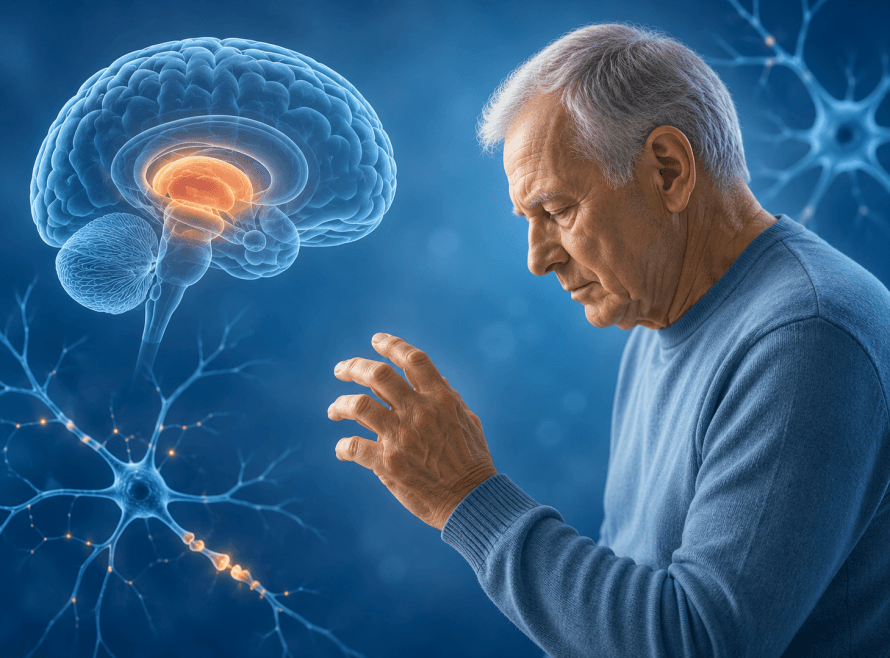
Image generated by AI
What is Parkinson’s disease?
Parkinson’s disease is a chronic, progressive disorder of the nervous system. In this condition, nerve cells in a specific area of the brain that produce the neurotransmitter dopamine gradually die off. Dopamine is responsible for controlling movement. When its concentration decreases, movement patterns can no longer be coordinated smoothly.
The disease usually develops slowly over several years. The first changes often begin long before typical movement disorders appear. As a result, Parkinson’s is not always recognized immediately, especially in the early stages.
What are the symptoms?
Symptoms vary considerably from person to person. While some patients initially experience tremors, others notice an increasing slowness of movement.
Typical symptoms include:
- Tremor at rest (resting tremor)
- Slowed movements (bradykinesia)
- Muscle stiffness (rigor)
- Balance problems
- smaller handwriting
- Reduced facial expressions
- Soft voice
- Unsteady gait
In addition to movement disorders, so-called non-motor symptoms often occur. These include sleep disturbances, constipation, impaired sense of smell, depression, anxiety, or difficulty concentrating.
How is Parkinson’s disease diagnosed?
To date, there is no single test that can definitively diagnose Parkinson’s disease. The diagnosis is based on a detailed neurological interview, a physical examination, and an assessment of typical symptoms. Imaging techniques such as magnetic resonance imaging (MRI) may also be used to rule out other conditions. In specific cases, nuclear medicine tests such as the dopamine transporter scan (DaTSCAN) are used, which can reveal changes in the dopaminergic system.
What medications are used?
Medication forms the basis of Parkinson’s therapy. The goal is to compensate for the dopamine deficiency and thereby improve mobility. The most important medication is levodopa (L-Dopa). It is converted into dopamine in the brain and is still considered the most effective treatment for motor symptoms.
Depending on the stage of the disease, the following may also be used:
- Dopamine agonists
- MAO-B inhibitors
- COMT inhibitors
- Amantadine
- Other medications tailored to the individual
As the disease progresses, the effectiveness of individual medications may vary. Many people with Parkinson’s experience so-called “on-off” phases, in which periods of good mobility alternate with periods of marked movement limitations.
What new treatment options are available?
Numerous innovative therapies have been developed in recent years. They are primarily used when medications alone can no longer adequately control symptoms.
Deep brain stimulation (DBS) plays an important role. In this procedure, fine electrodes are implanted in specific regions of the brain and connected to a small stimulator under the skin. The electrical impulses can significantly reduce movement disorders and lower the need for medication in suitable patients. Pump therapies are also becoming increasingly important. In this approach, levodopa or apomorphine is continuously administered via a pump. This keeps the drug level more consistent, which can reduce severe fluctuations in mobility.
In addition, intensive research is being conducted worldwide on new treatment approaches. These include antibody therapies targeting pathological protein deposits, gene therapies, and procedures using stem cells. Many of these approaches are currently still in clinical trials and are not yet part of standard care.
Why Exercise Is an Important Part of Treatment
In addition to medication, physical activity plays a central role. Regular physical therapy can help maintain mobility, balance, and muscle strength. Occupational therapy and speech therapy also help preserve daily living skills, as well as speech and swallowing abilities, for as long as possible.
Suitable options include:
- regular walking exercises
- strength and balance exercises
- dancing
- swimming
- Cycling
- Tai Chi or yoga
Studies show that physical activity not only improves mobility but can also have a positive effect on mood, sleep, and overall quality of life.
What are the future prospects?
Research on Parkinson’s disease is currently advancing at a particularly rapid pace. The goal of future therapies is not only to alleviate symptoms but also to influence the course of the disease as early as possible and slow its progression. Until then, early diagnosis combined with a personalized treatment plan remains the most important foundation for living as independently as possible with Parkinson’s disease.
Conclusion: Personalized treatment can make daily life easier
Parkinson’s disease is one of the most common neurological disorders and poses significant challenges for those affected in their daily lives. However, thanks to modern medications, deep brain stimulation, innovative pump therapies, and comprehensive rehabilitation, there are significantly more treatment options available today than there were just a few years ago. A personalized treatment plan can effectively alleviate symptoms and maintain quality of life in the long term. Anyone who notices early signs such as tremors, slowed movement, or balance problems should seek prompt neurological evaluation.
Share this article
About the medical author
Melanie Al Tikriti, BSc
Editor
Melanie Al-Tikriti, BSc – author: Explore expert medical articles in the Leading Medicine Guide.
More about the medical author →Verified expertise
Recommended specialists
6 specialists
6 results








News
Read next
- News
Kidney Stones – Modern Treatments, from Shock Waves to Lasers
Oct 7, 2026
Why Sudden, Severe Flank Pain Can Be a Warning Sign
Read more - News
Retinal Detachment: Flashes of Light Can Jeopardize Vision
Oct 5, 2026
Retinal Detachment: Quick Action Can Save Your Eyesight
Read more - News
The waiting period for a semen analysis prior to planned fertility treatment
Oct 5, 2026
Semen analysis: The effects of short waiting periods
Read more