
Botox treatment is one of the most effective methods for specifically reducing expression lines—without any surgery. The use of botulinum toxin relaxes overactive facial muscles, which can visibly reduce forehead wrinkles, frown lines, and crow’s feet. The key to a convincing result is not maximum smoothing, but a natural look. Modern aesthetic medicine relies on individually tailored dosages that make the face appear fresher without losing facial expression.
What Botox Is and Why It's So Popular
Botox is the best-known brand name for botulinum toxin type A. In aesthetic medicine, it is used to selectively relax overactive facial muscles. This is precisely how forehead wrinkles, frown lines, or crow’s feet can be visibly reduced without the face losing its natural radiance. For many patients, this is the key factor: they want to look fresher, more relaxed, and more rested, but not stiff or artificial. This is precisely why Botox treatment is now one of the most sought-after minimally invasive methods for treating facial wrinkles.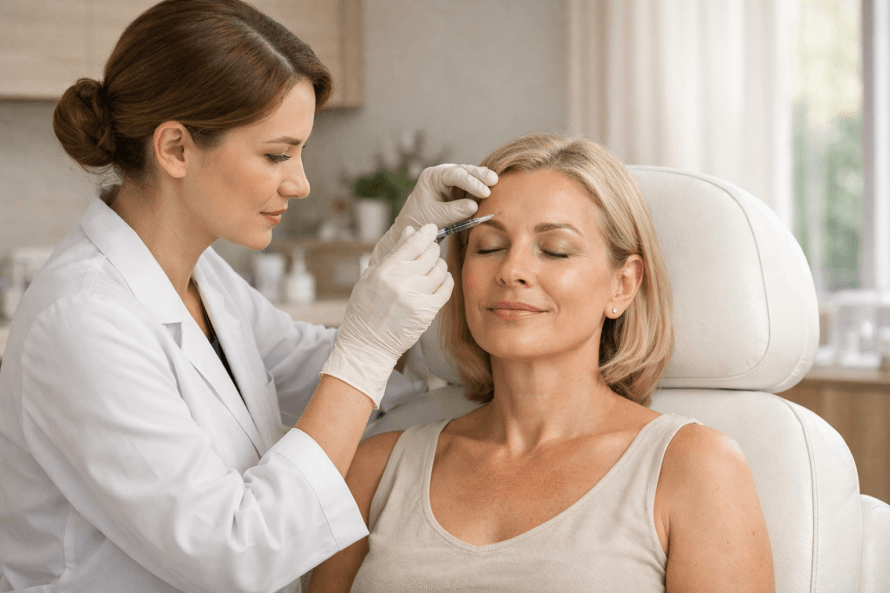
For Which Wrinkles and Areas Is Botox Treatment Recommended?
Botox is particularly well-suited for wrinkles caused by facial expressions. These primarily include the frown line between the eyebrows, horizontal forehead wrinkles, and the fine laugh lines at the corners of the eyes—commonly known as crow’s feet. Depending on the initial assessment, botulinum toxin can also be used to soften the appearance of the eye area or to subtly lift the eyebrows—similar to a non-surgical eyebrow lift. A precise analysis of the face is always crucial. Not every wrinkle requires Botox, and not every area should be treated the same way. Good aesthetic medicine does not follow a one-size-fits-all approach but rather employs an individualized treatment plan.
Natural Results Instead of a “Mask Effect”
The biggest concern of many patients is understandable: No one wants to look unnatural after treatment. This is precisely where routine differs from true expertise. A precisely dosed Botox treatment reduces unwanted muscle activity without completely eliminating facial expressions. The goal is not a smooth, expressionless face, but a harmonious, refreshed overall appearance. Especially in the forehead and eye areas, small corrections often work best. A reputable practitioner does not over-treat.
Procedure, Effects, and Duration
Every Botox treatment is preceded by a detailed consultation. During this consultation, we determine which areas should be treated, what results are realistic, and whether there are any medical reasons that would preclude treatment. The injection itself usually takes only a few minutes and is generally well tolerated. Initial effects are often visible after a few days, and the full effect typically develops within about two weeks. How long the results last depends on the treatment area, the dose, and individual muscle activity. Many patients schedule touch-ups at regular intervals to maintain a consistent, natural-looking result. Depending on the individual assessment, a complementary hyaluronic acid treatment, wrinkle fillers, or—specifically for the eye area—a treatment with polynucleotides may also be appropriate.
Safety, Consultation, and the Right Practitioner
Botox is a well-established treatment that is very safe when administered correctly. Nevertheless, it remains a medical procedure and should be performed by an experienced physician. Especially in the upper half of the face, even minor errors in dosage or placement can alter facial expression. Therefore, the treatment should never be chosen based solely on price or advertising. Medical qualifications, experience, a keen aesthetic sense, and honest consultation are crucial.
At Leading Medicine, the specialists focus on personalized treatment plans and natural-looking results. Anyone seeking Botox treatment for forehead wrinkles, frown lines, or crow’s feet can submit an inquiry directly via the patient contact form in the Leading Medicine Guide. Those considering a surgical solution as an alternative or supplement will also find information on the Leading Medicine Guide regarding eyelid correction, facial rejuvenation, and plastic-aesthetic eyelid surgery.

About the medical author
Prof. Dr. Dr. Ludwig Heindl
Medical Editor · Cologne