As a medical device, Fasciotens® was developed to relieve tension on the tissue in cases of hernias and complex abdominal wall defects and to promote natural healing. The targeted stretching of the fascia helps increase the volume of the abdomen and close the abdominal wall with minimal tension.
Whether Fasciotens®Hernia or Fasciotens®Abdomen—both systems offer specialists a safe and modern method to restore the physiological condition of the abdominal wall and reduce postoperative complications.
What is Fasciotens, and how does the technology work?
Fasciotens is a state-of-the-art medical device developed specifically for the treatment of complex hernias and open abdominal wounds. It helps surgeons control tension and ensure a secure closure of the abdominal wall—even in difficult cases. The goal is to increase the distance between the wound edges by applying targeted tensile forces to the fascia, thereby achieving a tension-free closure.
In abdominal surgery, controlled reduction of volume is considered a decisive factor for treatment success. Fasciotens® makes it possible to precisely regulate the tensile stress of the abdominal wall. This restores the physiological tension in the tissue and reduces pressure within the abdomen. This controlled approach reduces postoperative complications and improves healing after surgery.
The system is used primarily with Fasciotens Hernia and Fasciotens Abdomen. While Fasciotens Hernia is used primarily for large hernias or hernias of the abdominal wall, Fasciotens® Abdomen is used in patients with an open abdomen to facilitate gradual closure. Both systems offer precise tension control and help prevent the loss of abdominal wall volume.
The development of Fasciotens is largely attributable to Prof. Dr. Gereon Lill, an experienced surgeon and specialist in complex abdominal wall reconstructions who helped develop the system clinically. Lill and his team thus laid the foundation for a gentle and effective treatment of severe hernias and open abdomens.
By combining innovative medical technology with surgical precision, Fasciotens enables a significantly improved recovery. Specialists can tailor the method to each individual case, thereby effectively closing even complex hernias or secondary abdominal wall defects—safely, in a controlled manner, and under optimal conditions for abdominal tissue regeneration.
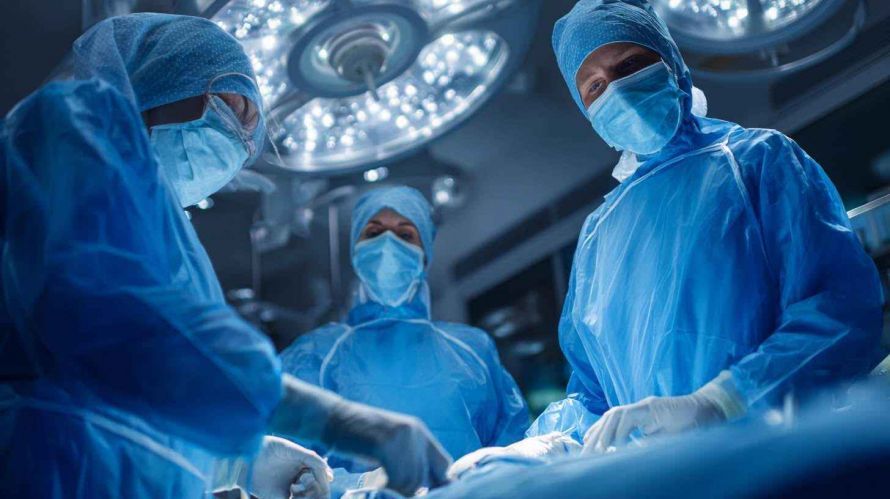
Surgeons prepare for a procedure in a modern operating room—a sterile environment, with the highest precision and professionalism.
Fasciotens for Complex Hernias and Open Abdomen—Support for Critically Ill Patients
In cases of complex hernias or an open abdomen, closing the abdominal wall is often difficult or impossible. Here, Fasciotens offers an effective solution: Through targeted, vertical tension, the intra-abdominal volume can be increased and the tension on the abdominal wall significantly reduced.
The procedure serves not only to restore the anatomical structure but also to stabilize critically ill patients for whom conventional methods have reached their limits. In many cases, the result is a successful, tension-free closure of the abdominal wall, which contributes significantly to improving the chances of recovery.
With its technology, Fasciotens has solved a significant medical problem that was long considered nearly insurmountable in surgery. The ability to increase intra-abdominal volume while simultaneously reducing intra-abdominal pressure enables safe and controlled reconstruction. Clinical observations show that the targeted use of this method significantly improves outcomes in many cases and optimizes treatment results in the long term.
Treatment Procedure – Use for Hernias and Open Abdomen
Treatment with Fasciotens is a precise yet gentle process aimed at reclosing the abdominal wall under controlled tension. Depending on the clinical presentation—whether a hernia or an open abdomen—either Fasciotens Hernia or Fasciotens®Abdomen is used. Both systems offer surgeons a smart solution for preserving the natural anatomy of the abdomen and avoiding postoperative complications.
Preparation and Positioning
Before the operation begins, the surgeon secures the Fasciotens system to the abdominal wall. During this process, the fasciae are grasped using special clamps and stretched with a precisely controllable tension. This stretching increases abdominal volume and reduces intra-abdominal pressure—a crucial step in alleviating tension and preparing the abdominal wall for subsequent closure.
Intraoperative Use for Hernias
Fasciotens Hernia is used in patients with hernias or a large abdominal wall defect. This medical device allows for dynamic stretching during the procedure, enabling the surgeon to gradually adjust tissue tension. The procedure is particularly helpful when the defect is too large to be closed primarily. Through controlled stretching of the fascia, the hernia can be corrected without tension—which significantly reduces the risk of recurrence.
Treatment of the Open Abdomen
Fasciotens®Abdomene is used in cases of an open abdomen, such as after severe infections or trauma. This system maintains the abdominal wall under controlled tension throughout the entire treatment phase and prevents the fasciae from separating. After a few days, the surgeon can gradually reduce the tension until a secure, tension-free closure is possible. This modern surgical method enables faster healing, better postoperative recovery, and a significant improvement in the patient’s functional outcome.
Fasciotens – Open Abdomen Therapy for Surgeons and Patients
The management of the open abdomen poses a particular challenge in modern surgery. This is where Fasciotens comes into play—a system developed by experienced surgeons and now distributed by Dahlhausen Medizintechnik. The goal is to maintain controlled tension on the abdominal fascia, thereby ensuring safe and effective treatment of the open abdomen.
The use of Fasciotens can significantly shorten the duration of treatment. The constant tension applied to the abdominal wall gradually brings the tissues together without causing additional injuries or pressure damage. The system ensures that the fascia remains intact and facilitates the subsequent restoration of the anatomical structures of the abdominal cavity.
This method is considered a major advance in the treatment of open abdomen—it combines precision, safety, and efficiency. Fasciotens thus offers valuable support to surgeons who must treat complex cases involving large tissue defects.
Fasciotens—Benefits, Suitable Patient Groups, and Practical Experience
For whom is Fasciotens®Hernia or Fasciotens®Abdomen particularly suitable?
Both types were developed by surgeons for surgeons to address one of the greatest challenges in modern hernia surgery and open abdomen management: the safe and tension-free closure of the abdominal wall. Both systems are manufactured by Fasciotens GmbH, an innovative company that develops high-precision devices for surgical practice in cooperation with Dahlhausen Medizintechnik.
Fasciotens®Abdomen is used in patients with an open abdomen or severe abdominal wall defects, where closing the open abdomen is often difficult or impossible due to retraction or tissue damage. Through controlled fascial traction—that is, vertical tension applied to the fascia—the abdominal wall is gently stretched, which increases intra-abdominal volume and reduces intra-abdominal pressure. This helps maintain anatomical integrity and gradually stabilize the abdominal cavity.
Fasciotens®Hernia, on the other hand, is primarily used for complex hernias or large defects. The system applies vertical traction to the fascia, prevents continuous fascial retraction, and facilitates tension-free abdominal closure. This method offers surgeons a new approach to hernia surgery, particularly for large defects in the abdominal wall. Procedures such as component separation or botulinum toxin can also be used as adjuncts to reduce tension on the abdominal wall.
Results and Clinical Experience with This Innovative Medical Device
Experience from clinics shows that Fasciotens can significantly shorten treatment duration and improve healing outcomes. Studies and early outcomes demonstrate that, in many cases, primary fascial closure—that is, the complete, primary closure of the abdominal wall without additional grafts—was achieved with Fasciotens®Abdomen.
When treating patients with Fasciotens Hernia, surgeons observed a noticeable reduction in recurrence rates following major hernia surgeries. Controlled fascial traction and reduced tension improve functional outcomes by preserving the anatomical integrity of the abdominal wall.
The combination of Fasciotens with procedures such as NPWT (negative pressure wound therapy) or complementary techniques for component separation has proven particularly effective in complex hernias. Hospitals report faster recovery times, fewer complications, and improved postoperative healing. As a result, Fasciotens—developed by surgeons for surgeons—has established itself as a groundbreaking solution for closing the abdominal wall even in the most challenging cases.
FAQs about Fasciotens
What is the indication for using the Fasciotens device?
The Fasciotens device is primarily used for complex hernias and in open abdomen cases, where conventional closure of the abdominal wall is often difficult or impossible. It assists surgeons by preventing fascial retraction and restoring the natural anatomical state.
How does the system’s “vertical traction” work?
The system applies targeted vertical traction to the fascia to distribute tension evenly and gradually close the abdominal wall. This helps lower intra-abdominal pressure and reduce the risk of further complications.
When can the use of the Fasciotens device be life-saving?
In critical cases of an open abdomen, the device can be life-saving because it helps stabilize the abdominal cavity and safely prepare for closure of the abdominal wall. This is particularly crucial for patients with severe infections or trauma.
What results can be achieved with Fasciotens?
The result of using Fasciotens is often a complete and tension-free closure of the abdominal wall. At the same time, fascial retraction is prevented, which improves long-term stability and reduces the need for further interventions.

About the medical author
Sabine Schneider
Editor-in-Chief
Sabine Schneider – medical author: Explore expert articles and medical expertise in the Leading Medicine Guide.
More about the medical author →