
The pancreas is a vital organ in the human body and is located transversely in the upper abdomen behind the stomach. The pancreas performs both exocrine and endocrine functions. It produces digestive enzymes that are released into the duodenum and aid in the digestion of fats and carbohydrates. At the same time, the pancreas produces important hormones such as insulin and glucagon, which regulate blood sugar levels. These hormones are released directly into the bloodstream. The pancreas is closely connected to the intestines, liver, and spleen. Pancreatic disorders can occur acutely and severely impair digestion and metabolism. Therefore, the function of the pancreas is vital.
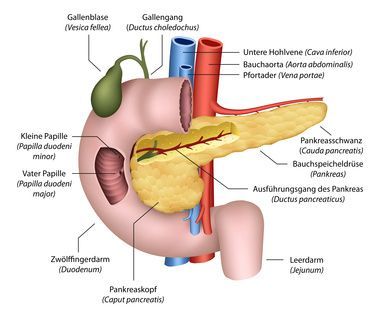
Function of the Pancreas
The pancreas is an endocrine gland that produces, among other things, the hormones insulin and glucagon via the islet cells of Langerhans to regulate blood sugar levels. Only through insulin can the sugar in the body be utilized by the cells.
Without this hormone, glucose cannot be absorbed, which quickly leads to life-threatening conditions. If there is too little sugar in the body, glucagon ensures that the body’s stored reserves—primarily from the liver—are released. The islet cells of Langerhans, which produce these hormones, account for only about 2.5 g of the pancreas’s total weight.
The exocrine portion of the pancreas also produces digestive enzymes such as
- amylase (for the digestion of carbohydrates),
- trypsin (for digesting proteins),
- and lipase for fat digestion
and releases them into the duodenum. However, the enzymes are not converted until they reach the intestine, at which point they can fulfill their purpose. Otherwise, the pancreas would digest itself. A total of 20 different enzymes are produced.
The pancreas’s two functions—the production of hormones and digestive enzymes—operate largely independently of one another. In the event of a disease, one of these functions may be impaired without the other necessarily being affected as well.
Common Diseases of the Pancreas
Acute pancreatitis
A rapidly developing, severe inflammation of the pancreas leads to the destruction of the organ’s cells. Characteristic symptoms include sudden, severe pain in the upper and middle abdomen. Nausea and vomiting often occur. The pain may radiate around the waist into the back. Bloating, fever, and signs of shock are additional symptoms.
The acute form of pancreatitis must be distinguished from a flare-up of chronic pancreatitis. Common causes include excessive alcohol consumption and gallstones that block the organ’s main duct—less commonly, medications, metabolic disorders, and other causes.
Chronic Pancreatitis
Recurrent inflammation—which in some cases goes unrecognized as such due to nonspecific symptoms—can lead to a slow, i.e., chronic, destruction of the organ. Scar tissue then forms in place of healthy tissue.
As the disease progresses, this severely impairs digestive function, and insulin production is also reduced. This results in diabetes and digestive disorders caused by enzyme deficiency. In about 80 percent of cases, excessive alcohol consumption is the cause; less commonly, congenital genetic mutations, chronic gallstones, and other factors are responsible.
Pancreatic Tumor
When pancreatic cells grow uncontrollably, a pancreatic tumor forms. The first step is to determine whether the tumor is benign or malignant. Cysts (fluid-filled cavities), for example, can be benign. Malignant tumors, on the other hand, grow very rapidly and invade surrounding tissues and organs. In the worst-case scenario, pancreatic cancer metastasizes and forms secondary tumors in other organs. There are also types of tumors that exhibit uncertain behavior and cannot be clearly classified as benign or malignant.
Despite intensive research, the causes of tumors have not yet been clearly established. However, studies have shown that changes in the genetic material of pancreatic cells can occur, causing a normal cell to become a tumor cell.
In addition, risk factors have been identified in large observational studies. However, even if an individual has these risk factors, they do not necessarily lead to the disease. The most important risk factors are smoking (including secondhand smoke) and severe obesity. Chronic pancreatitis and type 2 diabetes can also increase the risk.
In some cases, risk genes can be inherited (familial pancreatic cancer). Individuals affected by this are advised to seek counseling at a specialized pancreatic cancer center. To date, no clear link has been established between diet and environmental toxins as risk factors.
Pancreatic cancer rarely causes symptoms in its earliest stages. Symptoms may include
- loss of appetite,
- nausea and vomiting
- a feeling of weakness
- and/or diarrhea
. It can also lead to disturbances in the production of digestive enzymes. The result is what is known as fatty stools (steatorrhea). However, these symptoms are also present in numerous other conditions, which makes diagnosis difficult. Significant weight loss over a short period of time (more than five percent in three months) is always a warning sign and requires immediate medical evaluation.
Note on Diabetes
In fact, pancreatic disease is the cause of diabetes in less than one percent of cases. The most common cause of insulin resistance is an unhealthy lifestyle (severe obesity and lack of exercise). Adipose tissue reduces insulin sensitivity, which the pancreas initially compensates for by increasing insulin production—until it becomes exhausted.
Diagnostic Methods for Pancreatic Disease
Because the symptoms of pancreatic disease are nonspecific, it is important for the physician to identify the specific condition and distinguish it from others. A variety of diagnostic methods are available, such as
- laboratory tests (blood and urine),
- ultrasound,
- CT and MRI scans in ambiguous cases,
- endoscopic examination (ERCP)
- or a puncture.
In some cases, an X-ray can also provide important clues (e.g., regarding bowel paralysis, calcifications of the pancreas, or gallstones). In any case, it is important to seek medical evaluation rather than relying solely on self-diagnosis based on information you have gathered yourself.

About the medical author
Sabine Schneider
Editor-in-Chief
Sabine Schneider – medical author: Explore expert articles and medical expertise in the Leading Medicine Guide.
More about the medical author →