
In the treatment of osteoarthritis, far too often the X-ray is treated, not the person. And the classic recommendation to “take it easy” is one of the most common and serious mistakes—it leads to further muscle loss, more pain, and poorer function. Modern osteoarthritis treatment follows a different principle: movement is medicine. The only question is, what kind of movement and in what dosage.
As a geriatrician, I see every day what happens when conservative treatment options are fully exhausted—and how many patients benefit from them without ever needing surgery.
What is osteoarthritis?
Osteoarthritis is a progressive joint disease characterized by the loss and remodeling of joint cartilage. It affects not only the cartilage but the entire joint—bones, ligaments, synovial membrane, and surrounding muscles. In the context of geriatrics and geriatric medicine, it is the most commonly treated joint disease of all.
The term “wear and tear” is misleading. Osteoarthritis is not mechanical wear and tear, as with a tire, but an active biological process involving inflammatory, hormonal, and metabolic components. This is clinically important because it leads to treatment approaches that go beyond mere pain management.
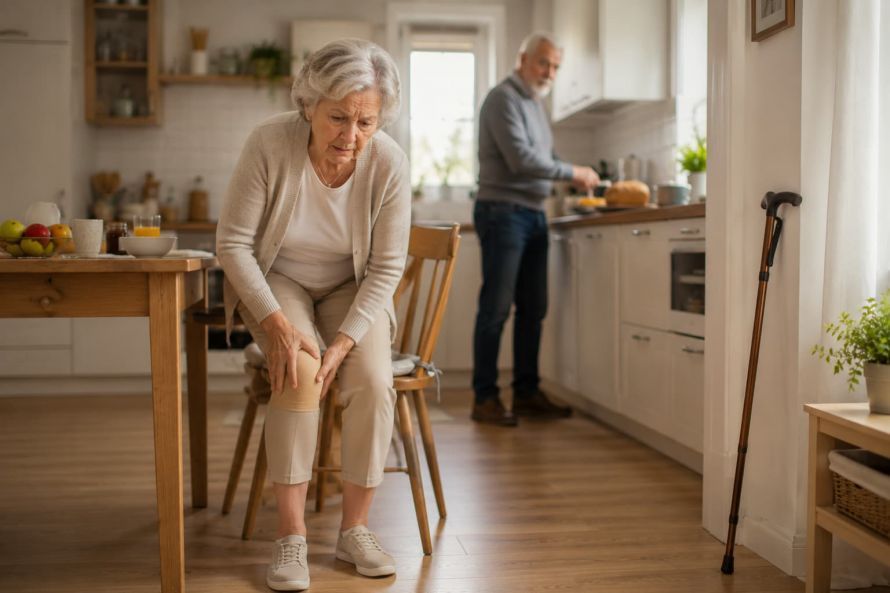
The Most Common Forms of Osteoarthritis in Older Adults
- Knee osteoarthritis (gonarthrosis): The most common form. Often more pronounced on the medial (inner) side. Symptoms: Start-up pain in the morning, pain on weight-bearing when climbing stairs, and later, pain at rest.
- Hip osteoarthritis (coxarthrosis): The second most common form. Pain in the groin, when standing up, and during prolonged walking. Often diagnosed late because the pain tends to radiate into the thigh or knee.
- Finger joint osteoarthritis: Particularly common in postmenopausal women. Heberden’s nodes at the distal joints, Bouchard’s nodes at the middle joints. Painful, but often surprisingly manageable in terms of function.
- Thumb saddle joint osteoarthritis (rhizarthrosis): Very common. Pain when gripping, especially when opening jars.
- Spinal osteoarthritis: Often experienced as back pain. Complex interplay with disc degeneration and postural changes.
- Shoulder and ankle osteoarthritis: Less common, but increasingly frequent in older adults.
→ Surgical treatment when conservative therapy is insufficient: joint replacement in older adults.
→ Specifically regarding hip replacement: Total hip replacement (THR) starting at age 80.
→ Specifically regarding knee replacements: Knee replacement in older adults.
How common is osteoarthritis?
- Radiographic signs of osteoarthritis: detectable in over 70 percent of people over 65
- Symptomatic osteoarthritis: approximately 40 percent of people over 65
- The most common cause of chronic joint pain in older adults
- One of the most common causes of reduced mobility and an increased risk of falls in older adults
An important point: Not every case of radiographic osteoarthritis causes symptoms. And not every symptom has a corresponding finding on an X-ray. The discrepancy between imaging findings and symptoms is the rule, not the exception.
Risk factors
- Age: The strongest single factor.
- Female gender: Especially after menopause.
- Overweight: Has both mechanical and metabolic effects. Every extra kilogram places four times the normal load on the knee when walking.
- Previous joint injuries: Ligament injuries, meniscus tears, and fractures increase the risk of osteoarthritis—as does a previous femoral neck fracture in older age.
- Alignment abnormalities: Bowlegs or knock-knees, hip dysplasia.
- Muscle weakness: Weak thigh muscles accelerate knee osteoarthritis and are often a sign of early-stage sarcopenia.
- Metabolic disorders: Diabetes in older adults, gout.
- Genetic predisposition: In osteoarthritis of the finger joints, and in some cases also in osteoarthritis of the knee and hip.
Diagnosis
The diagnosis is made clinically and radiologically:
- Detailed medical history and targeted physical examination
- Functional tests: range of motion, load-bearing capacity, gait pattern—a structured gait analysis can provide valuable insights
- X-ray — standard for symptomatic osteoarthritis
- MRI is rarely necessary—if used, it is indicated for unclear findings, suspected meniscus problems, or bone edema
- Joint aspiration if an inflammatory component is suspected
- In cases of unclear findings: rheumatological evaluation to rule out inflammatory joint diseases such as rheumatism. Frailty screening is also recommended for older patients to assess their overall condition. A comprehensive geriatric assessment allows for the systematic evaluation of all relevant functional areas.
Conservative therapy—the first and often decisive pillar
Exercise—the most important single measure
The most common mistake in osteoarthritis treatment is the advice to “take it easy.” The opposite is true. Exercise—in the right amount—is the single measure with the strongest evidence:
- Strength training strengthens the muscles that support the joints and reduces stress on the joint
- Aerobic exercise improves blood circulation, metabolism, and overall well-being
- Range-of-motion exercises maintain joint mobility
- Guided physical therapy is particularly beneficial for patients with a fear of movement—especially when combined with immobility associated with aging
Recommendation: A combination of 2 to 3 strength training sessions per week plus regular aerobic activity (swimming, cycling, walking)—gentle on the joints, yet effective. If symptoms are severe, start with low-impact activities and gradually increase the intensity.
→ On the importance of muscle mass in older adults: sarcopenia.
Weight loss
One of the most effective interventions for those who are overweight. Studies show that a 5 to 10 percent weight loss can reduce knee pain by 30 percent or more. This is worthwhile even with moderate overweight—also because malnutrition in older adults is equally problematic, and balanced nutritional counseling should therefore always take both factors into account.
Assistive Devices and Footwear
- Using a cane on the contralateral side relieves pressure on the affected joint
- Well-fitting, cushioned shoes
- Insoles for misalignments
- For severe knee osteoarthritis, sometimes knee braces or weight-bearing orthoses
- Grab bars, toilet seat risers, and bath boards in the home—also crucial for effective fall prevention
Physical therapy
- Heat for muscle tension
- Cold therapy for inflamed, swollen joints
- Electrotherapy (TENS) for chronic pain
- Manual therapy and massage as adjunctive measures
Medication
Use with special caution in older adults:
- Acetaminophen: First-line treatment for mild pain. Limit the daily dose for older patients to 2 to 3 grams.
- Topical NSAIDs (diclofenac gel, ibuprofen cream): Local application, minimal systemic side effects, proven effective for knee and finger osteoarthritis.
- Oral NSAIDs (ibuprofen, diclofenac, naproxen): Effective, but problematic in older adults. Risks: Gastric ulcers, bleeding, renal insufficiency, increased blood pressure, and decompensated heart failure in older adults. May be used short-term and at low doses, but not as long-term therapy.
- COX-2 inhibitors (celecoxib, etoricoxib): Slightly better gastrointestinal tolerability, but similar cardiovascular risks. Special caution is required when prescribing these to older patients with known atrial fibrillation.
- Opioids: Only for uncontrollable pain and after other options have been exhausted. Titrate doses with particular caution in older adults—risk of falls and delirium. For targeted prevention of medication-induced delirium: Delirium prevention.
- Intra-articular corticosteroid injection: Effective in the short term for acute inflammation, but problematic for the cartilage with repeated use.
- Intra-articular hyaluronic acid: Evidence is conflicting; sometimes helpful in selected patients.
The most important point regarding medication therapy for osteoarthritis in older adults: NSAIDs are not intended for long-term use. Anyone taking ibuprofen or diclofenac daily risks stomach ulcers, kidney failure, and heart failure. The alternative strategy: increase physical activity, engage in targeted exercise, and use pain relievers only during flare-ups.
→ On medication review in older adults: Polypharmacy in older adults. Anyone taking multiple medications should also be familiar with the concept of deprescribing.
When is surgery appropriate?
Surgery—especially joint replacement—is the last step in the treatment cascade, not the first. Criteria for the decision:
- Nighttime pain, sleep disturbances due to joint pain
- Significant limitation in walking distance and daily activities
- Conservative therapy has been exhausted for at least 6 months
- Radiologically advanced osteoarthritis (X-rays alone do not justify surgery)
- Quality of life significantly impaired
- The patient is a candidate for surgery—age alone is not a determining factor here. For fall-related injuries that occurred prior to surgery, similar principles apply as in geriatric traumatology.
For older patients, a preoperative geriatric assessment is standard practice prior to any elective surgery. Following the procedure, early geriatric rehabilitation plays a crucial role in the success of recovery.
→ On the decision to perform joint replacement in older adults: Joint Replacement in Older Adults.
→ On preoperative risk assessment: Surgical risk in older adults.
What Family Members Can Do
- Encourage movement rather than rest: Take walks together, engage in light activities, and participate in adapted exercise programs.
- Support weight loss: Moderate changes, joint meal planning.
- Adapt the home environment: Install grab bars, consider stairlift solutions, prevent falls — find more tips in our article on falls in older adults.
- Monitor medication adherence: Especially with pain relievers—secret self-medication with over-the-counter NSAIDs is dangerous in older adults. If you’re unsure about interactions, it’s worth looking into the topic of polypharmacy in older adults.
- Accompany them to the doctor: For changes in treatment or decisions about surgery.
When should you see a doctor or geriatrician?
- If you experience new joint pain that lasts for weeks
- If existing symptoms worsen significantly
- If you experience nighttime pain or pain at rest
- If there is an increasing limitation in daily activities—a sign of possible immobility in old age
- If you have joint swelling, redness, or warmth (suggesting acute inflammation)
- If pain requires daily use of pain medication
- Before deciding for or against surgery
The first point of contact is the primary care physician. Orthopedic surgeons contribute their specific expertise in joints and surgery. Geriatricians provide a comprehensive overview in complex situations—such as multimorbidity, polypharmacy, frailty syndrome, or a tendency to fall. For older patients with additional renal impairment or diabetes in older adults, close interdisciplinary coordination is particularly important. If osteoporosis in older adults is also present, this should be included in the treatment plan as well.
→ For a comprehensive evaluation in older adults: Geriatric Assessment.
Share this article
Sources
- Bannuru RR, Osani MC, Vaysbrot EE et al. (2019): OARSI guidelines for the non-surgical management of knee, hip, and polyarticular osteoarthritis. Osteoarthritis and Cartilage. DOI: 10.1016/j.joca.2019.06.011
- German Society for Orthopedics and Trauma Surgery: S2k Guideline on Gonarthrosis. AWMF Register 033-004, current version.
- Fransen M, McConnell S, Harmer AR et al. (2015): Exercise for osteoarthritis of the knee. Cochrane Database of Systematic Reviews. DOI: 10.1002/14651858.CD004376.pub3
- Messier SP, Mihalko SL, Legault C et al. (2013): Effects of Intensive Diet and Exercise on Knee Joint Loads, Inflammation, and Clinical Outcomes Among Overweight and Obese Adults With Knee Osteoarthritis. JAMA.
