
Warts, known in Latin as verrucae, are small, benign growths on the upper layer of the skin. They are most commonly caused by infection with human papillomavirus (HPV). Warts are flat or slightly raised. The viruses enter the skin through tiny breaks in the skin and, after a few weeks, develop into the typical growths. People infected with a viral wart should avoid skin-to-skin contact with others as much as possible, since warts are contagious.
Here you will find further information as well as a selection of dermatologists specializing in warts.
How do warts develop?
Warts are usually caused by pathogens from the human papillomavirus (HPV) group. These viruses enter the skin through tiny breaks in the skin and, after a few weeks, develop into small, benign growths.
Warts often appear in exposed areas such as
- the face,
- on the hands,
- on the forearms, or
- the neck
. Warts are particularly common—though not exclusively—in children and adolescents. As a rule, they clear up on their own once the immune system has learned to cope with the pathogen.
In adults, a massive outbreak of warts mainly occurs when the immune system is weakened.
Wart viruses are highly contagious. For this reason, treating viral warts is advisable from an epidemiological perspective. Transmission occurs through smear infections or direct skin contact.
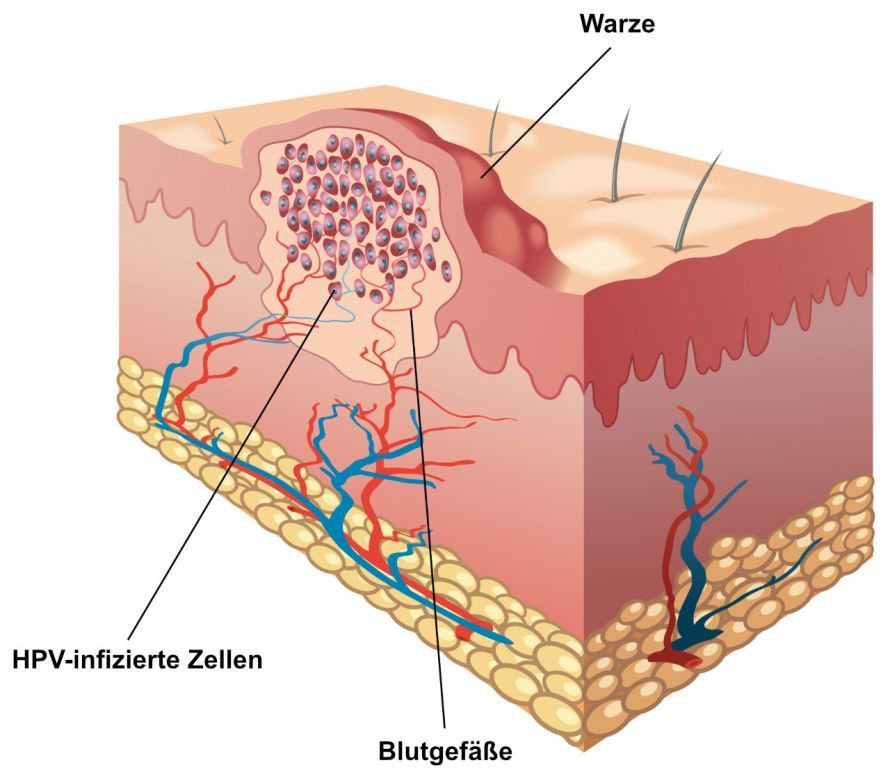
Cross-section of a wart © rob3000 | AdobeStock
What types of viral warts are there?
Different types of warts develop depending on the viral strain:
Flat warts (also called plan warts) appear as flat, yellowish-gray or brownish round patches that may have a reddish border.
Verrucas (also known as common warts) are the most common type of wart and appear as prominent, keratinized nodules. Scratching the warts spreads the virus to the surrounding area and often leads to the formation of secondary warts.
Plantar warts occur on the soles of the feet and grow inward due to mechanical pressure. They are recognizable by swelling of the stratum corneum and small red or black dots. Plantar warts can be very painful when walking, as they protrude into the foot. They are particularly common in
- swimming pools,
- gyms, or
- locker rooms
.
Mosaic warts also occur exclusively on the soles of the feet. However, they do not grow inward and are therefore less painful. They do, however, appear in clusters and merge with one another, creating a mosaic pattern on the sole of the foot
Viruses that cause genital warts prefer warm and moist areas of the skin. They therefore frequently occur in the genital area or on the mucous membranes there, specifically on
- the foreskin/glans,
- the vagina,
- anus, or
- rectum.
They first develop as small papules, often in clusters, but subsequently grow into larger growths.
Genital warts can be transmitted through sexual contact. They primarily take hold in small skin lesions or in the context of other local or systemic infections. Those affected often have a weakened immune system.
Genital wart-causing viruses are classified as low-risk or high-risk types. High-risk types can lead to malignant transformation and corresponding types of cancer:
However, high-risk types are very rare.
Molluscum contagiosum is not caused by human papillomaviruses. It is caused by a member of the poxvirus family (molluscum contagiosum virus, MCV).
They appear round and pink and usually occur in clusters. Molluscum contagiosum warts occur primarily on exposed areas of the skin or in the genital region. They differ from other types of warts in that they are less keratinized but are fluid-filled.
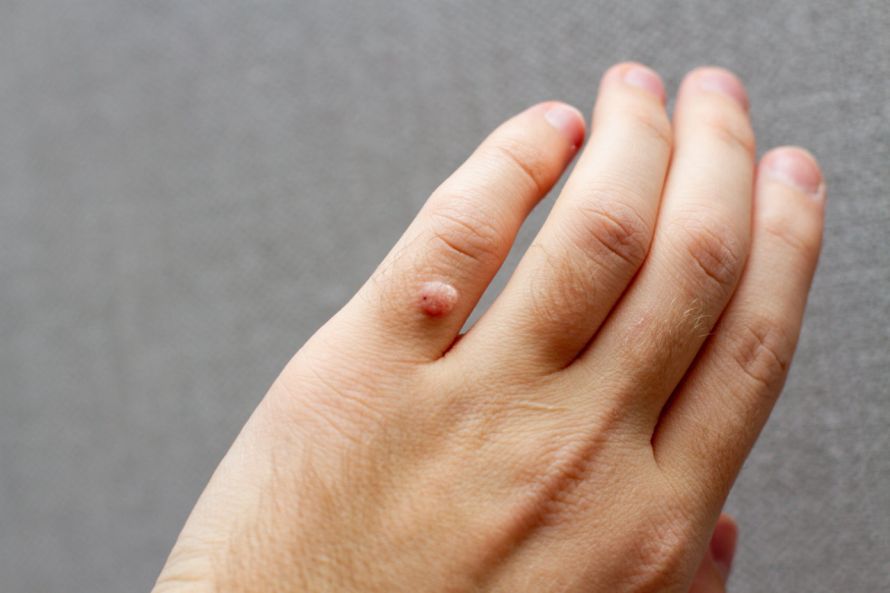 Warts are “lumpy” growths on the skin © epovdima | AdobeStock
Treatment of Warts
If a wart has already developed on your skin, the first step is to see a dermatologist. The dermatologist will determine what type of wart it is. Accurately identifying the type of wart is key to treating it effectively and successfully.
Flat warts often affect children and adolescents who
- have a weakened immune system and
- whose bodies are under stress from taking antibiotics.
Sometimes these warts go away on their own after a while. If the flat wart infection persists for an extended period—even after stopping antibiotics and the illness has resolved—you should see a dermatologist. The dermatologist will often prescribe red light therapy, which initiates the healing process.
Permanently removing plantar warts is somewhat more difficult. Cryotherapy or laser treatment is usually used in these cases. You should discuss these options with your doctor early on to prevent the wart from spreading rapidly.
You can also treat and remove spiny warts specifically using cryotherapy and laser treatment. Some surgeons use so-called wart spoons to scrape out the wart. Here, too, a quick healing is not to be expected due to the lack of stimulation of the immune system.
Genital warts can also be treated and permanently removed with laser therapy. The healing process is accelerated by stimulation of the immune system.
Below you will find further information on the various treatment methods for warts.
Freezing: Cryotherapy for Warts
Freezing (cryotherapy) is an effective treatment for plantar and flat warts. This procedure is performed in a doctor’s office. The doctor exposes the affected skin area and the wart itself to extreme cold. The cold kills the top layer of skin along with the wart.
After about fourteen days, the wart will then fall off.
It is also possible to perform cryotherapy at home. For this, you can obtain over-the-counter products at the pharmacy that you simply apply to the affected wart.
Cauterization: Treating Warts
Another method is chemical treatment, which you can also perform at home. Medically, this procedure is called cauterization. It is highly effective for flat warts.
Over-the-counter medications contain salicylic acid or lactic acid. They are applied to the wart.
After about five to six days, the tissue sloughs off and the healing process can begin.
Laser Treatment for Warts
Laser treatment for warts is usually performed in a hospital, as it can be very painful. It is most commonly used for plantar warts, which are located deep in the sole of the foot.
Because plantar warts extend deep into the skin, cryotherapy is not effective in this case.
The laser treatment is performed under anesthesia. The wart is cut away with laser beams, depending on its depth. A scar forms.
Afterward, the patient may experience further pain, which can sometimes be very severe.
Wart patches
Wart patches are available at pharmacies and gently cause the wart to disappear. However, complete removal of the wart cannot be guaranteed. Wart patches are not particularly effective for deep-seated warts on the sole of the foot.
The wart patch also contains an acid that penetrates the wart when applied to the affected area.
Wart Ointments
A wart ointment works similarly to a wart patch, as it is also applied to the affected wart.
The wart ointment contains salicylic acid and has a caustic effect on the wart tissue. You should apply it to the wart several times a day to achieve a successful result.
You can also achieve good results here by stimulating the immune system at the same time.
Scraping: Surgical Wart Removal
A very effective treatment method is the surgical removal of warts. This procedure is primarily used for deep-seated plantar warts. Surgical removal eliminates deep plantar warts that do not respond to other methods.
This treatment is performed in a hospital.
The surgeon literally scrapes the wart out using a wart spoon. Afterward, the patient may experience severe pain for some time. The healing process can sometimes take up to four weeks.
Wart Treatment with Antiviral Medications
Antiviral drugs are medications that combat viral pathogens in the human body. Antiviral drugs are also used to treat warts.
Combination preparations (e.g., Verrumal) soften the wart tissue and also have a cytostatic effect on the host cells. Thus, antiviral drugs additionally prevent the multiplication and spread of wart viruses.
Another type of antiviral is used primarily to treat genital warts. So-called immunomodulators stimulate the skin’s immune system to fight the wart viruses on its own.
In this process, the applied antiviral medications trigger the release of the body’s own interferons and interleukins. The inflammatory reaction triggered locally in this way leads to the destruction of the virus-infected cells. Imiquimod cream or interferon gel is used.
Treatment with these antiviral medications lasts up to 16 weeks. The body’s own immune system fights the viruses on its own. Therefore, the chances of a complete cure without recurrence are very good.
At the same time, surgical treatment is often performed in cases of severe genital wart infection.
However, immunomodulators may cause more severe side effects than other wart medications. In addition to local inflammatory reactions—some of which can be severe—they can also cause systemic symptoms that may resemble the flu.
Most of these methods must not be used in pregnant women or immunocompromised individuals.

Warts are particularly common in swimming pools © yanlev | AdobeStock
Complications and Risks Following Wart Removal
Treatment and removal can involve complications and risks that you should carefully consider beforehand. You should read the instructions for use on the package inserts very carefully and follow them exactly as directed.
When applying active ingredients topically, they may come into contact with unaffected, healthy skin. Since these products contain acid, there is a risk that healthy tissue will also be treated.
This should be avoided at all costs. Healthy skin can be damaged even during application, which is noticeable as a severe burning sensation on the skin. As a precaution, cover the healthy skin around the wart with a greasy cream.
After a wart excision, the dressing should be changed regularly and the wound cleaned. If this is not done, new germs can enter the wound, which greatly complicates the healing process.
A removed wart leaves a wound, whether it is a flat wart or a deep-seated plantar wart. Good hygiene and cleanliness are essential for better wound healing.
Once the wound has healed, it is recommended to apply a healing ointment. This promotes the rapid growth of new skin cells. The active ingredient dexpanthenol is particularly effective for this purpose.
Preventing a Wart Infection
To prevent a wart infection, strengthen your immune system. A wart can only develop if the immune system is compromised or weakened. The immune system requires
- a healthy and balanced diet,
- enough sleep,
- plenty of outdoor exercise, and
- a balance between work and relaxation.
Frequent stress causes the body to be under constant strain, which can also weaken the immune system.
Personal care and hygiene are also particularly important.
Home Remedies for Warts
There are various home remedies that can help remove warts. One effective remedy is citric acid, which acts like a caustic agent.
Nature also offers solutions for the targeted removal of warts. Celandine and tea tree oil are recommended for this purpose. Both oils work in the same way and are applied directly to the affected wart.
You’ll need to be patient in this case as well. Even with repeated daily application of the oils, the warts usually don’t disappear until after ten to fourteen days.
Which warts can be treated with home remedies?
Warts can cause pain if they grow under the nail plate. Home remedies are no longer appropriate in such cases because treatment would take too long. These warts are usually removed surgically.
So-called brush warts (on the lips or eyelids) should also not be treated with herbal remedies. For example, if you use herbal tinctures around the eyes, the tincture can cause a burning sensation in the eyes.
You can treat plantar warts (verrucae plantares) with home remedies if they do not cause pain. These warts form clusters and can grow into the sole of the foot. In this case, you should not use home remedies.
Verrucae planae juveniles (flat warts) respond particularly well to home remedies. They often appear on the fingers and hands, but also on the face and forearms. However, experts advise against treating warts on the face with home remedies.
Genital warts, also known as condylomata acuminata (genital and anal warts), can also appear on the cervix and the urethra. According to experts, these warts should not be treated with herbal remedies. In these cases, surgical removal is usually the only effective treatment.
Since home remedies also have antimicrobial effects, warts can also be treated internally.
What herbal remedies are available for warts?
Alternative medicine now has a great deal to offer. Many conventional doctors are acquiring the relevant knowledge. Although herbal remedies do have side effects, they are still considered a gentle form of wart treatment.
However, some herbal remedies are still controversial. These include, for example, the home remedy “tea tree oil.” This oil has anti-inflammatory and pain-relieving properties. Essential oils can soften the skin, causing the wart to disappear on its own.
However, this herbal remedy cannot fight the virus itself. You must have a healthy immune system for the tea tree oil to be effective and prevent the wart from reappearing.
The herbal remedy “celandine”
A very effective herbal remedy for removing warts is celandine. In scientific terms, the plant is known as Chelidonium majus, Papaveraceae. This herbal remedy has a cholagogue effect, which is why it’s also commonly used in alternative medicine to treat gastrointestinal complaints.
It has been found that celandine can affect the liver. Its use is not recommended for people with liver diseases, such as fatty liver.
For removing warts, this herbal remedy is an excellent home remedy. Celandine has a yellow-orange milky sap that is applied to the wart.
The dried or chopped upper parts of the herb are used as a home remedy. The sap extracted from it contains alkaloids (cortisone, chelidonine, and berberine). Alkaloids are chemical, nitrogen-containing, organic compounds. These compounds can have a direct effect on the human body.
Colloquially, these compounds are referred to as “natural enemies” and are used as such. They have
- antimicrobial (targeted against microorganisms),
- sedative,
- pain-relieving,
- antispasmodic, and
- cholagogue.
Celandine must not be used if you have liver problems.
The herbal remedy “Thuja”
Thuja, commonly known as “arborvitae” (Thuja occidentalis), is considered a herbal remedy with healing properties. It can be used both internally and externally. Botanists classify arborvitae as part of the cypress family.
Thuja is poisonous. Therefore, it is important to use this herb in the form of an appropriate over-the-counter medication. Eating the fresh branches can lead to
- symptoms of poisoning,
- stomachaches and headaches, as well as
- abdominal cramps and
- kidney damage
.
Thuja is available as a
- homeopathic tincture or essence,
- ointment,
- globules,
- solution, or
- lozenges.
In various pharmacies, the thuja wart remedy is also produced as a house remedy. The thuja remedy contains, among other things, minerals, coumarins, and flavonoids. These are plant compounds with health-promoting effects.
It is also used for
- rheumatic complaints,
- scrapes,
- digestive disorders,
- allergic skin conditions,
- sunburn,
- burns, and
- inflammation
.
In Switzerland, thuja is used in combination with other herbal remedies to treat colds. It is not indicated for treating warts there and is available only by prescription. In Germany, this remedy is approved as a wart tincture.
If you apply this home remedy as an ointment to a wart, do so externally once or twice a day. Be sure to protect the healthy skin around the wart, for example with a bandage. This ointment is contraindicated during pregnancy or while breastfeeding. It is also not suitable for young children.
Under no circumstances should you apply it to open wounds. This can lead to inflammation.
The herbal remedy “oak bark”
Oak bark is an effective herbal remedy for warts and has astringent properties. This herbal remedy can also be used for
- other skin conditions,
- inflammation in the throat and mouth,
- itching, and
- excessive sweating
. The dried, young, fresh bark is used medicinally. These bark twigs contain tannins. Tannins can bind to proteins, causing them to change. Oak bark also contains flavonoids.
In theory, oak bark can also be used in the genital and anal areas, although some conventional medical practitioners do not recommend this. Oak bark should also not be used near the eyes.
For warts, compresses are helpful; these should not be applied for longer than two to three weeks. Partial or full baths with five grams of oak bark per liter of water are also helpful.
If you have a widespread skin condition, you should refrain from self-treatment and see a doctor.
The herbal remedy “kitchen onion”
The onion contains a natural antibiotic: Allii cepae extractum. Alliins are sulfur-containing compounds that have health-promoting effects. The onion also contains flavonoids and peptides. A peptide is a molecule composed of amino acids.
Accordingly, the onion acts as a herbal remedy with antibacterial properties and is effective for treating warts. In addition, onions help with other conditions
- as a scar ointment,
- as an onion compress for earaches, such as middle ear infections,
- to lower blood lipid levels, and
- to lower blood pressure.
The herbal remedy “garlic”
Garlic lowers blood lipid levels and blood pressure. The active ingredients in garlic include alliin, allicin, amino acids, and flavonoids.
This herbal remedy is often used to treat warts because of its antimicrobial properties. You can apply garlic juice to the wart (simply squeeze out pieces of garlic). It’s best to make a compress. However, the smell can be very unpleasant.
Garlic is now considered a traditional herbal remedy, although its effectiveness is highly controversial among experts.
There have been studies in which cell cultures were treated with garlic. These cell cultures exhibited a so-called cytotoxic (cell-killing) effect.
Other home remedies for removing warts
Adhesive tape is often recommended as another home remedy for warts. The tape is applied to the wart to seal it off from the air. Supposedly, this causes the wart to soften after about five days, allowing it to be removed with a pumice stone.
This method is highly controversial. It is said to take four to six weeks for the wart to disappear completely. To date, there have been no long-term studies on wart removal using adhesive tape.
This is how long treatment with herbal remedies takes
If you want to remove warts with herbal remedies, you’ll need a lot of patience. It can sometimes take weeks or even months to see results. Experience has shown that treatment with home remedies can even last up to two years.
However, as long as your immune system isn’t functioning optimally, even herbal remedies won’t be able to work effectively. The viruses will still have an easy time of it.
You should also take preventive measures: don’t walk barefoot in the swimming pool, and always use your own towel. Eat a healthy diet, reduce stress, and get enough exercise. All of this strengthens your immune system.
Share this article

About the medical author
Sabine Schneider
Editor-in-Chief
Sabine Schneider – medical author: Explore expert articles and medical expertise in the Leading Medicine Guide.
View full expert profile →