For many women, the inability to conceive or recurrent miscarriages (habitual miscarriages) represent an enormous emotional burden. It is not uncommon for the cause to lie in anatomical abnormalities: uterine malformations (abnormalities of the uterus) are congenital conditions that are often not discovered until a woman becomes pregnant or undergoes infertility testing. These congenital uterine anomalies arise during embryonic development when the so-called Müllerian ducts fail to fuse properly or regress. The spectrum ranges from harmless variations to complex malformations that complicate pregnancy.
Development and Causes: The Müllerian Ducts
To understand uterine malformations, it is helpful to look at embryology. The uterus, the fallopian tubes, and the upper part of the vagina develop from the two Müllerian ducts. Normally, these ducts fuse to form a single hollow organ. If this fusion does not occur or occurs only partially, uterine malformations result. The medical literature (e.g., *Obstetrics & Gynecology*) often refers to these as “anomalies associated with Müllerian duct defects.” Vaginal malformations may also occur concurrently.
Classification of Uterine Malformations
The categorization and classification of these anomalies are crucial for treatment. International societies such as the ESHRE (European Society of Human Reproduction and Embryology) and the ASRM have developed guidelines for the classification of uterine anomalies. The VCUAM system (Vagina Cervix Uterus Adnex – associated Malformation) is also used.
Here are the most important uterine anomalies in women:
1. Uterus septus and subseptus
A septate uterus is the most common uterine malformation. In this condition, the Müllerian ducts have fused, but the dividing wall (septum) has not resolved.
- Subseptate uterus: The septum extends only partially into the uterine cavity.
- Complete septate uterus: The septum completely divides the uterine cavity and extends into the cervix.
- Clinical significance: Since the endometrium (mucous membrane) on the septum is often poorly perfused, the risk of miscarriage is increased. A septate uterus is considered a common cause of infertility.
2. Bicornuate uterus
In a bicornuate uterus, the Müllerian ducts failed to fuse in the upper portion. The uterus has two “horns.” A distinction is often made between a partial bicornuate uterus and a unicollis bicornuate uterus (two horns, one cervix). A bicornuate uterus often poses less of a problem for conception but increases the risk of preterm birth due to lack of space.
3. Uterus didelphys
In a uterus didelphys (double uterus), no fusion has occurred at all. There are two separate uterine cavities, two cervixes, and often a double vagina as well.
4. Unicornuate uterus
In this case, only one Müllerian duct has developed. The result is a unicornuate uterus, often with only one fallopian tube. Sometimes a rudimentary horn exists on the opposite side, which can cause problems if a pregnancy implants there (ectopic pregnancy).
5. Arcuate Uterus
The arcuate uterus is the mildest form. The fundus (top of the uterus) is slightly indented. It is often considered a normal variant and usually has no negative effects on pregnancy.
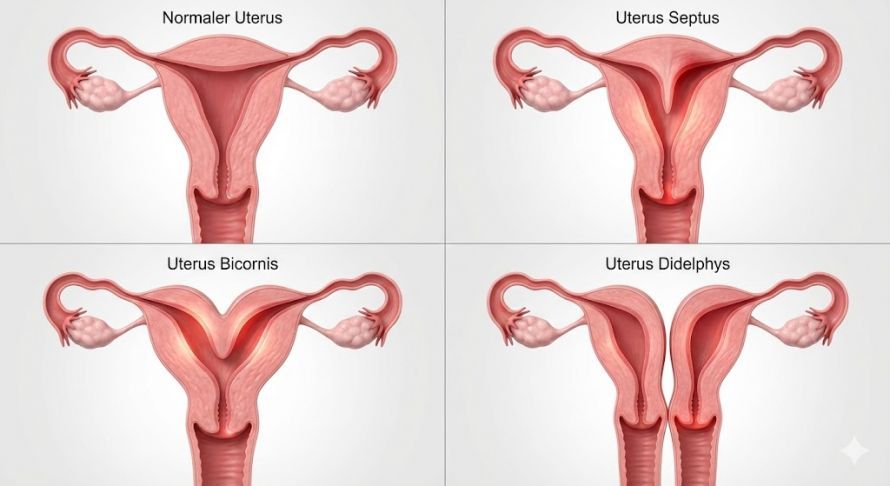
From a septate uterus to a bicornuate uterus—congenital uterine anomalies can take many forms and require precise diagnosis via ultrasound or MRI.
Diagnosis of Uterine Malformations
If a uterine malformation is suspected in a patient—for example, following miscarriages—precise diagnosis is essential.
- Ultrasound: 3D ultrasound is now the gold standard for assessing, for example, a septate uterus and its extent.
- Hysteroscopy & Laparoscopy: Hysteroscopy and laparoscopy provide a direct view of the anomalies.
- MRI: Helps diagnose complex malformations of the female genital tract.
Medical reference works such as the DocCheck Flexikon or specialized journals (Obstet Gynecol) emphasize that the kidneys should also be examined, as renal malformations are frequently associated with Müllerian anomalies.
Treatment: When is surgery necessary?
Not every malformation requires treatment. However, in patients with recurrent miscarriages and a confirmed uterine septum, hysteroscopic septum dissection (removal of the septum) is the standard of care.
- Preoperative planning is essential.
- The goal is to create a normal uterine cavity to facilitate implantation.
- Postoperatively, hormone therapy may be administered to build up the endometrium and prevent intrauterine adhesions.
In cases of a unicornuate uterus or didelphys uterus, surgical correction to unite the uteri is often not possible or is too risky. In such cases, close monitoring of the pregnancy is the priority.
Conclusion
Uterine malformations are complex but can be easily diagnosed thanks to modern medicine. A congenital uterine malformation is not an absolute barrier to pregnancy, but it does require specialized care. Whether it is a septate uterus, bicornuate uterus, or arcuate uterus: Individualized counseling by specialists in gynecology and reproductive medicine is the key to having the child you desire.
FAQ: Frequently Asked Questions About Uterine Malformations
What is the most common uterine malformation?
A septate uterus (including a subseptate uterus) is considered the most common anomaly. In this condition, a wall of tissue divides the uterine cavity. Studies show that a uterine septum is often associated with an increased risk of miscarriage.
Can I get pregnant with a bicornuate uterus?
Yes, women with a bicornuate uterus can often get pregnant without any problems. However, the risk of preterm birth or a breech presentation is increased because space is limited in one of the uterine horns.
How are uterine malformations detected?
Usually by chance during routine examinations or specifically when trying to conceive. 3D ultrasound is the most important diagnostic method. If the findings are unclear, an MRI or diagnostic laparoscopy can help.
Is surgery always necessary?
No. An arcuate uterus almost never requires treatment. However, a septate uterus is often treated surgically if miscarriages have occurred. In cases of complex malformations such as a didelphic uterus, surgery is usually performed only if symptoms (e.g., menstrual discomfort due to flow obstruction) arise.
What is the difference between a unicornuate and a bicornuate uterus?
In a bicornuate uterus, there are two horns that are connected at the bottom. In a unicornuate uterus, only one half of the uterus (one horn) is present; the other is missing or underdeveloped (rudimentary horn).
Is there a connection to other conditions?
Yes, uterine malformations and renal malformations often occur together. A septate uterus and endometriosis can also occur together. In addition, adhesions (intrauterine adhesions) resulting from inflammation can cause symptoms similar to those of congenital anomalies.
Share this article

Sources
- Deutsche Gesellschaft für Gynäkologie und Geburtshilfe (DGGG)
- Berufsverband der Frauenärzte e.V. (BVF)
- European Society of Human Reproduction and Embryology (ESHRE)