Ultrasound is an imaging procedure. It is routinely used in urology to diagnose urological conditions. Here you will find further information as well as a selection of specialists and centers that perform urological ultrasound examinations.
Definition: Urological Ultrasound Examination
An ultrasound examination is a painless imaging procedure with no side effects. It uses ultrasound waves to display the internal organs on a monitor.
In urology, a doctor can use ultrasound to examine the entire urinary and reproductive systems, including the abdominal cavity. A urological ultrasound examination therefore typically assesses and examines
In urology, ultrasound is used specifically to diagnose and evaluate urological diseases.
The doctor first applies a water-based gel to the skin. The gel allows the transducer of the ultrasound machine to glide smoothly over the skin.
The device then emits ultrasound waves. These waves encounter various tissues of the internal organs within the body, from which they are reflected with varying degrees of intensity. The ultrasound machine captures this echo and converts it into an image. The doctor can now view this image in real time on the monitor.
When is a urological ultrasound examination performed?
A urological ultrasound exam is performed for certain conditions and symptoms. These include, among others
- kidney or bladder stones
- malignant tumors such as bladder cancer or prostate cancer
- Urinary outflow obstruction
- Congenital abnormalities
- Prostate conditions such as an enlarged prostate or prostatitis
- Kidney diseases such as renal artery stenosis, hydronephrosis, kidney inflammation, or kidney failure
Ultrasound examination of the kidneys
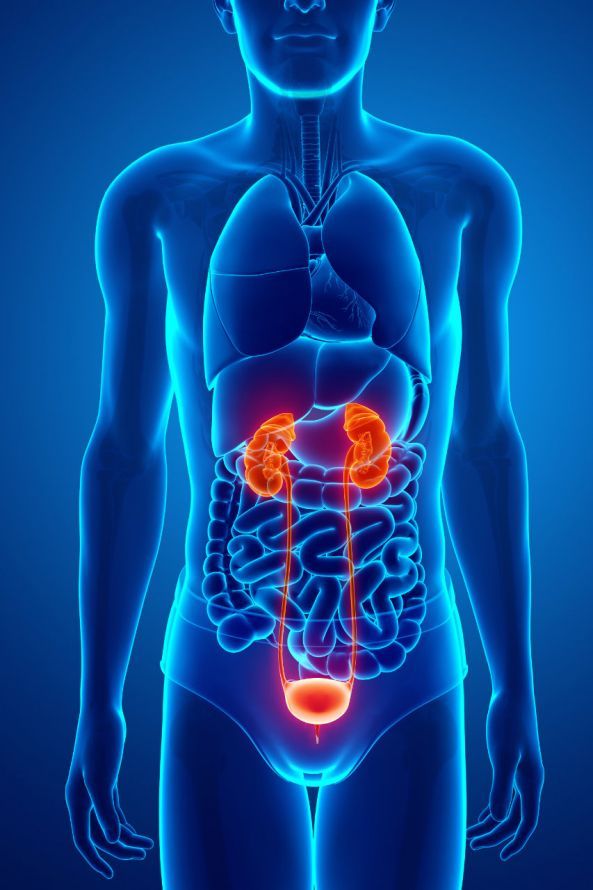
The two kidneys are located in the abdominal cavity behind the intestines, below the diaphragm, on either side of the spine, and in front of the back muscles. The right kidney is located beneath the liver, and the left kidney beneath the spleen.
Each kidney is between 10 and 12 centimeters long and weighs between 120 and 200 grams. Blood vessels branching off from the aorta supply the kidneys with blood. The kidneys produce urine, which is excreted through the renal pelvis, the ureters, the bladder, and the urethra.
The kidneys are clearly visible during a urological ultrasound examination. For this reason, ultrasound is one of the standard methods for evaluating and diagnosing kidney diseases and kidney-related symptoms.
During a kidney ultrasound examination, the patient is usually in the supine position. If necessary, a semi-recumbent position—in which the patient is raised by 30 degrees—may be required.
The ultrasound then scans the kidney in both longitudinal and cross-sectional views. The urologist assesses the size and shape of the kidneys and determines whether there are any tumors or kidney stones present.

Ultrasound examination of the ureters and bladder
The bladder is located above the pelvic floor muscles. In women, it lies in front of the uterus and the vaginal opening, and in men, in front of the prostate or rectum.
The ureters, which originate from the kidneys, empty into the bladder. Urine produced by the kidneys continuously trickles into the bladder. It has a capacity of about 0.3 to 0.5 liters.
Using a urological ultrasound examination, the doctor can diagnose anatomical changes in the bladder. The examination also provides information about the bladder’s function.
The ultrasound examination of the bladder is first performed with a full bladder. This allows the doctor to determine the thickness of the bladder wall and the bladder’s capacity. After voiding (complete emptying of the bladder), the bladder is examined again using ultrasound. During this examination, the doctor assesses the amount of residual urine.
In this way,
- the bladder’s emptying function and
- the length, width, depth, and contour of the bladder.
The doctor can also detect any abnormalities that may occur in bladder cancer.
Urological ultrasound examination of the ureter is difficult because it is obscured by the intestines. Therefore, it is usually only possible to examine the proximal (toward the body) and distal (away from the body) ureters using ultrasound—the middle ureter cannot be visualized by ultrasound.
Ultrasound examination of the testicles and the penis
In an adult male, the testicle is 4 to 5 centimeters long, 2 to 3 centimeters thick, and has a volume of 12 to 30 milliliters.
A urological ultrasound examination of the testicles and penis can be used to diagnose or rule out tumors or calcifications.
In addition, a color Doppler examination can assess blood flow to the testicles and the penis. This allows the doctor to determine whether there is reduced blood flow due to testicular torsion or erectile dysfunction caused by changes in the blood vessel walls.
Ultrasound Examination of the Prostate
The prostate is a chestnut-sized organ located between the bladder and the pelvic floor in men. It consists of glands, connective tissue, and smooth muscle. The upper part of the urethra, into which the vas deferens from the testicles empty, runs through the prostate.
The urological ultrasound examination of the prostate is performed using an ultrasound probe. The examining physician inserts the probe through the rectum until it is positioned directly against the prostate. This examination is also known as a transrectal ultrasound of the prostate (TRUS). It allows for the assessment of the prostate’s size, shape, borders, and internal structure.
In addition, transrectal ultrasound is also used to perform prostate biopsies under ultrasound guidance.