The spleen is an important organ of the human body and is located in the upper left abdomen, below the diaphragm. As the largest lymphatic organ, the spleen plays a central role in the lymphatic and immune systems. In anatomy, a distinction is made between red pulp and white pulp, which perform different functions. While the red pulp primarily breaks down old red blood cells, the white pulp is involved in immune defense.
The spleen has a rich blood supply and is closely connected to vascular structures such as the splenic artery. Conditions such as splenomegaly or splenic rupture can impair the spleen’s function. Overall, the spleen is a functionally important organ for blood filtration and infection defense.
Definition and Structure of the Spleen
The spleen is a small, bean-shaped organ that performs important functions in the human immune system. It is also part of the lymphatic system.
Size of the Spleen: On average, it is ten to eleven centimeters long, six to seven centimeters wide, and four centimeters thick. The spleen weighs about 150 to 200 grams, has a soft texture, and is reddish to blue-violet in color.
Location of the Spleen: The organ is located in the upper left abdomen, below the diaphragm, at the level of the tenth rib. Unlike many other organs, the spleen generally cannot be felt from the outside.
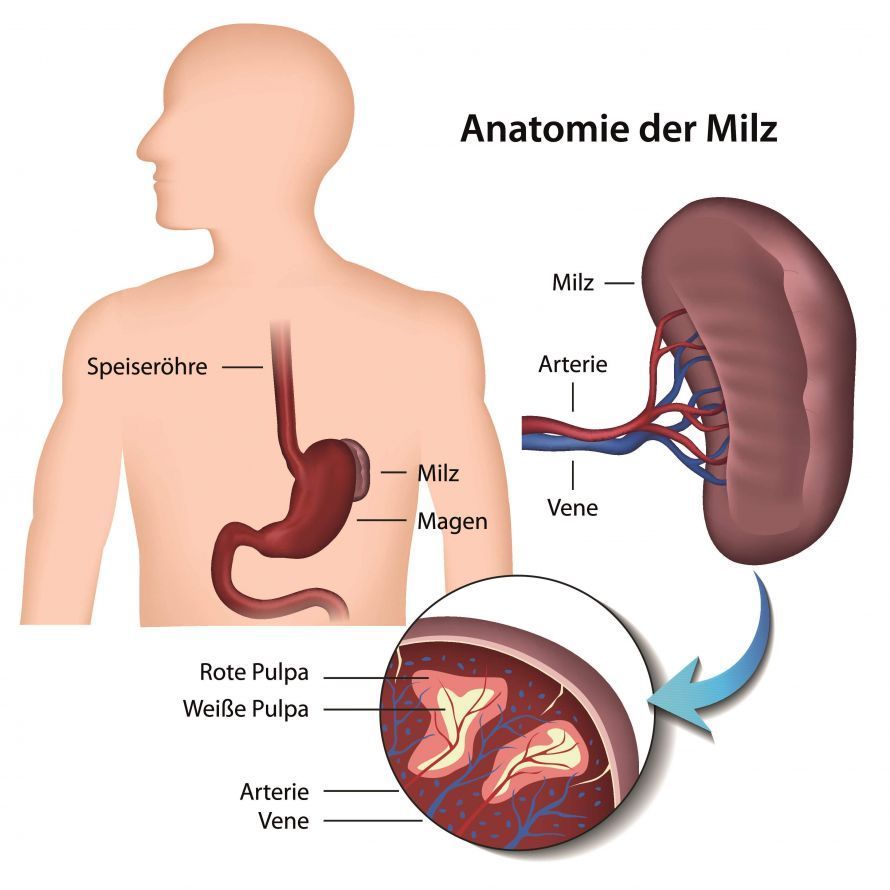
The spleen is surrounded by a capsule of connective tissue (tunica fibrosa). This protects the soft interior from injury. The rib cage provides additional mechanical protection.
In addition, the spleen is connected to its neighboring organs by ligaments made of connective tissue;
The spleen consists of
- the red spleen pulp (Latin: pulpa = flesh) and
- the white spleen pulp
are distinguished from one another.
The red pulp consists of blood vessels and immune system cells and makes up about 80 percent of the spleen. The white pulp is embedded within the red pulp and consists of tiny white splenic nodules. These contain lymph follicles (Latin: folliculus = sheath, casing).
Functions of the Spleen
As a filtering system of the circulatory system, the spleen plays an essential role in the body’s immune defense. The red spleen pulp removes spent erythrocytes (red blood cells) and thrombocytes (platelets).
The white spleen pulp allows lymphocytes (cell components) within the leukocytes (white blood cells) to mature. It is also responsible for storing them. Lymphocytes play a key role in the complex processes of disease defense. Furthermore, the spleen produces so-called immunoglobulins, which are released into the bloodstream in the event of an infection. Another function of the spleen is to store blood, which is released as needed—for example, in the event of bleeding.
Before birth and—to a lesser extent—during the first six years of life, the spleen also plays a central role in the formation of red blood cells. After that, production ceases because the bone marrow takes over the responsibility for blood formation as life progresses.
However, in cases of diseases affecting the bone marrow, the spleen is capable of producing blood again even in later life.
Special Features: Accessory Spleens
About 15 percent of people have an anatomical peculiarity known as accessory spleens. These develop as a result of cell dispersion during the embryonic period. In most cases, accessory spleens are discovered incidentally during an ultrasound examination of the abdominal region.
Their structure corresponds to that of the spleen. Accordingly, accessory spleens also consist of white and red pulp. If the accessory spleens are located near the spleen itself, they are easily recognizable. They are usually about one to four centimeters in size. Accessory spleens located far from the spleen, on the other hand, are often overlooked indefinitely.
In most cases, such a finding is ignored and requires no treatment. Accessory spleens do not cause any impairment. In some patients with a history of oncological or hematological conditions, however, they often mimic tumors or metastases. In such cases, further investigation and treatment are necessary. If accessory spleens are detected during a splenectomy, they must be removed as well.
Diseases of the Spleen
Spleen Diseases Caused by Internal Injuries
A disease is often preceded by specific pain in the spleen. Most patients do not know how to interpret the pain, as it manifests in various locations. Consequently, it is usually not associated with the spleen.
Pain that can be localized, for example, below the left rib cage, indicates an enlarged spleen. The swelling is caused by either a viral or a bacterial infection. In cases of splenomegaly (enlargement of the spleen), the immune system works harder to fight off pathogens. This activity results in swelling of the spleen. Treatment generally focuses on addressing the underlying cause of the condition. Medications are frequently used as a therapeutic measure.
Another cause of enlargement is a splenic tumor or a metabolic disorder. If there is a severe disruption in blood supply, a splenic infarction may occur. This involves a blockage in a blood vessel in the immediate vicinity of the spleen, usually in the splenic artery or the aorta.
If the splenic infarction is only partial, the condition can be successfully treated. In the case of a complete infarction, removal of the spleen (splenectomy) is often the only option.
In cases of impaired spleen function, a balanced and easily digestible diet is considered helpful. This includes foods that are as natural as possible and a good supply of vitamins and minerals.
Spleen Disorders Caused by External Injuries
Spleen pain can also result from external injuries, such as those caused by an accident. If the pain is felt in the area of the left shoulder or on the left side of the neck, a spleen rupture is often identified as the cause.
External force, such as a blow to the abdomen or a kick, can also cause a ruptured spleen. Broken ribs are another common cause.
Whenever possible, every effort is made to preserve the spleen following an accident. Since the organ consists of very soft tissue, it is well supplied with blood throughout its entire structure. A rupture can quickly lead to significant bleeding.
A particular concern is delayed bleeding into the abdominal cavity, which—depending on the type of injury—may not occur until days later. The more effectively bleeding is controlled following an accident, the greater the likelihood of spleen-preserving treatment.
A young age is also
- a young age and
- favorable anatomical conditions (such as the absence of significant obesity).
Life After Spleen Removal
The spleen is generally important for the proper functioning of the body. After the loss of the spleen, the body is able to take over certain functions.
This is aided by
- organs of the lymphatic system,
- the liver, and
- the red bone marrow.
Even though those affected can lead a largely normal life, the risk of infectious diseases is significantly increased. Vaccinations are essential for people without a spleen.
This includes, above all, the pneumococcal vaccine. Pneumococci are bacteria that can cause various illnesses. Any signs of illness, such as a fever or unusual fatigue, should also be evaluated by a doctor. In such cases, the treating physician is always informed about the absence of the spleen to facilitate the implementation of the correct therapeutic measures.
In general, living without a spleen results in a significant impairment of the immune system’s ability to fight off bacteria. If an infection is not detected in time, dangerous sepsis can result in a medical emergency.
Conclusion
In conclusion, it is evident that the spleen, as a lymphatic organ, plays a central role in the human body and is considered the body’s largest lymphatic organ. The spleen is the largest lymphatic organ and, at the same time, a highly vascularized organ that is essential for immune defense and blood filtration. Its structure and function make it clear that both its microscopic and macroscopic anatomy are crucial to its effectiveness. The spleen tissue contains specialized reticular cells as well as B and T lymphocytes, which recognize and combat pathogens.
The spleen is located intraperitoneally beneath the costal arch and above the left kidney, protected by a connective tissue capsule. In this well-perfused organ, red blood cells and platelets are regulated and, when necessary, phagocytosed. Its role in the immune system is particularly important, as the lymphatic organs work together to provide effective defense.
Diseases of the spleen, such as splenomegaly (an enlarged spleen), can impair its function, while a rupture poses an acute danger. In some cases, surgical removal of the spleen is necessary, although this is followed by an increased risk of infections caused by pneumococci, meningococci, or Haemophilus influenzae. Without the spleen, the immune system must partially compensate for these functions.
Examination of the spleen is therefore clinically important for the early detection of changes. Overall, the spleen remains a vital organ and the largest lymphoid organ in the human body, the importance of which is often underestimated. A healthy spleen plays a crucial role in maintaining the stability of the immune system and provides sustained support to the body in defending against pathogens.
FAQ
Where is the spleen located in the body?
The spleen is located in the upper left abdomen, below the diaphragm and above the left kidney. It is situated behind the ribs and is usually not palpable in healthy individuals. As a lymphoid organ, it is closely connected to vessels such as the splenic artery.
What is the function of the spleen?
The spleen is a functionally important organ that plays a role in immune defense and the breakdown of red blood cells. Lymphocytes are activated in the white pulp, while the red pulp breaks down old red blood cells. In addition, the spleen stores blood cells and supports blood formation.
What happens when the spleen is removed?
The surgical removal of the spleen is called a splenectomy. After the spleen is removed (asplenia), the risk of infection by bacteria such as pneumococci or Haemophilus influenzae increases. Nevertheless, the body can partially compensate for many of these functions through other lymphoid organs.
What are some diseases of the spleen?
The most common diseases of the spleen include splenomegaly, splenic infarction, and splenic rupture. An enlarged spleen can occur due to infection or liver cirrhosis. In severe cases, a rupture can lead to dangerous bleeding.
What is the structure of the spleen?
The spleen consists of parenchyma surrounded by a capsule. Inside, it is divided into red pulp and white pulp, which contain lymphatic follicles and PALS. These structures are responsible for immune defense and the breakdown of blood cells.