Pain when sitting, an uncomfortable pulling sensation when standing up, or a stabbing pain at the bottom of the spine: These symptoms may be caused by coccygodynia. This condition involves pain in the area of the tailbone, which can significantly interfere with daily life. Prolonged sitting or the transition from sitting to standing is often particularly uncomfortable.
The terms “coccygodynia” and “coccydynia” are used interchangeably. The condition is also often referred to as “tailbone pain.” The symptoms may occur after a fall or other injury. However, it is not always possible to identify a clear trigger.
What are the possible causes? How is coccygodynia diagnosed, and what treatment options are available? Here you’ll find an overview of the most important information.
What is coccygodynia?
The coccyx—medically known as the os coccygis—forms the lowest section of the spine. It consists of several small, interconnected vertebral segments and is located immediately above the gluteal fold.
Although the coccyx is relatively small, it performs important biomechanical functions. Various ligaments and muscles attach to it, including structures of the pelvic floor. When sitting, this region is also exposed to mechanical forces.
Medical professionals define coccygodynia as pain that occurs in the coccyx itself or immediately around it. Typically, the pain is clearly dependent on pressure and strain. Prolonged sitting, in particular, can be uncomfortable for those affected.
The symptoms may begin acutely and then subside. In some patients, however, persistent or chronic coccyx pain develops, lasting for months and significantly impairing quality of life.
What are the symptoms of coccygodynia?
The characteristic symptom of coccygodynia is localized pain in the area of the tailbone. Many people affected can pinpoint the painful area relatively precisely at the lower end of the spine.
The pain is described in various ways. It can be stabbing, pulling, burning, or dull. It often intensifies when pressure is applied to the coccyx.
Typical symptoms include:
- Pain when sitting for long periods
- Pain when sitting down
- Increased discomfort when standing up from a seated position
- Tenderness over the tailbone
- Pain in certain sitting positions
- Discomfort during bowel movements
- Occasional pain during sexual intercourse
- Pain radiating to adjacent areas
Hard seating surfaces are often particularly uncomfortable. As a result, some patients automatically shift their weight to one side of their buttocks or lean forward while sitting to relieve pressure on the tailbone.
The longer the symptoms persist, the more they can impact daily life. Car rides, office work, dining out, or long trips can then sometimes become a significant burden.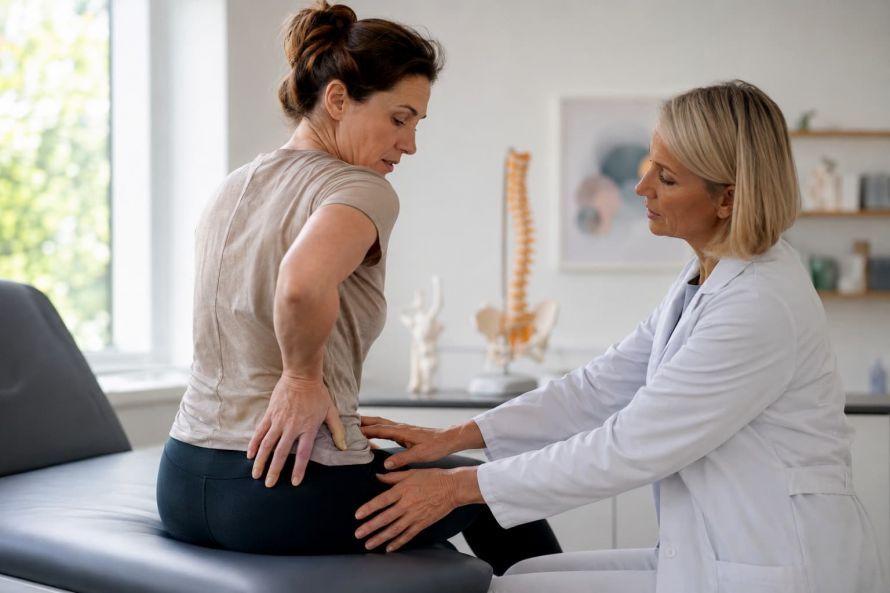
Causes and Risk Factors: What Causes Coccygodynia?
Pain in the tailbone can have various causes. Generally, medical professionals often distinguish between trauma-related coccygodynia and symptoms for which no clear trigger can be identified.
Injuries to the tailbone
A typical trigger is a fall onto the buttocks—for example, on stairs, during sports, or on black ice. In such cases, significant forces act directly on the coccyx.
The injury does not necessarily result in a fracture. A contusion, as well as injuries to the ligaments or changes in the position and mobility of individual coccyx segments, can also cause symptoms.
Possible causes include:
- Contusions
- Sprains or ligament injuries
- Fractures
- Subluxations
- Dislocations
Interestingly, the pain does not necessarily occur immediately after the accident. In some patients, there are long intervals between the initial trauma and the onset of characteristic symptoms.
Altered mobility of the coccyx
The coccyx does not have the same range of motion in every person. Some patients exhibit excessive mobility, while in others it may be unusually rigid.
In particular, instability or noticeable mobility of individual segments can cause pain when sitting. This is precisely why functional imaging while sitting and standing can be helpful for diagnosis.
Prolonged sitting and repetitive strain
Even without a specific accident, prolonged mechanical stress can contribute to symptoms. Prolonged sitting on hard or unsuitable surfaces increases pressure on the coccyx region.
Problems can arise, for example, in people who spend many hours sitting for work. Certain sports activities can also place repeated strain on the region.
Pregnancy and Childbirth
Women are significantly more likely to be affected by coccygodynia than men. One possible cause is the specific stresses experienced during pregnancy and childbirth.
During a vaginal delivery, the coccyx is moved backward to widen the birth canal. In the process, the joint and ligament structures may be subjected to considerable forces. In some cases, persistent coccyx pain develops afterward.
Coccygodynia with No Apparent Cause
A clear cause cannot be identified in all affected individuals. Doctors often refer to this as idiopathic coccygodynia.
However, this does not mean that the pain does not exist or is merely imaginary. Rather, the available diagnostic methods cannot identify a clear structural trigger.
Examination and Diagnosis: How Is Coccygodynia Diagnosed?
Coccyx pain can have various causes. Therefore, an important part of the diagnostic process is to narrow down the symptoms as precisely as possible and rule out other conditions.
The process begins with a detailed medical history. Among other things, the doctor will ask when the pain began, in what situations it occurs, and whether there was a prior accident or childbirth.
Important questions include, for example:
- How long have the symptoms been present?
- Where exactly is the pain located?
- Does the pain get worse when sitting?
- Does it hurt to go from sitting to standing?
- Was there a fall or accident?
- Do you experience discomfort during bowel movements?
- Does the pain radiate to other parts of the body?
- What treatments have already been tried?
This is followed by a physical examination. During this examination, the doctor may gently palpate the coccyx region to determine whether the typical pain is triggered by pressure.
Depending on the findings, a rectal examination may also be recommended. This allows the doctor to assess, among other things, the position and mobility of the coccyx.
Imaging for Coccygodynia
Imaging studies may be necessary for long-standing or severe symptoms.
A distinctive feature of coccygodynia is the use of dynamic lateral X-rays. In this procedure, the coccyx is imaged both while standing and while sitting. Comparing the images can reveal whether the coccyx moves unusually much under load or changes position noticeably.
Depending on the individual situation, additional tests such as magnetic resonance imaging (MRI) may also be used. These are particularly indicated when other causes of the symptoms have been ruled out or when soft tissues and surrounding structures need to be evaluated more closely.
What conditions must be ruled out?
Not all pain in the coccyx region actually originates in the coccyx. Symptoms from neighboring organs or tissue structures can radiate to this region.
Depending on the symptoms, conditions related to orthopedics, proctology, gynecology, urology, or neurology, for example, must therefore be considered.
Inflammatory changes, cysts, and—very rarely—tumors can also cause symptoms in the coccyx region.
A medical evaluation is therefore particularly important if the pain occurs without an apparent trigger, becomes increasingly severe, or persists for an extended period.
Which doctor treats coccygodynia?
Your primary care physician may be the first point of contact. If symptoms are persistent or severe, you will often be referred to a specialist in orthopedics and trauma surgery.
Depending on the cause and symptoms, specialists in pain medicine, neurosurgery, proctology, or other fields may also be involved in the treatment.
In cases of chronic tailbone pain, experience with coccygodynia is particularly helpful, as the condition is relatively rare and can sometimes be difficult to diagnose.
Treatment: What helps with coccygodynia?
Treatment depends on the cause, duration, and intensity of the symptoms. In most cases, treatment begins conservatively, meaning without surgery.
The goal is to relieve pressure on the coccyx, reduce pain, and address any underlying muscular or functional issues.
Relief While Sitting
One of the simplest measures is to reduce direct pressure on the coccyx. Special coccyx cushions with a cutout can be used for this purpose.
Regularly changing positions and avoiding prolonged periods of sitting can also be helpful. It is crucial to adjust your sitting position so that as little pressure as possible is placed on the painful area.
Medications for Coccyx Pain
Anti-inflammatory pain relievers from the group of nonsteroidal anti-inflammatory drugs (NSAIDs) can be used for temporary pain relief.
Which medications are appropriate depends on the individual’s health status and should be discussed with a doctor, especially if long-term use is planned.
Physical Therapy and Pelvic Floor Treatment
Physical therapy may be particularly beneficial if muscular tension or pelvic floor dysfunction is contributing to the symptoms.
Depending on the findings, mobilization techniques, exercises to improve pelvic floor function, and other physical therapy methods may be considered.
Treatment should be individually tailored to the cause of the symptoms. A general exercise program is therefore not equally suitable for every patient.
Injections and Interventional Pain Management
If symptoms persist despite conservative treatment, targeted injections may be considered. In such cases, for example, a local anesthetic and, if necessary, a corticosteroid are injected into the painful area.
Another option for selected patients is treatment of the ganglion impar. This nerve plexus is located in front of the coccyx and plays a role in transmitting pain signals from the pelvic and coccygeal regions.
In addition to ganglion impar blocks, specialized centers offer other interventional pain management procedures. Whether these are appropriate must be determined based on the individual patient’s findings.
When is surgery necessary?
Surgery is rarely necessary for coccygodynia. It is generally considered only when symptoms have persisted for an extended period, conservative and interventional treatments have not been sufficiently effective, and the pain can be clearly attributed to the coccyx.
In a procedure known as a coccygectomy, the coccyx is partially or completely removed. The procedure falls within the field of spinal surgery.
The surgery can lead to a significant improvement in carefully selected patients. However, it is not a routine procedure and should only be considered after less invasive treatment options have been exhausted.
Since the surgical site is located in close proximity to the gluteal fold and the anal region, the risk of wound healing complications and infections, among other factors, plays an important role in the decision to proceed with the procedure.
Course and Prognosis: How Long Does Coccygodynia Last?
The course of coccyx pain varies widely. Acute symptoms following a contusion or overexertion may improve within a few weeks.
In other patients, the pain persists for months and develops into chronic coccygodynia. In such cases, in particular, an accurate diagnosis is crucial to identify possible mechanical or other treatable causes.
In general, several conservative and interventional treatment options are available. Surgery is reserved for select cases.
How quickly improvement occurs depends, among other things, on the cause, the duration of the symptoms, and any changes in coccyx mobility.
When should you see a doctor for tailbone pain?
Mild discomfort following temporary strain often goes away on its own. However, if the pain persists or significantly interferes with daily life, a medical examination is advisable.
In particular, severe or worsening pain, pain following a serious fall, and tailbone pain accompanied by other notable symptoms should be evaluated promptly.
These include, for example, fever, pronounced swelling, neurological symptoms, unexplained weight loss, or problems with bladder and bowel control.
Can coccygodynia be prevented?
Not all cases of coccygodynia can be prevented. However, the risk of chronic strain on the coccyx region can be reduced.
People who sit for long periods at work should regularly change their position and take breaks to move around. An ergonomic sitting position can also help reduce pressure on the tailbone.
After falling onto the buttocks, the area should be given sufficient time to recover. If the pain persists or worsens, a medical examination is recommended.
Conclusion
Coccygodynia is a pain syndrome in the coccyx region that causes discomfort, particularly when sitting, as well as when sitting down and standing up. A fall onto the buttocks is one of the possible triggers, but a clear cause cannot be identified in every patient.
A detailed medical history and physical examination are crucial for diagnosis. In cases of persistent symptoms, dynamic X-rays taken while sitting and standing can provide important clues regarding changes in coccyx mobility.
Treatment is initially primarily conservative. The focus is on rest, pain management, and individually tailored physical therapy. For persistent symptoms, injections and other interventional procedures may be considered. Surgical removal of the coccyx is reserved for patients in whom other treatments have not been sufficiently successful.
Frequently Asked Questions About Coccygodynia
What is coccygodynia?
Coccygodynia refers to pain in the coccyx or in the immediate vicinity of the coccyx. Typically, the symptoms are exacerbated by pressure on the area, especially when sitting.
Is coccygodynia the same as coccydynia?
Yes. Coccygodynia and coccydynia are different spellings for the same condition. In everyday language, people usually refer to it as tailbone pain.
Where does the pain occur in coccygodynia?
The pain is typically located in the center of the lowest end of the spine, immediately above the gluteal fold. It can radiate to adjacent areas.
Why does the tailbone hurt when sitting?
When sitting, mechanical forces act on the tailbone and the surrounding structures. In cases of coccygodynia, this pressure can significantly intensify the pain. Hard seating surfaces and prolonged periods of sitting are often particularly problematic.
What causes coccyx pain?
Possible causes include falls and other injuries, abnormal mobility of the coccyx, repeated mechanical stress, and changes following pregnancy and childbirth. In some cases, the exact cause remains unclear.
How is coccygodynia diagnosed?
In addition to a medical interview and physical examination, imaging techniques may be used. Lateral X-rays taken while standing and sitting can be particularly revealing, as they show the mobility of the coccyx under stress.
What helps with coccygodynia?
Treatment usually begins with conservative measures. These include reducing pressure while sitting, appropriate pain medication, and physical therapy. If symptoms persist, injections or other pain management procedures may be considered.
Can coccygodynia become chronic?
Yes. In some patients, symptoms persist for several months or longer. In cases of chronic coccyx pain, a targeted diagnostic evaluation is particularly important.
When is surgery performed on the coccyx?
Surgical removal of the coccyx is considered only for select patients. This is generally indicated in cases of long-standing, significant symptoms that cannot be adequately treated with conservative or interventional procedures.
Share this article